Efficiency is not simply cutting costs or asking people to do more. It means improving productivity and simplifying processes while protecting customer relationships. To strengthen business operations, leaders need to understand how resources turn into results, then remove friction and align capacity with demand.
That takes more than a new system or another round of targets. You need a clear view of which work matters, where time and resources are being lost, and whether performance is improving. This article explains how to strengthen business operations through practical changes that protect quality and customer service.
You’ll learn how to streamline processes, set and monitor operational plans, match people and resources to demand, and identify the elements that keep operations running smoothly. The focus is on decisions your leadership team can put into practice and measure.
Key Takeaways
- Compare the resources used with the results produced to see where operational effort is creating value and where it is being lost.
- Map recurring workflows, remove unnecessary steps and review processes regularly before adding more tools or complexity.
- Turn operational priorities into clear plans, measures and review points so leaders can spot gaps and act on them.
- Match staffing, resources and stock to expected demand, adjusting capacity as demand changes.
- Align people, processes, technology and location so each supports reliable delivery and customer expectations.
1. What is operational efficiency in business?
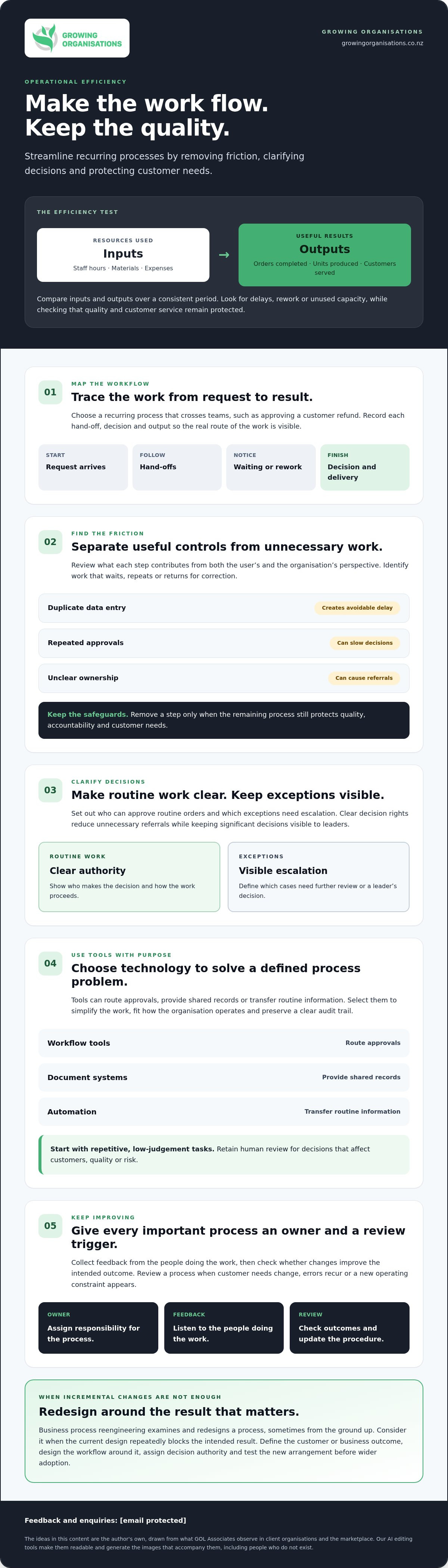
Operational efficiency describes how effectively a business turns resources into useful outputs without weakening quality or customer service. Operations management coordinates people, processes and stock so work moves reliably. Efficient operations support productivity and help the business meet service levels. A sound operations strategy can also improve day-to-day performance and competitiveness.
Measure efficiency by comparing inputs and outputs over a consistent period. Inputs might include staff hours, materials and operating expenses. Outputs could be completed orders, units produced or customers served. For example, track completed orders per staff hour and compare the result across teams or periods. A falling ratio may point to rework, delays or unused capacity. Expenses divided by revenue offer another perspective, but the ratio needs context: lower expenses do not prove better performance if service quality or sales also decline.
Set key performance indicators (KPIs) that link daily work to business goals. Choose measures leaders can act on, such as delivery timeliness, defect rates, stock availability or output per labour hour. Give each KPI an owner, target and review date. If orders are late, compare the queue, available staff hours and stock records to locate the constraint. A useful KPI shows whether performance is changing and where management attention is needed.
Workplace health and safety rules require businesses to identify work-related hazards and apply suitable controls. Privacy requirements shape how organisations collect, use, protect and provide access to personal information. Build both into procedures, staff responsibilities and record-handling practices.
There is no single cost to improve operations. The investment depends on the work involved, staff time, equipment, stock and implementation needs. Consultancy costs depend on scope and are provided after a quote request; assess the expected benefit against the resources required.
To assess efficiency and find bottlenecks, map one process from request to delivery. Record waiting time, rework, hand-offs and resource use at each step. Compare inputs and outputs, then investigate where work accumulates or stops. This makes improvement priorities specific rather than assumed.
Strengthen cash flow with a rolling forecast comparing expected receipts and payments. Assign a budget owner to each major cost area, review actual spending against plan, and reconcile financial records. Monitor overdue invoices and stock tied up in inventory, as both can constrain working capital even when sales are growing.
Operational risks include supplier disruption, shifts in demand, equipment failure, data loss and reliance on one person for critical work. Record each risk, its likely effect, the controls in place and a practical contingency. Grants or business support may help fund capability or operational improvements; eligibility depends on the programme’s criteria and proposed work.
2. Streamlining processes and removing redundancies
Start with a recurring workflow that crosses teams, such as approving a customer refund. Trace each hand-off from request to decision, then consider what each step contributes. Duplicate data entry, repeated approvals and unclear ownership cause delays without improving the outcome. Remove steps only if the remaining process still protects quality, accountability and customer needs. Record the revised procedure in one accessible place so staff can follow the same method.
Assess the work from both the user’s and the organisation’s perspectives. A form may be easy for one team but force another to re-enter information. Review the inputs, decisions and outputs at each stage, then identify where work waits or returns for correction. In a purchasing workflow, clarify who can approve routine orders and which exceptions need escalation. Clear decision rights reduce unnecessary referrals while keeping significant decisions visible to leaders.
Business software and automation can streamline operations when they remove a defined manual task. Workflow tools can route approvals, document systems can provide shared records, and automation can transfer routine information between steps. There are many options.
Choose tools to address the process problem, not because the technology is new. A tool should simplify employees’ work, preserve a clear audit trail and fit how the organisation operates. Automate repetitive, low-judgement tasks first, while retaining human review for decisions affecting customers, quality or risk.
Continuous improvement needs a working routine, not a slogan. Assign a process owner, collect feedback from the people doing the work, and review whether changes improve the intended outcome. Lean manufacturing focuses on reducing waste and improving continuity in the supply chain, with attention to product flow from production to customer delivery. Six Sigma uses tools such as trending charts and potential defect calculations. Bill Smith introduced Six Sigma at Motorola in 1986 to improve manufacturing quality. These methods offer structured ways to examine variation and waste.
Some workflows need more than incremental changes. Business process reengineering examines and redesigns processes, sometimes from the ground up. Use it when the existing design repeatedly blocks the intended result, rather than polishing steps that no longer serve a purpose. First define the customer or business outcome. Then design the workflow around it, assign decision authority and test the new arrangement before adopting it across the organisation. Reengineering can change roles and hand-offs, so explain the reason for change and how success will be judged.
Set a review trigger for each important process, such as a change in customer needs, recurring errors or a new operating constraint. Compare the revised workflow with its stated purpose, then update instructions and responsibilities when the work changes. This keeps procedures useful rather than turning them into static documents. Leadership teams working through broader process changes can connect workflow redesign to business growth strategy and implementation, so the operational changes support the organisation’s direction.
3. Developing and monitoring operational plans
An operational plan turns business priorities into owned activities, resources and measures. Start with an outcome, such as improving order fulfilment without compromising quality. Set out the work required, who leads each activity, which skills or equipment it needs, and how progress will be assessed. Link each action to a business goal so teams can distinguish essential work from activity that consumes capacity without supporting results.
Turn priorities into measurable commitments. A plan to improve fulfilment, for example, could track completed orders, delays, stock availability and customer complaints. Give each measure an owner and define how information will be collected. A target is useful only if managers can act on it. If delays rise, the responsible team should know whether to review staffing, supplier timing, stock records or the workflow itself.
Resource the plan before approving it. Check whether the people assigned have the time, authority and skills to deliver their activities. Compare planned workload with available staff, equipment, materials and working capital. If a team is already handling urgent customer work, adding an initiative without reallocating capacity can undermine both. Make trade-offs explicit, including which existing tasks will stop, change or receive fewer resources.
Set a review cycle that matches the pace of the work. At each review, compare actual progress with the plan, record variances and assign follow-up actions. A concise operational dashboard might show:
- Progress against the agreed outcome and supporting measures.
- Staffing, equipment or stock constraints affecting delivery.
- Risks, decisions required and the person responsible for each response.
- Actions completed since the previous review and their effect on results.
Monitor inventory actively: shortages can interrupt delivery, while excess stock ties up resources. Assign responsibility for checking stock records and escalating changes that threaten planned work. Match purchasing decisions to expected demand, supplier timing and storage capacity. If a critical material becomes harder to obtain, adjust the plan early, consider workable alternatives and communicate the likely effect to dependent teams.
Build risk management into the plan, not a separate document no one uses. Identify events that could disrupt key activities, such as supplier delays, equipment breakdowns or sudden changes in demand. For each risk, state the trigger, likely operational effect, owner and response. A contingency might allocate work to another capable team or prioritise essential customer orders. Review these responses when assumptions or operating conditions change.
Connect operational measures to financial performance. Track whether added resources support revenue, service or profitability, and whether costs remain within the approved budget. When a plan misses its target, diagnose the cause before adding effort. Revise the action, owner or resource allocation, then record the decision. This gives executives a clear link between strategic priorities, daily activities and accountable delivery.
4. Aligning capacity with customer demand
Capacity means what a business can deliver within a defined period. Capacity planning matches staff, resources and stock to expected customer demand. If a sales team plans to gain 25% more customers by Q3, leaders must translate that target into the service, production and fulfilment work those customers will require. A sales target without an operational response can create queues, missed commitments and pressure on existing teams.
Start with a demand forecast based on relevant signals. Review previous orders, current enquiries, customer commitments and known seasonal patterns. Distinguish predictable demand from sudden changes. A business supplying products can compare expected orders with available stock and supplier lead times. A service firm can assess booked work against staff skills and hours. The forecast is not a promise; it is a working basis for allocating capacity effectively.
Build a capacity plan around the actual constraint. If trained staff limit output, additional stock will not solve the problem. If a production line is underused because materials arrive late, staffing changes alone will have little effect. Identify the resource that controls delivery, then compare its available capacity with forecast demand. Include support functions such as customer service, dispatch and maintenance, because sales growth can increase their workload too.
Adjust capacity as demand changes. During quieter periods, schedule maintenance, training or work that can be completed ahead of peak demand. When demand is expected to rise, prepare staffing, materials and production schedules in advance. A business holding finished products can produce during quieter periods and fulfil orders promptly when demand increases. This approach requires disciplined stock records and a clear view of which products customers are likely to need.
Inventory decisions involve trade-offs. Raw materials can help increase production quickly and reduce the impact of supply delays. Holding stock also ties up working capital and creates storage, record-keeping and stocktake requirements. Set stock decisions against expected demand, supplier reliability and replenishment time. Review stock levels alongside sales forecasts rather than treating purchasing and demand planning as separate activities.
Coordinate suppliers and internal teams around the same plan. Share relevant forecasts with suppliers, agree how changes will be communicated, and identify alternatives if deliveries are delayed. Within the business, clarify who can reallocate people, stock or equipment when priorities shift. That authority prevents avoidable hand-offs during a demand spike and helps teams protect essential customer commitments.
Monitor whether capacity decisions are working. Compare forecast demand with actual orders, completed work, stock availability and delivery performance. If a backlog grows, locate where work accumulates before adding resources. If capacity sits unused, revise schedules or redirect effort. Timely provision of products and resources supports customer satisfaction and loyalty, but only if the plan protects quality as well as speed.
5. Business operations types and key elements
Four elements need to work together for business operations to run smoothly: people, processes, technology and location. A breakdown in one can undermine the others. Capable staff, for example, cannot fulfil orders reliably if procedures are unclear or systems hold outdated stock information. Review each element against a real outcome, such as providing a service, delivering an order or resolving a customer issue. This shows where operating choices support performance and where they create friction.
People bring the skills and judgement needed to complete work. Processes define how tasks move between roles. Technology supports information handling and operational activities, whilst location affects access to customers, suppliers and facilities. Map one customer journey, then identify the people, steps, systems and physical sites involved. This practical view helps leaders change connected activities without improving one team’s work at another team’s expense.
Businesses also decide how much work to perform internally. Outsourcing means buying products or services from another party instead of making them in-house. It can provide access to external capability, but leaders should account for the hand-offs, quality requirements and coordination involved. Compare the full workflow, not just the task being transferred. Clarify who owns the result, how information moves and how issues reach a decision-maker.
Vertical integration means owning or creating part of the production process. A manufacturer that brings a previously external production stage in-house changes its control over materials, timing and quality. It also takes on additional internal activities to manage. Assess whether the business has the skills, capacity and leadership attention to operate that stage effectively. Outsourcing and integration are structural choices, not automatic routes to lower costs or better service.
Operations managers may oversee several connected areas, including:
- Inventory and work-in-process levels, which show what is available and what remains unfinished.
- Raw-material acquisition, which affects the flow of inputs into production.
- Quality control, which checks whether outputs meet defined expectations.
- Materials handling and maintenance policies, which support the movement and continued use of equipment.
These responsibilities connect daily decisions to reliable delivery. A production delay, for example, may involve materials handling, equipment maintenance or an unfinished work queue. Assign clear ownership and use operating records to identify the cause before changing the process.
Quality is another operating element, not a final inspection alone. Define what customers should receive, measure whether outputs meet that standard, and communicate expectations to the teams doing the work. Customer feedback can reveal gaps between intended and actual performance. Marketing can also inform operations about customer expectations and demand, but those promises must align with delivery capacity. Growing Organisations can help leadership teams align these operating choices through business growth strategy and implementation support.
Growing Organisations: Consultancy and Development
Growing Organisations helps leadership teams turn operational priorities into practical growth plans and implementation. Its Consultancy and Development service can help align process changes, capacity decisions and business objectives in a clear execution plan.
Make the next operational decision count
Growth brings deferred leadership decisions into view. The next step is not to launch another initiative. Choose the operational constraint that most limits progress, agree who owns changing it, and make the required trade-offs visible. That discipline helps strengthen business operations without confusing activity with improvement.
When the challenge calls for external perspective and practical follow-through, Growing Organisations offers Consultancy and Development, including Business Growth Strategy and implementation support. Executive Performance Coaching can support leaders responsible for change. Start with a candid discussion about the business priority, the decisions blocking progress and the leadership capacity available to act.
Contact Growing Organisations today to discuss the operational challenge your team needs to address. Clear ownership and deliberate action can give the next stage of growth a stronger foundation.
For inquiries or feedback about strengthening your operations, contact us at hello@growingorganisations.co.nz.
Frequently Asked Questions
What is operational efficiency in business?
Operational efficiency is the ability to deliver the required customer and commercial outcome without avoidable effort or reduced quality. A returns team may process cases quickly but still perform poorly if customers must contact the business repeatedly. Assess both completed work and its effect on customers. The useful test is whether the operation consistently meets its purpose, not whether one task appears faster.
What does strengthening business operations involve?
To strengthen business operations, leaders connect commercial priorities to changes teams can deliver. A business adding a sales channel, for example, may need to clarify who handles new enquiries and how customer commitments are approved. Identify the gap between the intended outcome and current performance. Then assign an accountable owner, make the required decision, and check whether the change improves results without creating problems elsewhere.
What are the best ways to improve business processes and productivity?
Effective improvements distinguish routine work from exceptions, then make routine tasks easier to complete correctly. A customer onboarding process might use one agreed set of information, whilst unusual cases go to a named decision-maker. Ask staff where instructions conflict or work is returned for correction. Trial a revised method with the relevant team, gather feedback and refine it before wider adoption.
How can a business measure operational improvement using KPIs?
Measure improvement by comparing a consistent baseline with results after a change, using the same KPI definitions. Pair a speed measure with a quality or customer outcome so faster work does not conceal more errors. For example, assess completed service requests alongside repeat contacts. Compare like-for-like periods and note changes in demand or workload. If a KPI improves but customer outcomes weaken, review the process before judging the change successful.
[The ideas in this content are the author’s own, based on observations by GOL Associates in client organisations and the marketplace. AI editing tools help make them readable and generate the accompanying images, including people who do not exist.]

Article by
Ross Wilson, MBA. Principal Advisor, Growing Organisations Ltd.
The moment before a hard call you need to make: this is where I do my best work. Maybe a business unit that's stopped performing; a sales team that plateaued two years ago and nobody's proud of it, or a culture that technically functions but has simply gone flat. Perhaps you "high performers" are strangely off their game. What do you do with these dilemmas?
These are the kinds of calls CEOs and boards bring me into, because by the time they call, they already know the comfortable options no longer work.
I've spent 30 years in advisory, most of it at CEO and Board level, across 35+ countries. I earned an Executive MBA degree from the University of Auckland which helps a little.
The point is, what happens now: businesses that were losing money find their margin again, teams that had stopped believing in targets start hitting them, and cultures people used to merely tolerate become ones they're proud to work in.
I don't do this alone. Growing Organisations is a niche team of professional advisors, by design, working globally, each with a specific field they've mastered and a track record that speaks for itself. What we work together and share a refusal to hand over a report and simply disappear. We stay, advise, support practically, coach if necessary, review, and redirect until the result is real and it's yours, not ours.