Implementation support earns its place when it turns agreed priorities into owned work, visible progress and decisions that keep delivery moving. Hands-on business implementation support connects strategy to day-to-day execution through clear accountability and practical help matched to the business need right across New Zealand.
It is reasonable to expect more than advice and a plan. The test is whether leaders and teams can act on priorities, address obstacles and maintain progress when attention shifts elsewhere. This article explains how to choose support, review progress and accountability, and decide what ongoing involvement is useful. It also covers practical tools and support structures, helping you distinguish effective follow-through from activity that changes little.
Key Takeaways
- Match the support option to the execution gap, decision rights and internal capability you need to strengthen.
- Set clear owners, milestones and review points so progress leads to decisions and corrective action.
- Choose ongoing involvement according to the work still to be done and the capability your team can sustain.
- Prepare for an effective consulting engagement by defining the business issue, desired outcomes and access to key decision-makers.
- Judge the likely duration by the scope, dependencies and pace of decisions, then adjust support as implementation develops.
Choosing a support option
Choose support that closes the gap between your plan and execution. A board seeking clearer priorities needs different help from a management team working to deliver a specific initiative. Start by defining the work, the decisions required and the capabilities your team needs to retain. Then compare options against those needs, not against polished presentations.
The Regional Business Partner Network gives small and medium-sized businesses a single point of access to advice, support, funding and expertise to build business and innovation capabilities. It may suit leaders seeking broader capability support. For a defined commercial initiative, assess whether the provider will translate decisions into work plans, coordinate delivery and address obstacles. Advice alone will not close an execution gap.
Before engaging an implementation provider, consider the risks of unclear scope, confidentiality, conflicts of interest, decision authority and dependence on external support. Agree what information the provider can access, who owns decisions, how disagreements will be handled and how knowledge will transfer to your team.
Use these practical tools to compare options and identify gaps before work begins:
- Scope and outcomes brief: Record the business problem, intended outcomes, exclusions, dependencies and internal owner. This helps prevent a broad brief from becoming an open-ended engagement.
- Responsibility matrix: Assign who leads, approves, contributes and receives updates for each workstream. This is useful when a project crosses functions, such as sales, operations and finance.
- Milestone plan: Connect each deliverable to a decision, owner and evidence of completion. A market-entry initiative, for example, might require an agreed offer, customer validation and a launch decision.
- Capability map: Identify which skills the provider supplies and which the team must build. Use it to plan handover rather than allowing key processes to remain external.
Ask what the provider will do alongside your team. A credible approach makes responsibilities visible, provides a route for escalating blockers and leaves your people better able to continue. Test the fit against a specific example from your business. If the proposed method cannot explain how that example moves from decision to delivery, the support is too abstract.
Match the engagement to the scale of the task. A contained process improvement may need targeted implementation assistance. A broader growth initiative may require ongoing strategic input and coordination across teams, with executive consulting practices such as michelboutinstudio helping organisations align strategy with long-term growth. Set review points in advance, then adjust involvement as ownership, capability or delivery conditions change.
Implementation review and accountability
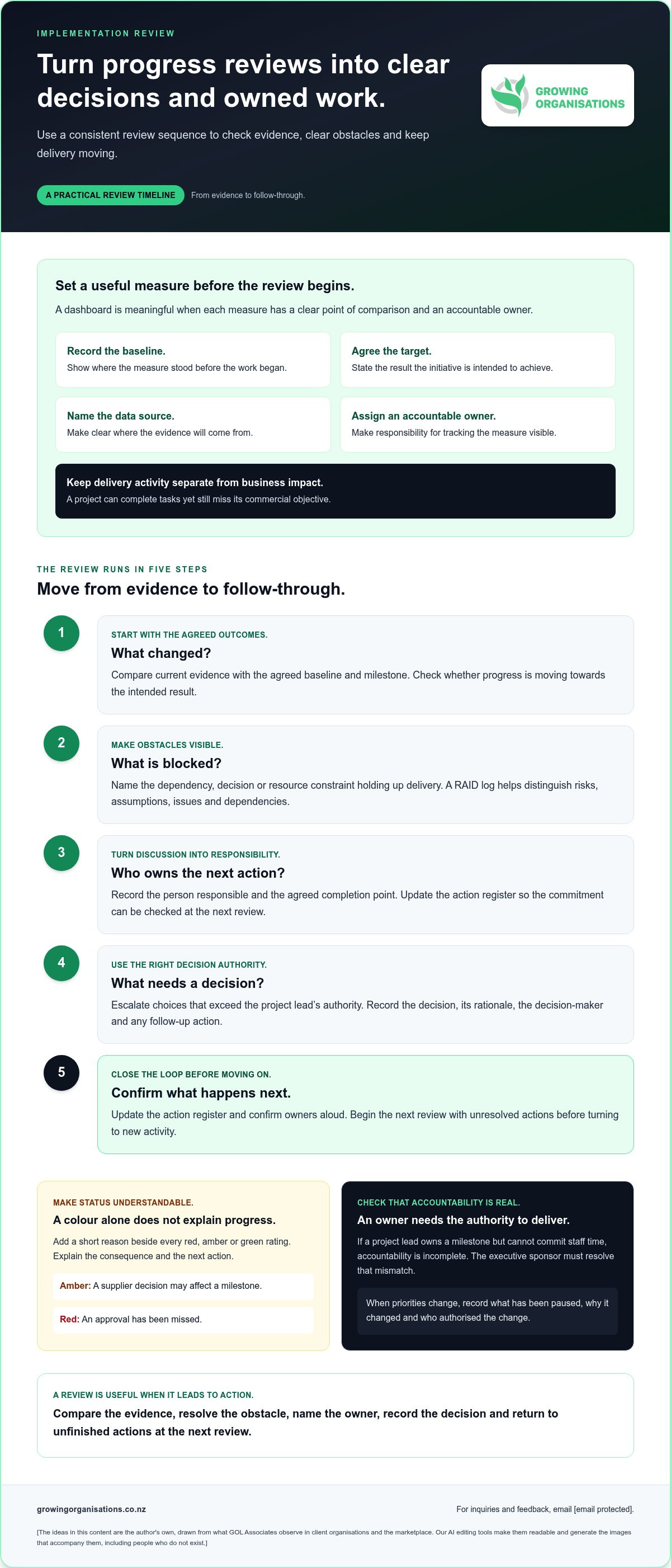
A review meeting should end with decisions, named owners and a clear record of changed commitments. Begin by revisiting the initiative’s agreed outcomes, then compare the evidence with the intended results. A project can complete tasks yet miss its commercial objective. Track delivery activity and business impact separately.
Choose measures that reflect the work. For a sales improvement initiative, track qualified opportunities, conversion behaviour and follow-up discipline. For an operational change, examine process completion, customer issues and staff adoption. Record the baseline, target, data source and accountable owner for each measure. Without those details, a dashboard can show movement without explaining its significance.
Use a consistent review sequence. The chair or executive sponsor can ask:
- What changed? Compare current evidence with the agreed baseline and milestone.
- What is blocked? Name the dependency, decision or resource constraint holding up delivery.
- Who owns the next action? Record the person responsible and the agreed completion point.
- What needs a decision? Escalate choices that exceed the project lead’s authority.
A decision log records the choice, its rationale, the decision-maker and any follow-up action. It helps when a later review revisits a trade-off, such as prioritising existing customers over a new segment. A RAID log records risks, assumptions, issues and dependencies. Use it to distinguish a possible future obstacle from a problem already affecting delivery.
Keep reviews evidence-based. Red, amber and green status indicators can help executives scan progress, but colour alone explains nothing. Add a short written reason beside each rating. An amber milestone might depend on a supplier decision, while a red status might reflect a missed approval. The explanation should identify the consequence and next action.
Accountability depends on clear decision rights. A responsibility matrix can show who delivers, approves, advises and receives updates. If a project lead owns a milestone but cannot commit staff time, accountability is incomplete. The executive sponsor must resolve that mismatch, not simply request another update.
Close every review by updating the action register and confirming owners aloud. At the next meeting, begin with unresolved actions before reviewing new activity. This stops repeated discussion from disguising stalled work. When priorities change, record what has been paused, why, and who authorised the change. That record protects focus and gives the board a reliable view of execution.
Ongoing business implementation support
Ongoing support is useful when delivery depends on repeated decisions, coordination across teams or skills the business is still building. The arrangement should address a specific execution need, not create a standing meeting without purpose. A growth initiative, for example, may need help coordinating sales and operations while managers build confidence in leading the work themselves.
Set the support rhythm around the decisions and dependencies involved. A fortnightly advisory meeting lasting 1.5 hours is included in THRIVE Accelerate. That cadence provides a defined point for advice and review. For your own implementation work, choose a rhythm that allows owners to raise blockers before they disrupt delivery, then reserve time between sessions for agreed actions.
Useful working tools make the support practical and visible:
- Rolling action plan: Keeps current priorities, owners, dependencies and next steps together. Use it when several teams need to coordinate delivery.
- Decision register: Records the choice, decision-maker and rationale. It helps leaders avoid reopening settled questions without new evidence.
- Capacity map: Shows who is available for key work and where operational demands compete with implementation. Use it to reset commitments before teams become overloaded.
- Learning log: Captures what the team has tested, what happened and what should change. It supports adaptation when customer or staff feedback challenges the original plan.
Review the arrangement at agreed milestones. Ask whether the work is progressing, whether internal owners can now lead it and where external input still adds value. If a sales process is being introduced, an adviser might help managers interpret early pipeline patterns. The team should own customer follow-up and routine coaching as those practices take hold.
Ongoing support should not blur accountability. Name an internal executive sponsor who can resolve competing priorities. Keep project ownership inside the business, even when an adviser facilitates planning or challenges assumptions. A clear handover can include documented processes, assigned owners and a review of unresolved decisions.
Scale involvement to the work rather than maintaining the same level by default. A new dependency may call for closer guidance for a period. Once the team can make decisions, manage delivery and respond to setbacks, reduce external input or focus it on the next strategic issue. That transition builds capability rather than preserving activity for its own sake.
What steps are involved in engaging a business implementation consultant?
Start an engagement with a business problem, not a generic request for advice. A managing director might need a new sales process embedded, while an executive team may need a growth plan translated into work. Define the decision or delivery gap first. This gives the consultant a practical brief and lets leaders judge whether the proposed work fits.
- Describe the outcome. Write down what must change, who benefits and how leaders will recognise progress. For a sales initiative, specify the behaviour to improve, such as consistent follow-up on qualified opportunities. Separate the intended result from the activities expected to produce it.
- Set boundaries. Identify the work included, what sits outside the engagement, relevant dependencies and internal capacity. If a new customer offer requires input from operations, name that dependency. State who can approve changes and who makes decisions when priorities compete.
- Share evidence. Provide the consultant with relevant plans, process documents, customer feedback and performance information. A short evidence pack helps reveal whether the issue is unclear strategy, weak ownership or delivery friction. Include competing initiatives, so the proposed work reflects actual management capacity.
- Test the working approach. Ask the consultant to explain how they would move one real business priority from decision to execution. Listen for practical steps, clear collaboration with your team and a way to transfer capability. A proposed method should address your example, not rely on general claims.
- Agree the engagement. Record outcomes, responsibilities, deliverables, decision rights, review arrangements and exit conditions. A statement of work provides a shared reference when scope or priorities shift. Resolve assumptions before work begins, especially around access to people, information and executive decisions.
- Start with a working session. Bring the sponsor, delivery owner and affected managers together. Confirm the immediate priorities, dependencies and route for escalating decisions. A shared action plan gives the team a practical starting point and prevents different functions from leaving with conflicting expectations.
Use a scope brief to define the problem and boundaries. A stakeholder map identifies who will contribute, approve or be affected. A decision log records choices and their owners. These tools reduce ambiguity before it creates delivery friction.
At the first review, test whether the consultant’s work is helping the team make decisions and advance agreed actions. If the engagement produces reports but leaves ownership unresolved, reset the scope. If the team is taking the work forward, clarify what support remains useful and what can transfer internally. The engagement should serve the business outcome, not continue by habit.
How long does business implementation support typically take?
There is no useful standard duration for implementation support. The work lasts as long as the business needs to move from a defined priority to delivery its own team can sustain. A focused process change has different demands from a growth initiative involving sales, operations and leadership decisions.
Scope is the first factor. A project with a clear outcome, available data and an empowered owner can progress with fewer delays than work requiring agreement across several functions. Refining a sales handover, for example, may be contained, while introducing a new commercial approach can involve customer insight, staff adoption and operational changes.
Dependencies also shape the timeline. A plan may rely on customer feedback, internal approvals, supplier input or decisions about staff capacity. Each dependency can pause progress. Map these in a dependency tracker, name the person responsible for resolving each one and revise the plan when evidence changes.
Use a stage plan to sequence the work, from diagnosis and decisions through testing, rollout and handover. Set completion conditions for each stage. A sales initiative might move from agreeing the target customer, to testing the offer, to embedding a repeatable follow-up process. Progress should depend on evidence, not the calendar alone.
A milestone review helps leaders decide whether to continue, adjust or pause. At each review, compare the agreed outcome with current evidence. Identify what has changed, which decision remains outstanding and whether the team has capacity to proceed. If customer feedback challenges the offer, revise the work before expanding implementation.
Duration can also change as capability develops. A team gaining confidence in managing a new process may need less external input over time. A newly identified risk or unresolved decision may call for more guidance. Plan for this by agreeing review points and defining what the internal owner must be able to manage before support reduces.
Watch for two warning signs. An engagement that continues without new decisions or work may have lost its purpose. A project that ends before staff can use the change may meet a date without achieving implementation. Use an exit checklist to confirm process ownership, access to working documents, unresolved actions and the next internal review.
For a clear estimate, define the outcome, dependencies, decision-makers and handover requirements before agreeing the working plan. If your leadership team is considering the support needed for a specific initiative, send your questions to hello@growingorganisations.co.nz.
Growing Organisations: Consultancy and Development
Growing Organisations helps leadership teams turn business growth priorities into practical action through Consultancy and Development, including Business Growth Strategy and implementation support. Consider this support when your team has agreed a direction but needs help translating it into coordinated execution, or when competing priorities are slowing delivery.
The right level of involvement depends on the work. Executive Performance Coaching can help leaders strengthen their approach to implementation, while a Fractional CEO or MD can provide senior leadership capacity. The focus is practical delivery and stronger organisational capability, with support shaped around the business need.
For enquiries or to share feedback, email hello@growingorganisations.co.nz.
Make the next move deliberate
Choose one priority that matters to the organisation now. Decide what must change, who needs to lead it and what is preventing progress. That clarity gives any discussion about hands-on business implementation support a useful starting point. It also helps distinguish a genuine execution need from a request for another plan.
Before committing, bring the relevant decision-makers together. Agree the outcome, the work your team will own and where additional input could help. Keep the first conversation focused on the business problem and the decisions ahead. A precise brief creates a stronger basis for action than a broad request to improve performance.
Growing Organisations can discuss how its Consultancy and Development work may fit your organisation’s needs. Talk with Growing Organisations about the priority you want to move forward. A clear next step can turn a strategic intention into work your team can lead with purpose.
Frequently Asked Questions
Which consultants provide hands-on business implementation support?
Growing Organisations works with leadership teams to design and execute practical commercial growth initiatives. Its services fit when a team has a clear growth priority but unresolved execution challenges. Look for a consultant whose role connects strategic decisions with practical action inside the organisation, rather than advice that ends when recommendations are delivered.
What does hands-on business implementation support include?
It includes practical work to put agreed business priorities into operation. Depending on the initiative, this can mean translating a growth decision into an operating plan, coordinating work across teams, resolving delivery obstacles and helping managers embed new practices. A business changing its sales approach, for example, may need support aligning customer messaging, team routines and management oversight, rather than recommendations alone.
How do business implementation consultants compare with coaches and management consultants?
An implementation consultant helps an organisation put agreed changes into practice. A coach focuses on a leader’s thinking, judgement and effectiveness rather than taking responsibility for project delivery. A management consultant may analyse an issue and recommend a course of action. These roles can overlap, so define the work by the gap: leadership development, diagnosis and recommendations, or execution support.
What outcomes and success measures should businesses expect from implementation support?
Expect agreed evidence of progress, not a guaranteed commercial result. Distinguish completed outputs, such as a revised sales process, from outcomes, such as stronger team use of that process. Select measures tied to the initiative: adoption, customer response, operational consistency or progress against a business objective. Record the starting position and review the evidence so leaders can decide whether to continue, adapt or stop.
[The ideas in this content are the author’s own, drawn from what GOL Associates observe in client organisations and the marketplace. Our AI editing tools make them readable and generate the images that accompany them, including people who do not exist.]

Article by
Ross Wilson, MBA. Principal Advisor, Growing Organisations Ltd.
The moment before a hard call you need to make: this is where I do my best work. Maybe a business unit that's stopped performing; a sales team that plateaued two years ago and nobody's proud of it, or a culture that technically functions but has simply gone flat. Perhaps you "high performers" are strangely off their game. What do you do with these dilemmas?
These are the kinds of calls CEOs and boards bring me into, because by the time they call, they already know the comfortable options no longer work.
I've spent 30 years in advisory, most of it at CEO and Board level, across 35+ countries. I earned an Executive MBA degree from the University of Auckland which helps a little.
The point is, what happens now: businesses that were losing money find their margin again, teams that had stopped believing in targets start hitting them, and cultures people used to merely tolerate become ones they're proud to work in.
I don't do this alone. Growing Organisations is a niche team of professional advisors, by design, working globally, each with a specific field they've mastered and a track record that speaks for itself. What we work together and share a refusal to hand over a report and simply disappear. We stay, advise, support practically, coach if necessary, review, and redirect until the result is real and it's yours, not ours.