Expansion is an important form of business growth but only one of them. Internal, qualitative growth is another, as is capability growth. So let’s think about the expansion form of growth.
Expansion is not progress if it weakens a business that already works. A sound business expansion strategy links growth to a clear commercial purpose, evidence of demand, recognises the current status of the business as its foundation for growth, and builds on the organisation’s ability to deliver more value for the customers and value for the investors.
Growth can open markets, strengthen customer relationships and create new revenue. The harder question is whether the business can pursue those gains without stretching its cash, people or operations beyond their limits. Expansion should be a deliberate choice, not a response to pressure or momentum.
This article explains what business expansion involves and why companies pursue it. It outlines the main routes to growth, including diversification, and how to assess financial and operational readiness. Use it to decide whether to deepen your position in an existing market, enter a new one, or wait until the foundations are stronger.
Key Takeaways
- Choose a growth route that serves a clear long-term objective, whether that means selling more to current customers, entering a new market or developing new offerings.
- Test demand and competitive conditions before committing resources to an unfamiliar market or customer segment.
- Treat diversification as a move into new business areas – a start-up of sorts – that may require capabilities, cash and other resources your organisation does not yet have.
- Scenario-test the effects of expansion on cash flow, working capital, talent capacity, and profitability, then test whether the business can sustain the plan.
- Assess operational capacity and leadership bandwidth before scaling. Finance and operations leaders can expose cash constraints and delivery bottlenecks early.
1. What is an Expansion Strategy?
A business expansion strategy sets out how a company will grow its customer base, sales or market presence. It links a commercial objective to a route the organisation can deliver. For example, a firm seeking more revenue from existing customers might improve repeat purchasing before entering another market. The right choice depends on the company’s strengths, available opportunities and evidence of demand.
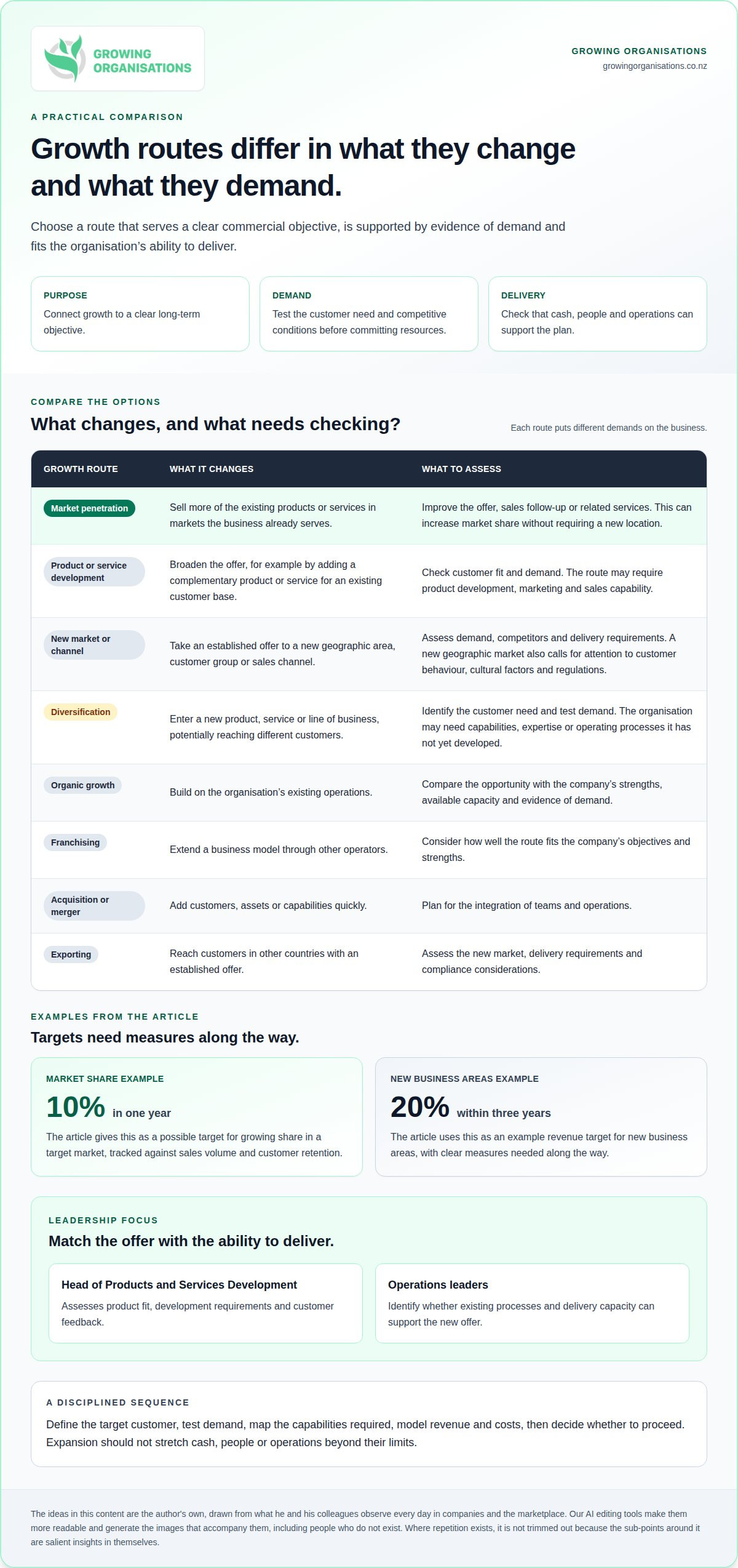
Market penetration means selling more products or services to customers in markets the business already serves, perhaps even dominates. A company might improve its offer, strengthen sales follow-up or introduce a related service for current clients. These moves can increase market share without requiring a new location. A target could be growing the share of a target market by 10% in a year, with sales volume and customer retention tracked against that objective.
Assess internal capability and capacity alongside external opportunity. A business with strong customer relationships but limited delivery capacity may need to improve operations before pursuing more sales. A company with spare capacity and repeat demand could focus on converting more prospects. Before committing resources, assess demand, competitors, market size and conditions. For a new geographic market, include local customer behaviour, cultural factors and regulations in the assessment.
The field of B2B selling offers almost endless opportunities for your representatives to be updating and upgrading their capabilities for greater business advantage over your competitors and for their own higher aspirations.
Organic growth builds on existing operations, while franchising extends a business model through other operators. Acquisitions can add customers, assets or capabilities quickly, but these require integration of teams and operations. Exporting reaches customers in other countries and brings new market, culture, delivery and compliance challenges. Compare routes not just by speed, but by how well each fits the company’s values, objectives and strengths.
The main routes include:
- Selling more to existing customers
- Developing new or varied products or services
- Entering new geographic or demographic markets
- Adding sales channels
- Franchising
- Exporting, and
- Acquiring or merging with another business.
For example, a firm could launch an online channel for a customer group it does not currently reach, then measure demand before expanding further.
Increasing market share can also mean broadening the offer. A company might add a complementary product that meets another customer need rather than relying on its existing range alone. These can strengthen your position in the same market, but each may require new funding, product development, marketing, and sales capability. Test whether the new offer serves the chosen customer and supports the wider objectives before going all-in.
Diversification takes a business into new products, services or lines of business. It may reach different customers, but can require capabilities the company has not developed. Distinguish it from geographic expansion: selling an established service in a new area changes the market, while launching an unrelated service changes the offer. Define the target customer, evidence of demand and delivery requirements before choosing either route.
2. Diversification
Diversification means entering a line of business beyond the company’s existing activities. It might involve a different product, service, customer group or production process. For example, a food producer could develop a packaged product for retail customers alongside its established wholesale work. A new revenue stream may reduce reliance on one source, but it also adds decisions, investment and delivery demands.
Start with the customer problem, not the product idea. Identify who would buy the offer, what need it meets and why the organisation can serve that need. Then test demand through customer conversations, limited trials or early sales. A business aiming to earn 20% of its revenue from new business areas within three years needs clear measures along the way, not just a distant target.
Bizzy saw a segment of their market that surrounds and supports their ICP. They built an additional offering in their portfolio to serve that segment and released a hot service they called Bizzy Advisor.
Capabilities matter. A company entering a new industry may lack the expertise, relationships or operating processes the work requires. A firm moving from physical products into subscriptions, for example, needs skills in ongoing customer service and retention. The Head of Products and Services Development can assess product fit, development requirements and customer feedback. Operations leaders can identify whether existing processes can support the new offer.
Product diversification can build on existing strengths. A commercial cleaning firm might add specialist maintenance for the same customer base, drawing on existing account relationships. Moving into an unrelated sector is a larger step and may require new market knowledge, delivery systems and specialist sales capability. Distinguish a complementary offer from a new line of business, then assess each against strategic objectives and likely demand.
Government grants and support programmes may help eligible businesses pursue defined growth activities. Their purpose and eligibility criteria vary, so treat potential support as one part of the funding plan, not as assumed revenue. A diversification case still needs to stand on customer demand, delivery capability and financial viability without grant income. (I confidently refer certain clients to Bizzyhub.co
International markets can widen the customer base, but entering them brings new demands. Selling an existing product abroad extends the market; developing a new product for unfamiliar customers also involves diversification. Keep these decisions distinct in the plan. Assess customer need, competition, delivery requirements and capability before committing resources. Don’t underestimate the influence of the local business culture in the new market. Too many companies fail primarily because of this overlooked critical success factor.
A disciplined sequence reduces guesswork:
- Define the target customer
- Test demand
- Map the capabilities required
- Model revenue and costs
- Confirm funding.
- Quantify ROI as accurately as possible.
Then decide whether to proceed. A successful diversification move creates a credible new income source without undermining the core business. If the organisation lacks expertise or delivery capacity, build that capability before scaling the offer.
3. Product Development Expansion
Business expansion increases what an organisation can sell, deliver or reach. Adding a product line is one route; opening another site, extending an online channel or offering an existing service to a new customer group are others. The chosen growth route should stand up under scrutiny of achievable commercial objective, and a clear and validated estimate of ROI, rather than simply make the business larger.
Product development is another expansion route. It starts with a specific customer need. A manufacturer might adapt an existing product for a different use, while a professional firm could package a service for a distinct type of customer. The Head of Products and Services Development can lead the work: clarify the problem, shape an offer, test its usefulness and refine it through customer feedback. Importantly, this keeps development tied to demand rather than internal enthusiasm.
As a fractional GM for a client, one day I had to disappoint a very enthusiastic engineer with a brave growth mindset when he approached me with a truly innovative idea. In the discussion that followed, though, his exciting idea failed the very basic tests: market demand, and ROI.
Product-line expansion can build on existing expertise. A business selling one core product might add complementary accessories, replacement parts or a related service. A shared customer base may help the new offering find buyers, but each addition brings production, promotion, capital, and support requirements. Assess whether the new line strengthens the overall offer or distracts from products that already generate reliable sales.
4. Pre-Launch
Before launch, map the work from idea to repeatable delivery. Identify required materials or specialist skills, and capital. Set quality standards, and decide how sales and customer support will handle the new offer. A service business expanding into a new area, for example, may need staff training and a revised delivery process. Operations leaders should identify bottlenecks before committing the team to a level of service it cannot sustain.
Expansion costs depend on the route and work involved. Product development may require design, testing, finance, stock, marketing, and training; a new site adds premises and ongoing operating needs, where managing baseline overheads with specialists like Easy2switch UK Ltd can help protect operating margins. Build a financial model in the business’s reporting currency, recording upfront investment, continuing costs, expected revenue and cash needed before sales arrive. Finance leaders should test how changes in demand or delivery costs affect cash flow and profitability.
Market conditions shape the launch decision. A product that suits current customers may still face stronger competition, different buying behaviour or distribution barriers in another segment. Set a small, measurable trial before committing to a broad rollout. Track enquiries, conversion, repeat purchases and delivery performance. These measures indicate whether the offer is gaining traction and whether the organisation can meet demand without weakening existing work.
Financial and operational readiness
Expansion readiness rests on evidence that the business can fund growth and deliver reliably. Stable profitability, predictable cash flow and sustained demand above current capacity are useful signals, but they are not enough on their own. A leadership team should test whether the proposed move can remain profitable five years into the future, including if sales build more slowly than forecast.
Always keep one eye on ROI. Build a financial model before committing capital. Record anticipated expenses, projected revenue, timing of cash receipts and working capital requirements. A new location, for example, may need funding before it generates steady sales. Model slower sales and higher operating costs as well as the expected case. Finance leaders should make assumptions visible to their colleagues and, just as transparently, track actual results against the plan.
Financing can come from retained earnings, borrowing, investment or a combination. The right mix depends on cash flow, repayment capacity, ownership objectives and, most importantly, the timing of expected returns. Match the funding period to its use: equipment or a site may need longer-term finance, while short-term stock needs can create working capital pressure. Minimise interest and fee costs. Do not build the plan around revenue that has not materialised.
Operational readiness is a separate test. Audit workflows, technology and leadership capacity to find bottlenecks before demand increases. A reliable team and repeatable sales processes support expansion; overloading the workforce can create fatigue and weaken delivery.
Geographic expansion not only adds operational costs such as travel but adds market-specific work. In some warmer and humid locations, production moves at a surprisingly slow pace. Assess customer demand, competitors, consumer behaviour, market size and operating conditions in the target area. International expansion also requires planning for local regulations and compliance. In some, employing family members takes precedence over meritocracy. Compare and contrast the target with markets where the business already has relationships or familiar operating conditions. This may reduce the burden of early learning and mistakes. Local assessment remains essential.
Use a structured readiness review. Proceed only when the evidence, funding plan and delivery responsibilities align.
Define your reasons to pursue business expansion
Expansion earns its place when it advances a defined business objective. That could mean increasing profit, reaching customers who cannot access the current offer, or improving service for existing customers. A board should state the intended result before approving growth. “Become larger” is not a useful target; choose a measurable outcome tied to customer value and financial performance, then measure and monitor results.
Growing Organisations: Business Growth Strategy and implementation support
Growing Organisations helps leadership teams turn growth priorities into practical plans and coordinated execution, following the advice we publish. Its Business Growth Strategy and implementation support can help when the direction is clear, unless choices, responsibilities or delivery are not aligned. GOL Advisory Services, Consultancy and Development supports initiatives shaped around the organisation’s commercial objectives.
For CEOs and executive teams managing competing priorities, Executive Performance Coaching can strengthen leadership focus. A Fractional CEO, Deputy CEO, or GM can provide senior leadership capacity where the business needs it. The right support depends on the challenge, whether that is choosing a growth path, aligning the team or keeping implementation on track.
CEOs and other business leaders can discuss their growth priorities or share feedback at hello@growingorganisations.co.nz.
Bring the decision, its main assumptions and the questions still unresolved into a conversation. Contact Growing Organisations to discuss expansion and consider the next step with your leadership team. A deliberate choice gives the business a stronger basis for moving forward.
Frequently Asked Questions
What is business expansion?
Business expansion is a purposeful change that extends a company’s commercial reach or capacity. It differs from routine improvement, such as reducing errors in an existing process, because it aims to create additional activity or serve a wider customer need. Improving order accuracy strengthens current delivery; adding a fulfilment option for customers who could not previously buy extends the business’s reach.
What is an expansion strategy?
An expansion strategy is the leadership team’s framework for pursuing growth. It should clarify who has authority to commit resources, which assumptions need testing, and what evidence would justify continuing or stopping. For example, a board might require a review of customer uptake and delivery performance before approving the next stage. This makes accountability part of the strategy, not an afterthought.
What is a business expansion strategy and how do you create one?
Create a strategy by turning the growth ambition into a testable business case. State the customer problem, explain why the organisation can address it, and identify assumptions that could invalidate the plan. Set a review point where leaders can compare evidence with those assumptions. This prevents an early commitment from becoming permanent simply because time and resources have already been invested.
How do you assess whether a business is ready to expand?
Test whether the business can operate without constant intervention from its most senior people. Select a routine decision, such as resolving a delivery issue, and see whether the responsible team can handle it with existing authority and information. If every exception returns to the chief executive, added activity may deepen that dependency. Readiness includes effective delegation and clear decision rights, not just available resources.
What market research should a business do before expanding?
Look beyond stated interest to understand how buyers discover, assess and approve a purchase. Map the decision-makers, purchasing process and alternatives considered. For a business selling through intermediaries, examine how each channel influences customer choice and what support it expects. This can reveal commercial barriers that broad demand estimates miss, including a mismatch between the offer and how customers prefer to buy.
What are the steps to expand into a new region or market?
Before launch, map the complete customer experience in the proposed market, from first enquiry through delivery and after-sales support. Identify who handles each stage and how problems reach a decision-maker. Then test the operating model with a contained launch, documenting where handovers fail or customers need different support. Use the findings to adapt processes before widening access or committing the wider organisation.
What are the risks of business expansion and how can they be managed?
One overlooked risk is that a new initiative draws skilled people away from essential work, weakening service for established customers. Name the roles and time commitments required before launch, then agree what work will be deprioritised if capacity tightens. A contingency plan should identify who can pause spending, change the launch scope or resolve operational issues. Clear authority helps leaders respond before the problem spreads.
[The ideas in this content are the author’s own, drawn from what he and his colleagues observe every day in companies and the marketplace. Our AI editing tools make them more readable and generate the images that accompany them, including people who do not exist. Where repetition exists, it is left because the sub-points around it are salient insights in themselves.]

Article by
Ross Wilson, MBA. Principal Advisor, Growing Organisations Ltd.
The moment before a hard call you need to make: this is where I do my best work. Maybe a business unit that's stopped performing; a sales team that plateaued two years ago and nobody's proud of it, or a culture that technically functions but has simply gone flat. Perhaps you "high performers" are strangely off their game. What do you do with these dilemmas?
These are the kinds of calls CEOs and boards bring me into, because by the time they call, they already know the comfortable options no longer work.
I've spent 30 years in advisory, most of it at CEO and Board level, across 35+ countries. I earned an Executive MBA degree from the University of Auckland which helps a little.
The point is, what happens now: businesses that were losing money find their margin again, teams that had stopped believing in targets start hitting them, and cultures people used to merely tolerate become ones they're proud to work in.
I don't do this alone. Growing Organisations is a niche team of professional advisors, by design, working globally, each with a specific field they've mastered and a track record that speaks for itself. What we work together and share a refusal to hand over a report and simply disappear. We stay, advise, support practically, coach if necessary, review, and redirect until the result is real and it's yours, not ours.