Às dèidh dhomh ùine a chur seachad ann an dùthaich mo shinnsirean, a bhith a’ gabhail aoigheachd ann an dachaighean na Gàidhealtachd, agus tilleadh gu Sealainn Nuadh le beagan mì-thoileachais, tha mo chridhe air fàs làn de fhaireachdainn gach turas a chuimhnicheas mi air an dùthaich a tha mi a-nis a’ meas mar mo dhachaigh fhìn.
Tha fios agam gu bheil sealbhadairean ghnìomhachasan agus stiùirichean ann an Alba a’ cur aghaidh ris na h-aon dhùbhlain ’s a tha fa chomhair an co-aoisean ann an Sasainn agus air feadh na Roinn Eòrpa, a bharrachd air dùbhlain eile a tha gu sònraichte Albannach. Tha mi gu mòr airson a bhith feumail, agus mar sin tha mi a’ cur an artaigil seo gu sònraichte thugaibhse.
Tha mi air an t-artaigil fhoillseachadh sa Bheurla, oir chan eil dragh sam bith orm ma gheibh na daoine gu deas cothrom cuideachd pàirt a ghabhail nar soirbheachas!
Tha mi an dòchas gun còrd an t-artaigil seo ribh, agus gum bi sibh deònach ur n-eòlasan fhèin agus an gliocas a choisinn sibh a cho-roinn.
Seo an t-artaigil as ùire agam, anns a bheil mi a’ rannsachadh nan cothroman agus nan dùbhlan a tha fa chomhair stiùirichean ghnìomhachasan ann an Alba ar cridhe.
Ma tha mearachdan anns a’ Ghàidhlig agam, tha mi an dòchas gun toir sibh mathanas do neach-ionnsachaidh dealasach!
Growth is rarely disrupted for lack of ideas. It stalls when advice, market access, and execution are disconnected.
As leading global business growth experts, Growing Organisations helps leaders turn commercial ambition into clear priorities and practical action. The value lies in connecting advice to both the decisions and the work required to make progress.
It is reasonable to look for evidence before deciding what support your business needs. Examples are useful too, when they explain the challenge, the choices made, and the work involved.
And so, when assessing a potential adviser, look beyond broad claims and consider whether their approach fits your organisation’s needs. For example, we can legitimately claim to have worked well with business leaders in over 30, perhaps 40 different countries, at all levels up to Board Chair, and that’s all fine and good. What makes us a good choice for you in Scotland and the wider British Isles, and even Europe is not what we did with IBM in India – or Haven Holidays (Bourne Leisure) in England – so much as it is that we know what to listen for when talking to you.
Most of my colleagues have postgraduate degrees in business, but this only helps us to know where to look in your business – which rugs to look under or cupboards to open 😉 – to find the breakthrough answers for your questions. What worked so well in Australia probably won’t work so well in Wales. But, then again, it might.
This article is built on a collective 150 plus years of deep engagement in contemporary business and it explains how business advice, training and development, market access, strategic & action plans, growth programmes and specialist expertise can support a firm’s progress in any context. It also considers how leadership roles contribute to execution and what to assess when seeking support. The focus is practical: connect the growth objective to clear decisions, accountable ownership, and the work your organisation can deliver.
Read it, of course, but if you want to know how we could best support your growth aspirations, you should talk to us.
My details are below.
Key Takeaways
- Match business advice and development support to the capability gap your leadership team needs to address.
- Assess new markets by looking at customer demand, suitable routes to market and the partnerships needed to reach buyers.
- Turn growth priorities into a strategic action plan with clear ownership, practical steps and regular review.
- Use a growth programme to bring structure to development, while keeping its priorities relevant to your business.
- Give marketing and sales clear and distinct, but integrated roles: generate qualified prospects, then convert them into profitable customers.
Business advice, training, and development support
Business growth should always start with a relevant and yet comprehensive audit of your business. Something like our Kairos Platform. Having then pinpointed where the development effort and resources should be directed, growth support can combine one-to-one advice, skills development, peer networks, or access to investment opportunities.
The right mix depends on the constraint: a founder may need to test a commercial offer, whilst an established leadership team may need stronger, collaborative execution. Define the decision or capability gap the support must address.
Remember to also examine the capacity to deliver results.
Entrepreneur support and networking organisations offer different routes to advice and connections. Some work to diversify economies, grow high-value businesses, and create skilled jobs. They can also encourage founders and leaders to raise and share their ambitions. A strong network can surface partnerships, practical insight and opportunities that a business might miss when working alone.
One-to-one advice is useful when a business needs to test an idea, clarify its offer or plan its next move. A productive conversation should leave the founder or CEO with a decision, a well-reasoned action and a way to assess progress, rather than a list of general suggestions.
Targeted training works best when it addresses a specific capability-dependent execution gap. Events, webinars and workshops can help leaders build relevant skills. A sustainable tourism toolkit, for example, can guide tourism businesses towards more inclusive, resilient and sustainable practices. Leaders can identify a relevant practice, assign responsibility and apply it within their operating context.
Investment support is distinct from general business advice. Before considering investment, leaders need a clear growth case, a credible use for capital and an organisation able to deliver the plan. Don’t overlook the critical importance of positive ROI when considering any investment decisions, whether share issues, PE, Angel Investors, or borrowing.
Advice can help clarify the opportunity and the capabilities required. The investment decision rests with the investors including existing shareholders, and the proposal presented.
Community-based support connects businesses with people and organisations around them. Again, for a tourism operator, local relationships can inform product development, partnerships and the business’s contribution to its destination. The practical step is to connect each relationship to a defined commercial or community objective.
Businesses can enquire about a consultation by emailing hello@growingorganisations.co.nz to arrange an online meeting. Describe the decision or growth issue you want to address. Growth support can cover strategic advice, development, and implementation planning. A location name alone does not establish an expert’s base or remote delivery arrangements. Discussing the business’s needs and preferred working arrangements helps define a suitable next step as a business growth expert.
Young entrepreneurs aged 18-30 can seek advice from business support organisations near them. Entrepreneurial networks can help build connections and encourage founders and leaders to raise and share their ambitions. We also provide individual and group mentoring. These routes can help a business to frame its immediate question and identify the kind of support it needs, whether that is advice, connections, training, or professional development.
Events may offer networking, while webinars and workshops foroffer capability-building for businesses in various sectors. Businesses can choose a format that fits their current needs and use it to build knowledge or make professional connections.
Reaching new markets
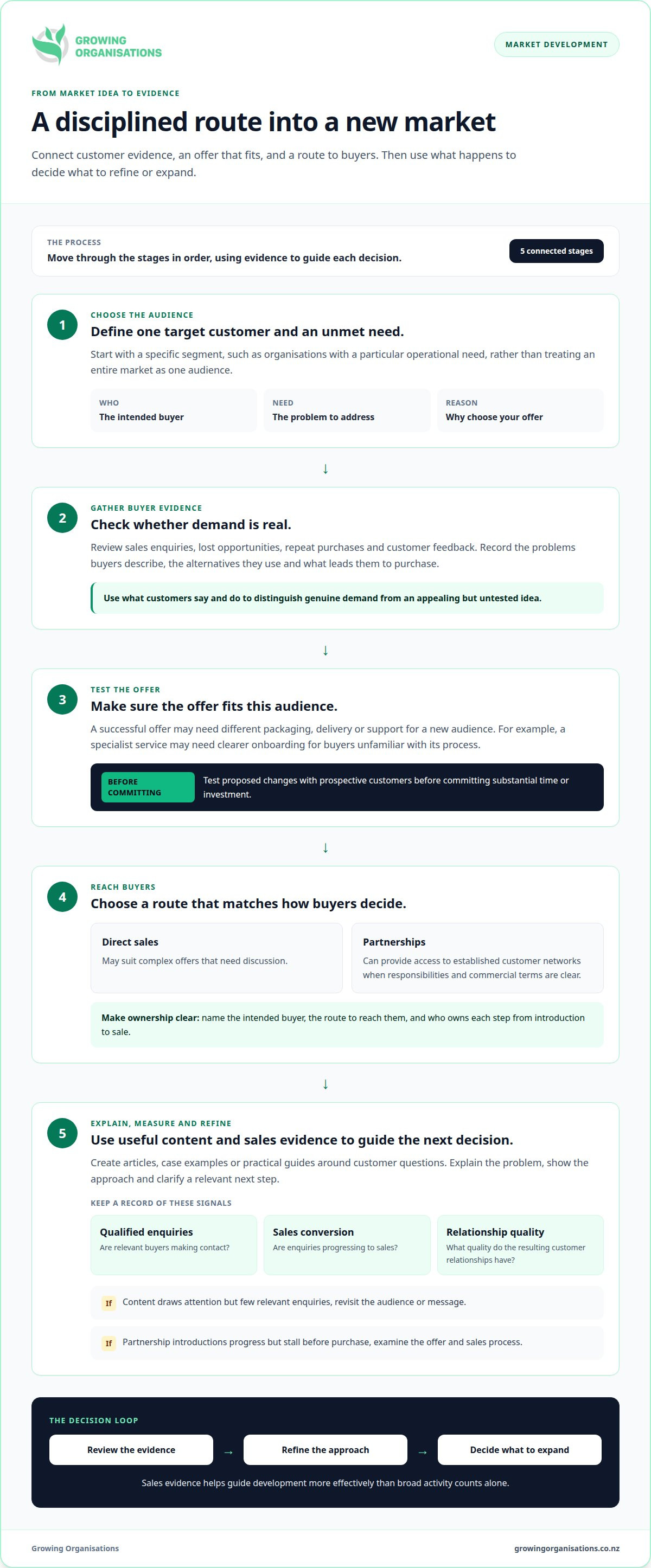
Entering a new market requires more than finding new buyers. It requires a clear reason to choose your offer, a credible route to customers and the capacity to deliver. Begin with one target segment, such as organisations with a specific operational need, rather than treating an entire market as one audience. Expand later.
Market development starts with evidence about customer behaviour. Review sales enquiries, lost opportunities, repeat purchases and customer feedback. Record the problems buyers describe, the alternatives they use and the conditions that lead them to purchase. These insights help distinguish genuine demand from an attractive but untested idea.
Next, assess whether the offer fits the segment. A product or service that succeeds with existing customers may need different packaging, delivery or support for a new audience. For example, a specialist service may need clearer onboarding for buyers unfamiliar with its process. Test proposed changes with prospective customers before committing substantial time or investment.
Choose a route to market that matches how buyers make decisions. Direct sales may suit complex offers that require discussion. Partnerships can provide access to established customer networks, provided responsibilities and commercial terms are clear. A channel decision should name the intended buyer, the route to reach them and who owns each step from introduction to sale and delivery.
Content marketing supports that route by answering the questions buyers ask before they engage. A leading article, case example or practical guide can explain a problem, show the approach and clarify the next step. Build content around customer questions, not internal product language. Use one useful insight across suitable formats, then direct interested readers towards a relevant conversation.
Keep a record of how each activity performs. Track qualified enquiries, conversion to sales and the quality of resulting customer relationships. If content draws attention but few relevant enquiries, revisit the audience or message. If partnership introductions progress but stall before purchase, examine the offer and sales process. These signals guide development more effectively than broad activity counts alone.
A disciplined market test can follow a simple sequence:
- Define the target customer and the unmet need.
- Test the offer and the route to reach that customer.
- Publish useful content that addresses real buying questions.
- Review sales evidence and decide what to refine or expand.
For leadership teams weighing a new market, market development and content planning can bring customer insight, commercial priorities and execution into one practical plan.
Businesses can draw on market-support resources that help build partnerships and reach international customers. Webinars on topics such as sustainability, digital marketing and market opportunities can be watched at a convenient time. Resources promoting specialist tourism experiences, such as dark sky tourism, can also help businesses extend demand into quieter seasons.
Growth advice and strategic action plans
Growth advice should lead to decisions, owners and visible work. Start by defining the commercial outcome: stronger margins, more qualified enquiries, repeat purchases or entry into a new region. Then identify the constraint blocking it. A business seeking global customers may need a different route to market from one improving sales to existing accounts.
A strategic action plan connects that outcome to what the organisation will do. It should name the priority, the person accountable, the resources required and the evidence that will show progress.
For example, if sales conversion is weak, the plan might focus on improving how prospects are qualified and followed up, rather than increasing lead volume or closing ratios.
Digital activity needs the same commercial discipline. Pay-per-click advertising can generate leads, while search engine optimisation (SEO) and content marketing can build longer-lasting search visibility. Measure the effectiveness of each activity. Use the results to allocate budget towards work that reaches relevant prospects and supports sales, rather than treating clicks or publishing volume as success on their own.
But, all of that can be wasted if your CRO is not great – conversion rate optimisation.
A useful planning meeting brings the right decision-makers together. The Head of Marketing can report on lead quality and channels. The Head of Sales can explain where prospects progress or stall. Together, they can test whether the issue lies in the audience, message, follow-up or offer. This makes the next action more precise.
Keep the plan manageable. Too many priorities dilute ownership and make progress difficult to assess. Group proposed work by commercial outcome, then sequence actions that depend on one another. If a new service needs customer research before promotion, complete that work first. The plan should connect each action to a decision or result, not simply record activity.
Review progress against the evidence agreed at the outset. If qualified enquiries rise but sales do not, examine the handover and sales conversation. If content attracts the right audience but produces few enquiries, refine its call to action or the next step offered. Each review should record what changed, what the evidence showed and who owns the response.
A practical action plan can include:
- Outcome: State the commercial result the leadership team is pursuing.
- Constraint: Identify what currently prevents that result.
- Action and owner: Assign specific work to a responsible leader.
- Evidence: Agree what will indicate progress and guide the next decision.
This discipline turns growth advice into accountable execution. It helps leaders connect digital investment, sales activity and operational capacity to a coherent direction.
Business growth programmes
A growth programme gives a leadership team a structured way to turn ambition into development work. Its value depends on fit: an innovation-focused business may need to test a new offer, while a service firm may need stronger delivery before pursuing more customers.
An adviser should frame the work around the organisation’s priorities, rather than apply a fixed sequence of activities or "one size fits all" solution.
Business advice within a programme should connect analysis to decisions.Athis is where the value of the right business audit (Like Kairos Platform) pays dividends.
A practical starting point is to map the firm’s current position, including customer needs, the offer, delivery capacity and decisions slowing progress. The leadership team can then select a priority and assign an owner. If product development is the constraint, the responsible leader can focus on customer needs, the offer’s value and a testable next version.
Innovation needs operating discipline. Treat a new idea as a proposition to test, not an assumption to fund indefinitely. Set out the customer problem, proposed response and evidence that would support further investment. A tourism business considering a new visitor experience, for instance, could test the concept with prospective, or existing customers before committing operational resources.
Before engaging a growth adviser, assess the proposed scope, the work they will lead and the decisions that remain with your team. Ask for relevant examples showing the business challenge, the adviser’s contribution and how implementation was handled. Agree how progress will be reviewed, who owns each action and what evidence will inform the next decision. A polished presentation is not enough and cannot replace clear accountabilities.
Judge an adviser’s fit against the work required, not the title alone. Clarify whether the need is strategic advice, implementation support or stronger leadership capability. Discuss how the adviser will work with decision-makers and how proposed actions connect to existing plans. These points help both sides establish a useful scope and avoid beginning with an ill-defined brief.
Programme design should account for leadership capacity. If a Managing Director already has several delivery responsibilities, adding initiatives without reallocating ownership will weaken execution. Map existing commitments, protect time for agreed actions and name a senior sponsor who can resolve obstacles. This turns the programme from a series of discussions into work the organisation can deliver and review.
A useful programme leaves the leadership team better equipped to make decisions after formal support ends. Capture the rationale behind priorities, record lessons from tests and build reviews into existing management meetings. Leaders can consider customer evidence, delivery risks and investment decisions together, then revise actions where needed. The programme should build organisational capability, not reliance on ongoing advice.
Specialist business expertise
Specialist expertise is useful when a growth decision depends on sector knowledge or a leadership capability the team lacks. The wider business ecosystem includes experience in retail, finance, business development, tourism, energy and technology. The relevant question is how that experience connects to your firm’s growth priorities and operating realities.
Industries and business sizes vary across the examples available here. The named experience spans retail, energy, technology, finance, business development and tourism, while the business support discussed in this article is aimed at firms and their leaders. Fit depends on the challenge, such as entering a market, improving sales leadership or making an existing operation more effective.
Assess expertise against the work required. A business reviewing its sales performance needs someone who can diagnose its commercial process, not simply discuss a vision. A team that is building a new service needs insight into product development and customer needs. In each case, connect the adviser’s relevant experience and capability to a defined business problem and practical next steps.
Experience also needs to match the scale and stage of the decision. A founder testing a new offer faces different choices from an established leadership team expanding an operation. Ask how an adviser would understand the firm’s context, involve decision-makers and translate specialist knowledge into actions. A useful discussion should make clear what will be examined and how the work supports execution.
The named profiles illustrate distinct forms of experience. Sarah has more than 20 years of management experience in retail. John has a 25-year global career in the energy and technology sectors. Those backgrounds can inform sector-specific perspectives, but they are not interchangeable. The business challenge determines which experience is relevant.
Other examples bring functional breadth. Lynn worked in Finance for 16 years, Business Development for 5 years and Travel and Tourism for 2 years before joining her team. This combination illustrates how financial, commercial and sector knowledge can inform growth decisions. It does not, by itself, establish formal qualifications or identify one adviser as suitable for every business.
For growing firms, leadership expertise is useful when it fills a clear gap. A Head of Sales can focus on converting prospects into profitable customers, while a Head of Operations can improve production and value delivery. Define the responsibility first. Then assess whether the specialist can help the leadership team make and implement the decisions that responsibility requires.
If your growth ambitions need specialist input, discuss your business growth priorities with a clear account of the challenge, relevant sector experience and the decisions ahead.
Growing Organisations: Business Growth Strategy and implementation support
Growing Organisations helps leadership teams turn growth priorities into practical plans and implementation. Its Business Growth Strategy and implementation support helps firms connect commercial goals with accountable delivery. Consultancy and Development can address organisational needs that affect progress.
Where leadership capacity is the constraint, Executive Performance Coaching supports leaders in their role. A Fractional CEO or MD can provide senior leadership capability when the business needs it. The right option depends on the work required and the leadership team’s priorities.
CEOs and other business leaders are welcome to send feedback or enquire about your growth plans at hello@growingorganisations.co.nz.
Our partnership-building process
For full transparency, allow me to outline the process we loosely follow with a new enquiry:
- An inbound call from a CEO, MD, or GM
- A confidential, straight forward conversation with our Principal Advisor
- A basic business audit – Kairos Primer – to identify the parts of the business most affected by the growth challenge *
- Debrief and honest diagnosis with the business leader, and agreement on a broad strokes outline of the next steps, if any.
- Typically, structured interviews with Executives and other key leaders, and the full Kairos Platform report *
- A facilitated examination of the health, performance, and realistic ROI projection to guide the first STOP/GO decision. *
- Assuming "GO", a workshop with key leaders to considee historical barriers, bottlenecks, and culture affecting change processes in the company. *
- Build the Growth Strategy, Projects, and Critical Action plans.
- Supported onboarding of teams through the company.
- Supported execution, with periodic reviews, celebrations, and remedies.
Other elements are built around this skeleton. NOTE: * means a fees progress payment is due.
Turn the next growth decision into action
The next step is to choose the business decision that needs leadership attention now. Set out what must change, who will own the work and what evidence will guide the next review.
We often use that simple TOP/START/CHANGE conversation.
That gives your Board, CEO and executive team a practical basis for deciding whether external support would add value.
Growing Organisations supports this work through Business Growth Strategy and implementation support, as outlined above. Where the challenge centres on leadership effectiveness, Executive Performance Coaching can help leaders strengthen their contribution to delivery.
The right starting point is the issue your organisation needs to resolve, not a broad promise of growth.
If you are ready to discuss a specific growth priority, contact Growing Organisations. Bring the decision you are facing and the outcome your team needs to work towards. A clear and honest conversation can help establish a useful next step, with your leaders accountable for putting all plans into practice.
Frequently Asked Questions
Can you highlight some real world examples in your portfolio?
yes, but all our work is bound by strict confidentiality agreements. However, some clients allow us to refer new enquirers to them for a call.
Anonymised client references include organisations in engineering, med-tech, agri-tech, defence technology, primary industry, manufacturing, hospitality & tourism, professional services, healthcare, restaurants, local government, and others.
Detailed project narratives and quantified outcomes are not included here, so the names alone cannot show what changed. For a useful comparison, focus on the business challenge, the advisory work involved and the evidence used to assess progress. That helps you judge relevance without treating another organisation’s experience as a forecast for your own.
How do you ensure you don’t pay too much for growth?
Define the work and decision required before committing resources. We apply a pay-as-you-go model because we believe this is the fairest and most ethical approach.
Besides that, though, if, for example, your priority is improving sales performance, clarify which parts of the sales function need attention and what support will address them. Assess proposed work against expected value, internal capacity and available evidence. Keep investment connected to an agreed business need, and review whether the work remains relevant as your priorities develop.
In the absence of – or even as well as – any other measurement, we like to pursue a clear business ROI objective.
What results or client case studies demonstrate their impact?
Client references and testimonials provide evidence of organisations’ experiences, but they do not guarantee the same result for another business. However, you can generally assess impact by identifying the original challenge, the work undertaken and the evidence of change. Your CFO may be able to put numbers to that.
This gives your leadership team a sounder basis for judging relevance than relying on a testimonial or company name alone.
What are the expert’s fees and consultation options?
Fees vary by country and context, and of course they depend on the scope of the bespoke engagement, so no single figure applies across different business needs.
However, we happily work with the CEO and CFO to calculate a realistic estimate of the total investment required, not only our fees.
Advisory can take the form of a regular, private advisory relationship structured around your needs and your calendar. Some clients meet weekly, others monthly.TSometimes our engagement is focused on supporting the CEO or Md; sometimes the Executive Leadership team, and still others on the whole, dispersed Management throughout the company. We use digital communications tech as much as is necessary while prefering human conversation. We use AI tools as only tools and primarily to make us more efficient.
To discuss a potential engagement, email hello@growingorganisations.co.nz with a brief description of the business issue and the support you are considering.
[The ideas in this content are the author’s own, drawn from what he and his colleagues observe every day in companies and the marketplace. Our AI editing tools make them more readable and generate the images that accompany them, including people who do not exist. Where repetition exists, it is not trimmed out because the sub-points around it are salient insights in themselves.]

Article by
Ross Wilson, MBA. Principal Advisor, Growing Organisations Ltd.
The moment before a hard call you need to make: this is where I do my best work. Maybe a business unit that's stopped performing; a sales team that plateaued two years ago and nobody's proud of it, or a culture that technically functions but has simply gone flat. Perhaps you "high performers" are strangely off their game. What do you do with these dilemmas?
These are the kinds of calls CEOs and boards bring me into, because by the time they call, they already know the comfortable options no longer work.
I've spent 30 years in advisory, most of it at CEO and Board level, across 35+ countries. I earned an Executive MBA degree from the University of Auckland which helps a little.
The point is, what happens now: businesses that were losing money find their margin again, teams that had stopped believing in targets start hitting them, and cultures people used to merely tolerate become ones they're proud to work in.
I don't do this alone. Growing Organisations is a niche team of professional advisors, by design, working globally, each with a specific field they've mastered and a track record that speaks for itself. What we work together and share a refusal to hand over a report and simply disappear. We stay, advise, support practically, coach if necessary, review, and redirect until the result is real and it's yours, not ours.