Executive teams frequently look outward for expansion, believing that top-line revenue additions are the only path forward. Internal growth takes the opposite approach: prioritising internal organic growth allows an enterprise to improve profitability and use existing resources more effectively.
It may truly surprise you how much more profit, shareholder value, or productivity can be generated in an established business with minimal spending. Internal growth is so often such a rich source of the benefits CEO’s and other business Leaders are seeking that I typically start any Growth Initiative for a new or returning client with a search for internal growth first.
My company has perhaps the most advanced auditing tools designed specifically to find growth opportunities, both inward and outward-looking, and we use these with our clients every day and, very often, a substantial proportion of the business growth they’re searching for is found with more effort and intelligence and less money. Shareholders love this!
Let’s explore internal growth opportunities for your business.
Typically, we find these opportunities within current operations, financial statements, and team structures to begin with. The core objective is qualitative: improve how the business performs, uses capital, serves customers, and converts existing resources into value. Eliminating operational friction, pruning underperforming product lines, renegotiating commercial terms, and deploying capital with discipline can improve ROI, ROCE, ROA, Gross Profit, Net Profit, and shareholder value while generating high strategic value at low financial cost.
This article examines how senior executives can uncover, evaluate, and execute internal growth opportunities across products, services, operations, finance, technology, and governance. It provides practical frameworks to evaluate operational productivity, rationalise capital allocation, improve service delivery speed, and link every internal initiative directly to financial returns. By turning leadership attention inward, executive teams can strengthen their core commercial engine and build a durable foundation for long-term value creation.
1. Financial rationalisation and capital optimisation
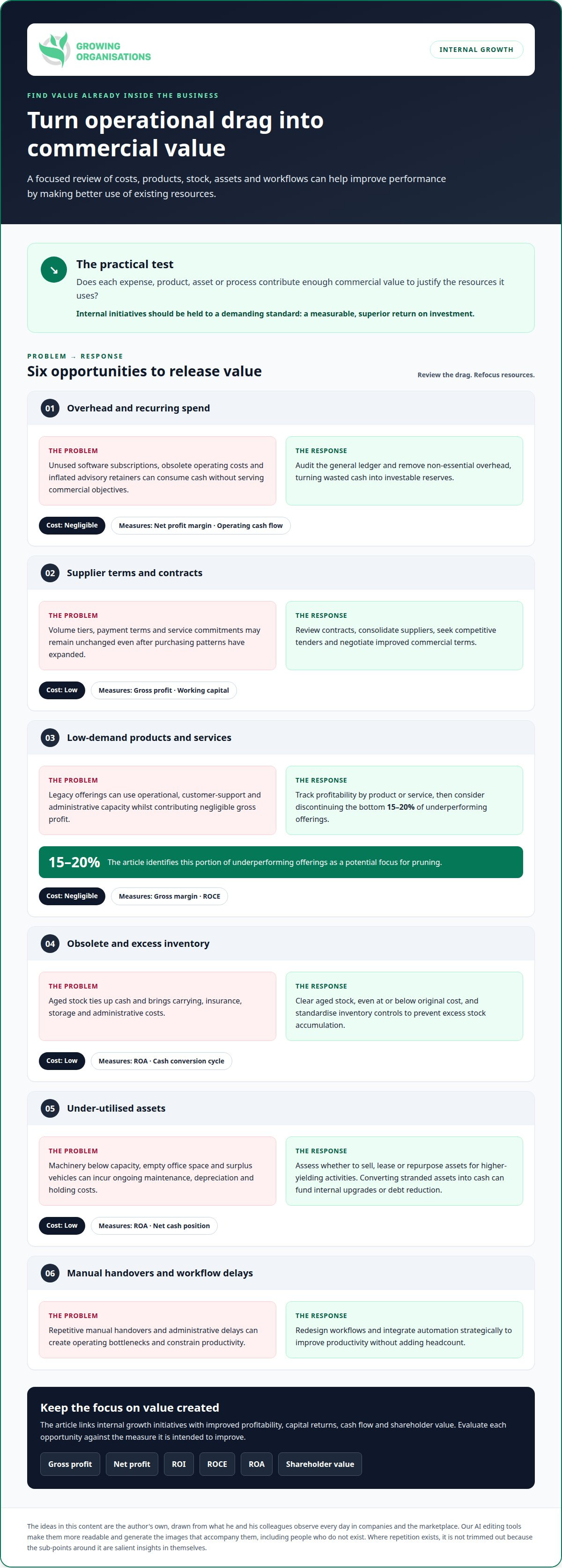
Internal growth begins with rigorous financial housekeeping. Many organisations accumulate operational bloat during periods of expansion: recurring software subscriptions that provide minimal utility, obsolete operational expenditures, and inflated payrolls. A systematic audit of the general ledger exposes expenses that no longer serve commercial objectives. Eliminating non-essential overhead directly improves Net Profit, turning wasted cash into investable reserves.
Supply chain agreements and vendor contracts represent immediate opportunities for commercial renegotiation. Volume tiers, payment terms, and service-level commitments often remain unchanged long after purchasing patterns have expanded. Consolidating suppliers, soliciting competitive tenders, and negotiating early-payment discounts or extended settlement terms can improve working capital and commercial terms. A structured review of supplier contracts can improve procurement efficiency and support Gross Profit.
Trapped capital severely restricts an enterprise’s ability to act on strategic initiatives, capitalise on limited offers, or seize other opportunities.
Warehouses holding obsolete inventory drain cash through carrying charges, insurance, storage, plant & equipment, labour and administrative overhead. Liquidating aged stock, even at or below original cost, converts stagnant balances into liquid capital while freeing up physical capacity.
A large engineering firm that came to us 10 years ago released over $400,000 in cash by liquidating idle steel stock scattered across their yards. They chose to use that cash to reduce costly debt and remove interest expense from their books.
In manufacturing and distribution environments, standardising inventory controls prevents excess stock accumulation and protects cash flow.
Fixed assets that sit underutilised drag down return on assets (ROA) and return on capital employed (ROCE). Machinery operating below capacity, empty commercial office space, and surplus fleet vehicles incur ongoing maintenance, depreciation, and holding costs.
Senior leaders should systematically evaluate balance-sheet assets to determine whether to sell, lease, or repurpose them into higher-yielding activities. Converting stranded assets into cash provides low-cost funding for internal technological upgrades or debt reduction.
For mature businesses generating robust free cash flow, executing share buybacks can enhance earnings per share (EPS) and lift shareholder value. Rather than chasing marginal, high-risk capital projects, repurchasing equity signals commercial confidence, concentrates future returns among existing shareholders, and potentially strengthens the business for future capital raising. This capital management tool improves financial ratios while demonstrating prudent stewardship.
Every internal reallocation of capital must be held to a demanding standard: generating a measurable, superior return on investment (ROI).
Tax efficiency also plays an important role in financial optimisation. Reviewing asset depreciation schedules, structuring internal transactions, and maximising legitimate deductions preserve precious working capital. However, leadership must balance tax positions against strategic imperatives.
A corporate initiative that reduces tax liability might occasionally constrain operational agility or lock capital into unproductive structures. In contrast, an initiative with lower tax efficiency might deliver vastly superior commercial flexibility, higher operational velocity, and greater enterprise value. Practical commercial prudence must always outweigh purely accounting-driven compromises.
2. Product rationalisation and asset redeployment
Unchecked expansion frequently produces product-line bloat. Companies add product variants, bespoke service tiers, and specialised offerings to capture specific client requests, but rarely retire them when demand drops. Over time, these legacy offerings consume disproportionate operational, customer-support, and administrative bandwidth while contributing negligible Gross Profit.
Tracking profitability by individual stock keeping unit (SKU) or service engagement reveals the true commercial contribution of each line.
Discontinuing low-demand and margin-diluting products is an effective internal growth initiative. Pruning the bottom 15 to 20 per cent of offerings can eliminate operational drag from underperforming stock and refocus delivery teams on core, high-margin solutions.
When leadership sheds low-yielding activities, customer service quality on primary offerings rises, delivery schedules shorten, and sales teams regain clarity. Removing weak offerings protects overall profitability and sharpens market positioning.
Releasing the lowest performing sales staff can enable investment in a specialist BDM for a new market initiative.
The table below illustrates how reallocating internal resources from low-yielding legacy activities to core operations directly impacts key financial performance metrics:
| Internal Growth Initiative | Direct Operational Impact | Primary Financial Metric Lifted | Capital Cost Required |
|---|---|---|---|
| Expense Audit and Overhead Elimination | Removes redundant software, subscriptions, and discretionary spend | Net Profit Margin, Operating Cash Flow | Negligible |
| Vendor and Supplier Contract Renegotiation | Secures competitive pricing tiers and improved payment terms | Gross Profit, Working Capital | Low |
| Low-Demand SKU and Service Decommissioning | Stops operational dispersion and focuses delivery on core capabilities | Gross Margin, ROCE | Negligible |
| Obsolete Inventory Clearance | Frees floor space and eliminates ongoing inventory holding costs | ROA, Cash Conversion Cycle | Low |
| Underutilised Asset Disposal or Repurposing | Liquidates idle equipment, vehicles, or vacant commercial property | ROA, Net Cash Position | Low |
| Targeted Automation and Workflow Redesign | Eliminates repetitive manual handovers and administrative delays | EBITDA Margin, Labour Productivity | Low to Moderate |
Redeploying internal resources requires objective commercial evaluation. Plant, equipment, and intellectual property assigned to dying market segments should be reallocated to operational divisions exhibiting strong organic demand. Rather than investing substantial capital in new machinery or technical architecture, leadership teams should evaluate whether existing equipment can be retooled, retrofitted, or rescheduled across multi-shift operations.
Asset redeployment also extends to working capital management. Releasing capital tied up in slow-moving work-in-progress, extended debtor books, and surplus warehouse space allows an enterprise to fund internal modernisation without external borrowing. By maintaining disciplined control over working capital cycles, the organisation strengthens its balance sheet and boosts its financial returns, proving that substantial commercial expansion can be achieved with modest financial outlays.
3. Workforce productivity and structural efficiency
Labour is often an enterprise’s largest operational expense, making workforce productivity a critical pillar of internal growth. Merely demanding greater effort from employees rarely produces sustained output; true productivity gains stem from intelligent structural design, clear role accountabilities, and the elimination of redundant bureaucratic layers. Consolidating fragmented teams and removing overlapping supervisory tiers accelerates operational decision-making and reduces internal friction.
To explore this organisational dynamic in depth, executives can examine How to improve executive team performance through shared leadership across functional divisions.
Team capacity improves when organisations identify operational bottlenecks and reallocate staff to high-value execution points. When non-billable, administrative work is automated or consolidated, skilled personnel can dedicate their time to more productive or profitable client delivery, technical problem-solving, and operational refinement.
Workforce consolidation does not mean indiscriminate downsizing; rather, it represents the deliberate concentration of talent where it directly supports customer outcomes and profitability.
Misaligned incentives silently erode commercial performance. In many mid-sized and large organisations, sales commissions reward top-line revenue without regard to project delivery costs or gross margin requirements. Similarly, operational bonuses are frequently tied to volume metrics rather than defect reduction, customer satisfaction, or cash collection speed. Realigning employee compensation structures with core financial metrics, such as Gross Profit contribution, client retention rates, and operating margin, aligns team activity with enterprise value.
When structuring executive and management accountability, defining key leadership roles makes an enormous difference. Two roles prove particularly decisive when executing internal growth strategies:
Head of Operations: Manages production and service delivery to add tangible value and multiply operational cash flow. This role identifies workflow bottlenecks, eliminates rework, optimises throughput times, and ensures operational capacity expands without requiring linear headcount additions.
Head of Finance: Manages cash, financial reporting, and tax compliance. This role tracks working capital metrics, evaluates the return on internal capital deployments, establishes financial controls around discretionary overheads, and designs incentive plans tied directly to Gross or Net Profit.
When these functional leaders work in unison, workforce productivity translates directly into higher return on capital employed. Clear boundaries, unambiguous operational metrics, and transparent financial reporting enable managers to lead with confidence. Employees work with greater clarity when their individual efforts are visibly connected to the commercial health and strategic priorities of the business.
4. Operational streamlining, automation, and technology integration
Operational bottlenecks limit throughput and degrade customer satisfaction. In service, manufacturing, and distribution organisations, delays typically occur during handovers between teams: sales passing contracts to delivery, operations transferring orders to billing, or technical teams waiting for management sign-offs.
Mapping internal workflows step by step uncovers systemic delays, ego-stroking approvals, and repetitive data entry that waste billable hours.
Modernising operations requires targeted technological upgrades rather than costly, open-ended enterprise software overhauls. Strategic integration of artificial intelligence and workflow automation improves operational efficiency by reducing repetitive manual work and administrative delays. Deploying AI for preliminary data analysis, contract review, routine customer inquiries, and financial reconciliation frees experienced staff to focus on strategic, revenue-generating activities.
To understand how to implement these structural improvements, review practical ways to strengthen business operations and improve efficiency throughout the enterprise.
Selective outsourcing offers another viable route to internal operational efficiency. Back-office functions that lack strategic differentiation, such as payroll processing, basic IT support, facilities maintenance, and routine accounting, can frequently be delivered more cost-effectively by external specialists. Outsourcing non-core tasks converts fixed overhead into variable costs, simplifies internal management structures, and allows senior leaders to concentrate attention on core commercial differentiators.
Increasing service delivery speed directly enhances commercial performance. In competitive markets, the speed with which a company responds to a proposal, delivers a completed project, or resolves an operational issue strongly influences customer retention and competitive standing.
Removing internal handovers, automating document generation, and empowering frontline managers to make defined operational decisions dramatically compresses cycle times.
Accelerated service delivery improves customer experience, operational efficiency, and the capacity of existing assets.
Technology investments must always be evaluated through the lens of commercial return. Technology deployed for its own sake introduces operational complexity and employee frustration. Senior executives must evaluate digital tools and AI integrations against explicit targets: reduced processing times, lower error rates, reduced manual intervention, and improved Net Profit margins.
A focused technological upgrade that solves a discrete operational constraint yields high strategic value at low financial risk.
5. Commercial realignment and customer-centric retention
A workplace culture clearly focussed on commercial realities out performs one focused on job preservation, individual career progression, and glamour projects in both productivity and profitability.
Internal commercial growth depends on retaining and expanding value from existing customer relationships. Businesses that improve the experience, speed, and consistency of delivery protect recurring revenue while creating opportunities to serve established accounts more effectively. As demonstrated in research on the
Value of customer retention and increasing retention rates significantly lifts profitability because long-standing accounts carry lower service acquisition costs, order in higher volumes, and are less price-sensitive.
Modernising sales procedures requires shifting from transactional pitching to understanding client operational priorities. Traditional sales approaches often focus on product features and aggressive closing tactics, which can produce high initial sales followed by disappointing customer churn and margin erosion.
Orienting sales procedures around consultative diagnostic reviews ensures incoming clients match your delivery capabilities, protecting Gross Profit and reducing post-sale operational strain.
Sales teams must also be trained to identify organic account expansion opportunities.
Account managers who understand a client’s broader commercial challenges can recommend complementary services, expanded operational support, and multi-year renewals. This organic cross-selling and up-selling generates high-margin revenue with negligible acquisition costs.
Improving how sales handoffs occur with operational teams ensures customer expectations established during the sales cycle are executed without friction.
Customer service is not merely a cost center; it is a fundamental engine of internal growth. Prompt communication, structured onboarding, and proactive operational check-ins prevent customer attrition. Resolving client complaints with urgency and transparency repairs relationships and frequently generates long-term commercial loyalty. Leaders who examine customer feedback – direct and indirect – and operational failures candidly and update business processes, product upgrades, and service standards protect their recurring revenue base from silent erosion.
Tracking customer metrics – including conversion rate optimisation (CRO) – alongside financial performance gives senior executives early visibility into business health. Net Promoter Scores, client retention percentages, renewal rates, and customer lifetime value (LTV) relative to customer acquisition cost (CAC) should be reviewed monthly.
When customer retention metrics improve, the enterprise secures stable cash flows, strengthens working capital, and builds the operational predictability needed to pursue selective internal initiatives.
Choosing an internal growth path your leadership team can own
Directing strategic attention inward requires executive discipline. It is often emotionally easier to announce a new initiative than it is to address internal operational inefficiencies, obsolete inventory, and misaligned compensation plans. Perception management is important to avoid rumours of business distress.
Internal growth improves business resilience, lifts enterprise profitability, and increases shareholder returns by strengthening the commercial engine already in place.
Leadership teams should conduct a rigorous internal audit. (We have excellent tools for that.) Evaluate your general ledger for redundant expenditures, renegotiate major supplier agreements, prune underperforming product lines, and redeploy stranded capital. Review your core operational workflows, automate manual handoffs, and align management incentives with Net Profit and capital returns.
Executing these internal initiatives with commercial rigor builds a high-performing enterprise capable of sustained profitability.
To establish priorities that translate into measurable operational progress, review how a Business Growth Implementation framework turns leadership goals into disciplined action with clear commercial gains.
When internal operations are lean, agile, and financially resilient, the business can handle market fluctuations from a position of commercial strength.
Growing Organisations: Business Growth Strategy and Implementation Support Specialists
Growing Organisations works with CEOs, Managing Directors, and executive leadership teams to design practical commercial growth strategies and provide direct implementation support. When a company encounters operational bottlenecks, declining margins, or execution friction across functional departments, an independent, fact-based perspective helps separate strategic substance from operational noise. Through Astute Analysis, Advisory Services, and Development work, Growing Organisations assists Executive Leaders in aligning internal capabilities, rationalising operational structures, and connecting day-to-day team performance with commercial profitability.
Where executive teams face complex organisational changes, capability gaps, or leadership capacity limits, Growing Organisations provides Executive Performance Coaching and Fractional CEO or MD services.
Engagements are bespoke and not formulaic, evidence-based, and tailored directly to the specific commercial challenges of your business, establishing clear accountability, operational discipline, and measurable outcomes.
If your leadership team is evaluating internal growth opportunities or seeking to convert strategic priorities into durable results, contact Growing Organisations at hello@growingorganisations.co.nz to discuss your situation.
Key Takeaways
- Internal growth shifts executive focus from top-line expansion to qualitative value creation, lifting margins and capital returns.
- Pruning non-essential expenses, renegotiating vendor contracts, and releasing trapped capital from obsolete inventory immediately strengthen cash reserves.
- Rationalising underperforming products and repurposing idle assets increases return on capital employed and return on assets.
- Modernising sales workflows, removing operating bottlenecks, and strategically integrating automation improve productivity without adding headcount.
- Aligning management incentives to net profitability and capital returns supports shareholder value and protects cash flow.
Frequently Asked Questions
Why are business growth strategies important?
A growth strategy provides a clear framework for allocating capital, human effort, and operational resources. Without a coherent strategy, leadership teams frequently pursue fragmented initiatives that increase sales volume while quietly eroding operating margins, draining cash flow, and overloading operational delivery teams. A disciplined strategy establishes measurable objectives, assigns clear accountabilities, and defines which low-yielding activities the organisation must set aside to protect profitability and enterprise value.
What are the best cost-free methods of growing a business?
The most effective low-cost internal growth methods involve optimising existing operations and commercial relationships. Eliminating redundant software subscriptions and unmonitored overhead costs immediately improves Net Profit. Renegotiating payment terms with existing suppliers, liquidating obsolete inventory, selling or repurposing underutilised assets, and consolidating workforce capacity release cash and improve returns without requiring substantial new investment.
How can businesses grow through existing customer relationships?
Businesses can grow internally by modernising sales procedures, improving customer onboarding, and orienting services around customer expectations. Faster service delivery and structured account reviews expose unmet needs within established relationships, creating opportunities to provide complementary services while protecting Gross Profit and strengthening retention.
How can businesses grow through internal capital reallocations?
Internal capital reallocation involves systematically auditing the corporate balance sheet to transfer cash and assets away from low-yielding activities towards high-return operational units. Liquidating obsolete inventory, selling underutilised physical assets, and decommissioning underperforming service lines releases capital. This liquidity can be redeployed into targeted workflow automation, technology modernisation, or share buybacks, supporting return on capital employed, return on assets, earnings per share, and shareholder value.
[The ideas in this content are the author’s own, drawn from what he and his colleagues observe every day in companies and the marketplace. Our AI editing tools make them more readable and generate the images that accompany them, including people who do not exist. Where repetition exists, it is not trimmed out because the sub-points around it are salient insights in themselves.]

Article by
Ross Wilson, MBA. Principal Advisor, Growing Organisations Ltd.
The moment before a hard call you need to make: this is where I do my best work. Maybe a business unit that's stopped performing; a sales team that plateaued two years ago and nobody's proud of it, or a culture that technically functions but has simply gone flat. Perhaps you "high performers" are strangely off their game. What do you do with these dilemmas?
These are the kinds of calls CEOs and boards bring me into, because by the time they call, they already know the comfortable options no longer work.
I've spent 30 years in advisory, most of it at CEO and Board level, across 35+ countries. I earned an Executive MBA degree from the University of Auckland which helps a little.
The point is, what happens now: businesses that were losing money find their margin again, teams that had stopped believing in targets start hitting them, and cultures people used to merely tolerate become ones they're proud to work in.
I don't do this alone. Growing Organisations is a niche team of professional advisors, by design, working globally, each with a specific field they've mastered and a track record that speaks for itself. What we work together and share a refusal to hand over a report and simply disappear. We stay, advise, support practically, coach if necessary, review, and redirect until the result is real and it's yours, not ours.