A growth plan earns its place through execution. Business growth implementation consultants help leadership teams identify growth opportunities, set practical priorities and put plans into operation. Their role is not just to recommend changes, but to connect strategy with decisions, responsibilities and day-to-day performance.
That distinction is important. A business facing stalled growth, stretched operations or competing priorities needs more than another set of ideas. It needs a clear view of what is holding performance back and what the organisation can realistically act on.
This article explains what business growth consultants do, how their specialisms and engagement models differ, and how support can change as a business develops. It also explores the link between growth strategy and organisational performance, helping you assess where external advice could help and what effective implementation involves.
Key Takeaways
- Assess whether advice will translate into clear ownership, decisions and follow-through, not just a strategy document.
- Match the engagement model to the work required, from a defined growth project to ongoing implementation support.
- Set priorities according to your organisation’s current capacity, constraints and commercial objectives.
- Look beyond revenue targets: operational efficiency, customer retention and team accountability also shape sustainable growth.
- Use external advice where leadership needs an objective view, stronger alignment or practical support to execute change.
What is a Business Growth Consultant?
A business growth consultant helps leaders connect commercial goals with a practical strategy, clear priorities and accountable action. A coach primarily develops a leader through challenge and reflection, while a management consultant may address broader organisational issues. A growth consultant focuses on commercial opportunities and putting the strategy into practice.
Growth Strategies Tailored to Business Goals
A tailored growth strategy links a company’s goals to choices its leaders can resource and deliver. This is important when revenue growth, profitability or market expansion compete for attention. For a UK business seeking more revenue, a consultant can examine market research and customer behaviour, then shape marketing priorities around the customers and channels that best fit its offer.
Leadership alignment turns those priorities into shared commitments. The board and executive team need to agree what success means, who owns each initiative and how progress will be reviewed. A strategy that accounts for both commercial aims and operational capacity helps managers make trade-offs, rather than leaving every team to pursue growth independently.
Reviewing Operations and Existing Strategies
A review examines how current operations, processes and strategies support the business’s goals. Activity can consume time without improving customer value or profitability. A consultant can compare stated priorities with the work being done, identify bottlenecks and analyse available business data to inform decisions.
For example, if customer demand is rising but delivery capacity is tight, leaders can investigate where work slows down before expanding sales activity. The review should distinguish a process problem from a strategic one. Clear findings give the executive team specific issues to resolve, rather than the vague instruction to “work more efficiently”.
Growth Opportunities and Strategic Planning
Growth opportunities become useful when leaders assess them against business goals, capability and likely return. This matters because pursuing every apparent opening can dilute management attention and operational capacity. Igor Ansoff’s four growth strategies were first laid out in 1957, offering a way to consider growth through existing or new products and markets.
Strategic planning turns that assessment into choices, sequencing and accountability. Leaders can compare opportunities, identify the capabilities each requires and decide what should happen first. A UK firm considering a new customer segment, for instance, can assess the opportunity against its current offer, sales capacity and ability to serve that market well.
Growth Strategies and Return on Investment
Return on investment helps leaders compare the expected commercial value of a growth initiative with the resources it requires. Limited time, money and management attention need to be directed towards the strongest business case. A consultant can help frame that comparison around costs, expected revenue, delivery capacity and relevant risks.
Prioritisation also requires clear measures. Leaders can set milestones for customer acquisition, retention, operational efficiency or profitability, then review whether results support continuing, changing or stopping an initiative. A forecast is not a result. Regular reviews give the board evidence to adjust the growth strategy before resources remain committed to a weak opportunity.
Growth consulting specialties and engagement models
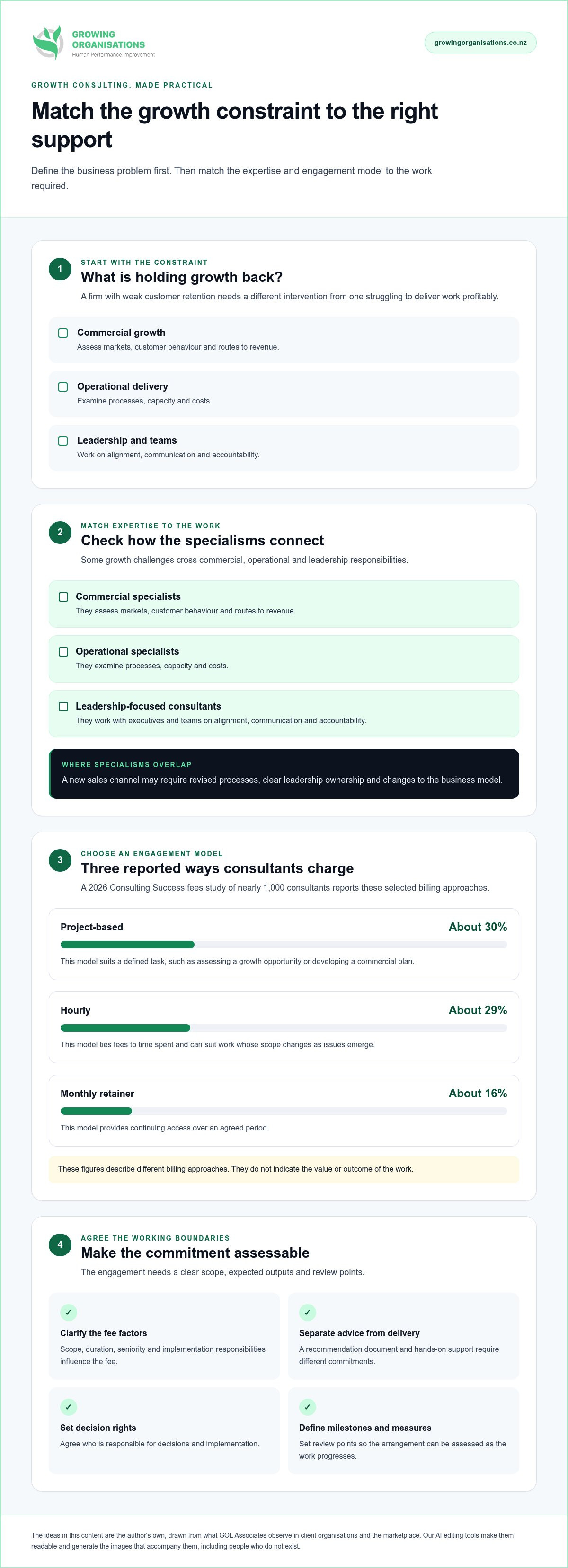
Growth consultants work across commercial strategy, operations, customer growth and organisational development. The right specialism depends on the constraint facing the business. A firm with weak customer retention needs a different intervention from one struggling to deliver work profitably. Define the business problem first, then match the expertise and engagement model to it.
Commercial specialists assess markets, customer behaviour and routes to revenue. Operational specialists examine processes, capacity and costs. Leadership-focused consultants work with executives and teams on alignment, communication and accountability. These areas can overlap. A new sales channel, for example, may require revised processes, clear leadership ownership and changes to the business model.
Business model innovation tests whether an organisation creates and captures value effectively. A consultant might help a manufacturer assess a service-based offer alongside product sales. The work could include examining customer demand, delivery requirements and commercial viability. Success depends on whether the company can make the new model work in practice, not simply on the appeal of the idea.
Engagement models define how the work is scoped and paid for. A 2026 Consulting Success fees study of nearly 1,000 consultants reports that about 30 percent charge by project, about 29 percent by the hour, and about 16 percent on a monthly retainer. These figures describe different billing approaches, not the value or outcome of the work.
A project-based engagement suits a defined task, such as assessing a growth opportunity or developing a commercial plan. Hourly billing ties fees to time spent and can suit work whose scope changes as issues emerge. A retainer provides continuing access over an agreed period. Each model needs a clear scope, expected outputs and review points.
The price of a consultancy engagement depends on the case and is provided after a quote request. Scope, duration, seniority and implementation responsibilities influence the fee. Boards should distinguish advice from delivery: a recommendation document and hands-on support require different commitments. Agreeing decision rights, milestones and measures upfront makes the arrangement easier to assess.
Choose an engagement that fits the decision ahead. If leaders need to discover whether a new route to market is viable, a tightly scoped assessment may be appropriate. If execution requires coordinated development across teams, ongoing support may fit better. A growth strategy and implementation approach connects commercial priorities with the work required to put them into practice.
Support for businesses at different stages of maturity
Growth support should match the organisation’s stage, leadership capacity and immediate commercial challenges. A business building its first repeatable sales process needs different guidance from an established company managing complex operations. The useful question is not simply how large the business is, but what currently limits its ability to grow.
A company turning over £500,000 faces different pressures from one turning over £5 million. At the lower turnover, leaders may need to make sales activity more consistent and clarify who owns delivery. At the higher turnover, the challenge may involve coordination across teams, management capacity or maintaining profitability as operations expand. Turnover alone does not identify the constraint, but it helps frame the discussion.
For an early-stage business, a consultant can help founders focus on a viable offer, customer demand and the basic processes needed to serve buyers. During expansion, the emphasis may shift to management roles, operational capacity and clearer accountability. For a mature organisation, support may focus on transformation, new growth opportunities or a stalled strategy. Each stage calls for different priorities, not a standard package of advice.
Mentorship and ongoing support can help leaders apply decisions as daily challenges arise. A consultant may work with an executive team to review progress, test assumptions and address obstacles to delivery. If a planned expansion is delayed by unclear team responsibilities, for example, leadership guidance can clarify ownership and reconnect decisions to agreed priorities.
UK SMEs working with coaching-led consultants commonly experience improved profitability and clearer team accountability within six to twelve months. Those outcomes depend on applying guidance within the organisation. Mentorship is most useful when leaders bring current decisions and practical challenges, then turn discussion into specific actions. It should strengthen the team’s ability to lead, not make the consultant a permanent decision-maker.
Ongoing transformation support helps organisations manage connected changes rather than treating each initiative in isolation. A business introducing a new service, for instance, may need to align customer communication, delivery processes and management responsibilities. Regular reviews help leaders identify where the change is working, where operations are under strain and what needs adjusting.
At every stage, define the current constraint, agree who owns the response and review evidence of progress. This gives the board a practical basis for deciding whether to continue, adjust or stop an initiative. The level of guidance should change as the organisation’s challenges and ability to execute change develop.
Role and expertise of business growth consultants
Growth consultants bring analysis, advice and practical support to commercial decisions. Their contribution should be useful insight, not simply another report.
Business Expertise and Industry Knowledge
Business expertise combines commercial judgement with knowledge of how a particular market operates. A competitive strategy needs to reflect real customer behaviour, operating conditions and company capabilities. A consultant assessing expansion for a Scottish manufacturer, for example, should examine its customer base, delivery model and sector pressures. Industry knowledge helps frame the right questions, while objective analysis tests assumptions rather than treating past practice as proof.
Qualifications and Experience for UK Consultants
Relevant qualifications and experience provide a foundation for sound analysis, but their application to your business matters most. For UK growth advice, look for evidence of work on comparable commercial challenges, clear reasoning and an ability to translate recommendations into action. No single credential demonstrates fit for every assignment. Ask how the consultant would approach your specific decision and assess the quality of the answer.
Customer retention is another practical area of expertise. A consultant can analyse customer experience, communication and patterns in repeat business, then identify where relationships are weakening. If customers leave after a particular stage, for example, examine that interaction before changing the entire sales approach. Retaining customers can support revenue stability, while the findings may also reveal where the offer or service needs improvement.
For a business expanding across borders, employee experience and benefits affect its ability to attract and retain people. Consultants can help leaders consider how workforce expectations, team communication and operating practices differ across locations. A UK company opening an overseas office, for instance, needs to understand how its management approach will work with a distributed team. The aim is a coherent employee experience that accounts for local context.
Good advisory work also connects insight to execution. A consultant may help leaders assess market research, customer behaviour and potential partners, then translate the findings into commercial choices. If expansion depends on a new supplier or channel, the analysis should show how that relationship supports the business model. External expertise can address skill gaps, but leadership remains responsible for decisions, priorities and delivery.
Assess the work by how well it informs the decision at hand. A consultant reviewing customer retention should show how evidence leads to action. Someone supporting expansion should explain the commercial assumptions and operational implications. These standards help boards distinguish relevant expertise from general commentary and keep advisory work focused on measurable business needs.
Business consultancy and organisational performance
Business consultancy is important when growth decisions affect the whole organisation’s performance. Revenue can rise while delivery costs, delays or customer losses weaken the result. A useful assessment connects commercial outcomes with the operational and leadership choices behind them. The board needs to understand not only what changed, but which decisions shaped that change.
A Harvard Business Review study found that 87 percent of the large companies it tracked stalled at least once. A stall is a signal to examine more than market conditions. Leaders can review internal priorities, decision-making, customer value and execution capacity to locate the constraint. That wider view helps distinguish a temporary setback from a performance issue requiring strategic change.
The same Harvard Business Review study found that external factors accounted for 13 percent of the causes of growth stalls. That finding puts organisational performance in focus. If most causes sit within the business, leaders should examine how strategy is communicated, how teams coordinate and whether responsibilities support delivery. Those factors shape how effectively the organisation responds to pressure.
Performance measures should connect decisions to outcomes. Revenue and profitability are important, but they do not show the full picture on their own. A board can also track customer retention, delivery reliability and progress against project milestones. If revenue rises while customer complaints and delays increase, growth may be outpacing the organisation’s ability to serve customers well.
Consultancy can help leaders identify where performance breaks down. Consider a project that repeatedly misses delivery dates. Review handovers, approval points, staffing capacity and customer requirements before prescribing a solution. This connects an operational symptom to its causes and gives managers a specific basis for changing the work, rather than adding another target without resolving the obstacle.
Sustainable performance depends on alignment between commercial choices and organisational capability. A business entering a new market, for example, must consider whether its teams, processes and partners can support the expansion. Consultants can help assess these connections and clarify the decisions leaders need to make. The executive team still owns the choices and the discipline needed to deliver them.
For boards, the practical test is whether advice improves decision quality and the organisation’s capacity to act. Define a business problem, agree what evidence to review and connect recommendations to accountable owners. This keeps consultancy focused on organisational performance, not activity for its own sake.
If growth priorities need to translate into measurable organisational action, explore business growth strategy and implementation.
Growing Organisations: Consultancy and Development
Growing Organisations helps leadership teams turn commercial priorities into practical action through Business Growth Strategy and implementation. Its Consultancy and Development supports organisations whose growth plans need clearer direction, stronger alignment or hands-on progress across the business.
For a board or executive team facing stalled growth, competing priorities or difficulty translating strategy into delivery, the work can focus on identifying the core constraint and shaping a response the business can execute. The emphasis is on connecting growth decisions with implementation, rather than leaving leaders with recommendations alone.
If your team needs support moving from growth strategy to action, contact Growing Organisations to discuss your priorities.
Make the Next Growth Decision Count
The next step is to identify the decision your leadership team needs to make and what is preventing action. Be specific about the outcome you need, who must own it and what evidence will show progress. This gives an advisory conversation a useful starting point.
Business growth implementation consultants can help turn that starting point into focused work with clear leadership accountability. The value comes from addressing the issue that matters now, rather than commissioning advice without a defined purpose. For your board or executive team, a candid discussion can clarify whether the priority is direction, alignment or execution.
Growing Organisations works with leadership teams on business growth strategy and implementation. If your organisation is ready to address a growth challenge, contact Growing Organisations to discuss growth.
Clear decisions make deliberate progress possible. Start with the decision your leadership team needs to make.
Frequently Asked Questions
What does a growth implementation consultant do?
A growth implementation consultant helps leadership teams turn commercial priorities into action. They can analyse performance, identify barriers and support decisions about what to change. A Scottish firm experiencing uneven demand, for example, might examine customer patterns and delivery capacity before adjusting its sales approach. The consultant connects analysis with execution, while company leaders remain responsible for decisions and outcomes.
What services do business growth implementation consultants offer?
Services can include growth strategy, operational reviews, organisational development and implementation support. The work may focus on one issue, such as customer retention, or coordinate changes across the organisation. Growing Organisations provides Consultancy and Development, alongside Business Growth Strategy and implementation. Its work helps leadership teams identify commercial opportunities and put practical growth initiatives into operation.
How much do business growth consultants charge in the UK?
The price depends on the case and is provided after a quote request. Costs are influenced by the scope of work, time required, seniority of the people involved and whether the engagement includes implementation support. A defined assessment differs from continuing advisory work. Before proceeding, agree what the work covers, what it will produce and how progress will be reviewed.
How do I choose a business growth implementation consultant in the UK?
Choose based on the business problem and the consultant’s ability to address it. Set out the decision you need to make, then assess how the proposed work would produce relevant evidence and practical action. For a Scottish company considering expansion, that could mean examining customer demand alongside delivery capacity. Clarify who owns decisions, what implementation support includes and how progress will be assessed.
How do implementation consultants measure business growth and ROI?
Measure performance against agreed objectives and the resources used to pursue them. A company entering a new sales channel might track revenue from that channel, customer retention and the delivery effort involved. Compare results with the starting position and review them at agreed intervals. If activity increases but commercial results do not, leaders can investigate their assumptions or change approach.
What steps do consultants use to create and implement a business growth strategy?
A useful process begins by clarifying the commercial objective and reviewing evidence about the business. The consultant then helps leadership assess opportunities, choose priorities and define ownership. Translate each priority into actions, milestones and measures. During implementation, review progress with the people responsible, address delivery obstacles and adjust decisions when evidence changes. For a Scottish business, local customer demand and operational capacity should inform the plan.
What risks should UK businesses consider when hiring a growth consultant?
Key risks include an unclear scope, recommendations that exceed the organisation’s capacity and weak ownership after advisory work ends. A strategy can also rely on assumptions unsupported by customer or performance evidence. Define the business issue, expected outputs, decision responsibilities and review points before work begins. Keep leadership involved throughout so managers can challenge assumptions and integrate agreed changes into normal operations.
Which UK business growth consultancies have strong reviews and case studies?
Growing Organisations provides Consultancy and Development, as well as Business Growth Strategy and implementation, for leadership teams working on commercial growth. Assess reviews and case studies for relevance to your organisation, not simply their volume or praise. Look for a clear starting challenge, the work undertaken and the evidence used to describe the outcome. This helps Scottish businesses judge whether an example reflects their needs.
[The ideas in this content are the author’s own, based on what GOL Associates observe in client organisations and the marketplace. AI editing tools help make the content readable and generate accompanying images, including depictions of fictional people.]