Growth can expose weaknesses that day-to-day work has concealed.
Effective organisational change for growth starts with a clear vision, practical objectives and candid communication. Involve people in shaping new ways of working, then support them through implementation and review.
Growth means more than adding customers or expanding operations. Roles, processes and expectations must change as well. If leadership and workplace culture do not keep pace, even a sound change can feel imposed and prompt resistance.
I call this qualitative growth, when the business and the team that operates it both improve intentionally.
This article explains how to manage operational change, improve efficiency and adaptability, and address resistance as a signal to investigate, not simply a people problem. It examines how culture affects whether new ways of working take hold, what leaders need to clarify, where employee involvement helps, and how ongoing learning supports lasting change.
Key Takeaways
- Set a clear vision and objectives before changing how work gets done. Give people a meaningful role in shaping implementation.
- Identify the internal and external pressures driving change, then distinguish immediate operational needs from deeper organisational issues.
- Build adaptability through learning, practical support and clear accountability, not process changes alone.
- Treat resistance as useful information about capability, workload, trust or culture. Address its cause rather than simply pushing harder.
- Connect new ways of working to the culture you want to sustain, and reinforce progress through follow-through and continuous improvement.
How to effectively manage operational changes during growth phases?
Growth changes the demands on people, processes and decision-making. Treat operational change as a planned part of the growth strategy, with clear ownership and measures.
Change management phases during growth
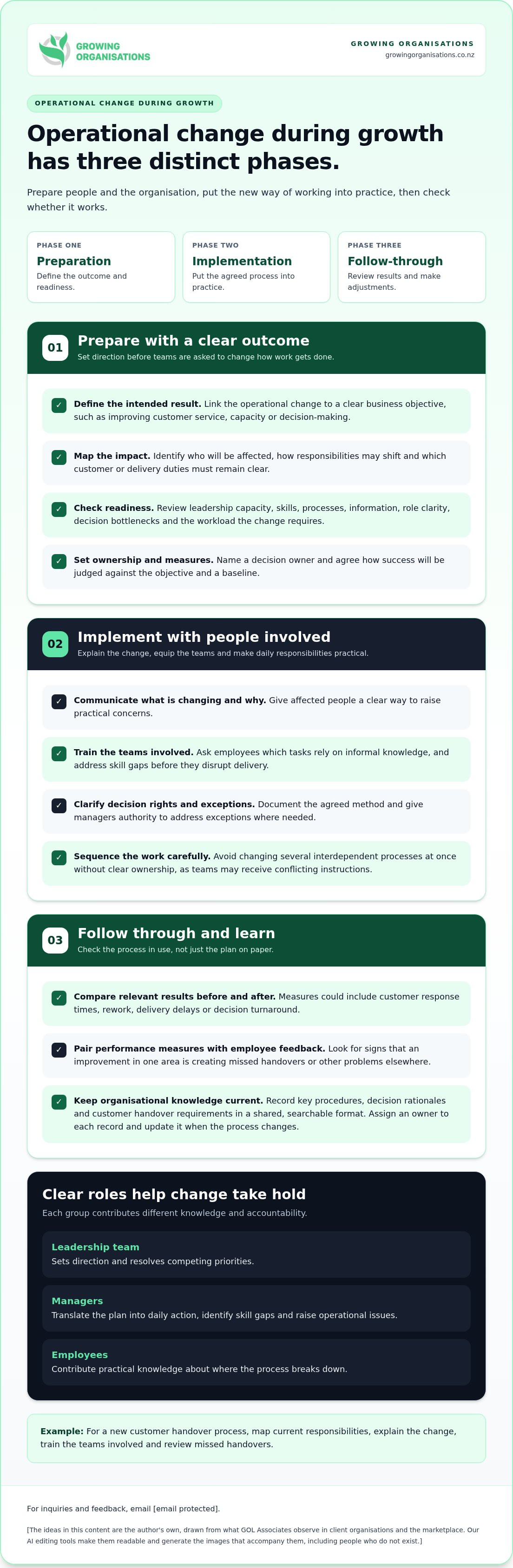
Organisational change management is a structured, people-centred process that prepares, equips and supports employees to adopt new ways of working. It has three phases: preparation, implementation and follow-through. During growth, preparation defines the intended outcome and who will be affected; implementation puts the new process into practice; follow-through checks whether it works. Treating these as distinct phases helps leaders address problems before they become routine.
For example, a growing business introducing a customer handover process can map current responsibilities, explain the change, train the teams involved and review missed handovers. The leadership team sets direction and resolves competing priorities. Managers translate the plan into daily action, identify skill gaps and raise operational issues. Employees contribute practical knowledge about where the process breaks down.
Strategies aligned with growth goals
A growth-aligned strategy links each operational change to a defined business objective. A change that adds complexity without improving customer service, capacity or decision-making consumes attention without advancing growth. Set the intended outcome first, assign a decision owner and agree how teams will know the change is working. Sequence the work so that essential customer and delivery responsibilities remain clear.
Choose measures that reflect the intended result. If the aim is faster customer responses, track response times alongside workload and unresolved enquiries. If you are standardising a process, document the agreed method and give managers authority to address exceptions. Avoid changing several interdependent processes at once without clear ownership. Otherwise, staff may receive conflicting instructions, and leaders may struggle to identify the cause of disruption.
Readiness assessment and change success
A readiness assessment tests whether the organisation has the leadership capacity, skills, processes and information needed to deliver its growth plan. Review current performance, role clarity, decision bottlenecks and the workload the proposed change requires. Ask managers where capability is limited and employees which tasks rely on informal knowledge. This gives leaders a practical view of what to address before implementation.
Measure success against a baseline and the objective set during preparation. Compare relevant results before and after implementation, such as customer response times, rework, delivery delays or decision turnaround. Pair performance measures with feedback from employees using the changed process. If one measure improves while handovers are missed elsewhere, the design needs attention; the change is not complete.
Knowledge management protects organisational memory as roles and teams expand. Record key procedures, decision rationales and customer handover requirements in a shared, searchable format. Assign an owner to each record and update it when the process changes. For example, documenting how an unusual customer issue was resolved helps a new team member apply that learning without relying on an experienced employee’s memory.
Restructuring must comply with the employment laws and agreements that apply to the organisation. Rapid operational change can also create unclear responsibilities, lost knowledge, overloaded managers and disrupted service. Identify affected roles early, explain what is changing and why, and give employees a clear way to raise practical concerns. This helps leaders manage delivery risk and the impact on people.
What Causes Organisational Change?
Organisational change begins when existing ways of working no longer fit the organisation’s goals or conditions. External pressure can come from market shifts, changing customer demand, competition or technology. Internal pressure may arise when processes constrain delivery, responsibilities overlap or leadership sets a new direction. The trigger determines what must change, who is affected and how success should be judged.
Growth itself can prompt transformation. Expansion into new markets may increase customers and revenue streams while exposing gaps in capacity, coordination and decision-making. A business may need clearer accountability as teams take on new work. Leaders should distinguish the growth objective from the operational changes needed to support it. Otherwise, the organisation risks adding complexity without addressing the constraint behind the change.
Some changes are deliberate responses to external conditions. Market fluctuations can prompt a business to reassess its offer, priorities or operating model. Technological advances can alter customer expectations or make existing processes less effective. Management should identify the specific pressure, assess its commercial effect and decide whether it calls for a limited adjustment or wider transformation. A change plan should connect that diagnosis to clear ownership and communication.
Internal drivers can be just as consequential. A new strategy may require different skills, stronger coordination or a shift in workplace culture. Culture change can reinforce other changes by improving coherence and supporting innovation. For example, a business introducing new approval processes may also need leaders to clarify which decisions teams can make independently. Without that shift in behaviour, the new process may add steps without improving execution.
Digital transformation makes the connection between technology and operating practice especially visible. Organisations may introduce enterprise systems to standardise processes, integrate data, improve inventory management or increase flexibility and productivity. These systems typically pass through three stages: stabilising after go-live, improving decision-making, then aligning the system with business strategy. Installing software is only part of the work. Teams must also understand how the system changes decisions, responsibilities and information flows.
Large-scale examples show why structural choices matter. Gannett had 100 business units reporting to its senior team. It announced in August 2014 that it would split its publishing business from its faster-growing digital and broadcasting businesses. Earlier, its market capitalisation more than doubled in the two and a half years after it announced a growth strategy in February 2012. That timing does not prove the strategy caused the increase, but it shows how growth plans can prompt major organisational decisions.
Transformation needs disciplined judgement, not a reaction to every new pressure. Identify the driver, define the intended business outcome, then decide what must change in structure, capability, technology or culture. Leadership teams assessing that connection can explore a business growth strategy as part of the decision.
Organisational efficiency and adaptability
Efficiency means delivering the intended result with less friction, delay or duplicated effort. Adaptability means adjusting work as conditions, priorities and customer needs change. Both are important at every stage of organisational development. A start-up focuses on a viable product or service and initial customers. During growth, operations and market presence expand. At maturity, operations stabilise, processes are optimised and profitability is sustained. Match operating practices to current demands, rather than preserving arrangements built for an earlier stage.
Start by identifying where work stalls. Map a customer request from first contact through delivery, then mark repeated approvals, handover gaps and rework. Ask the employees doing each task what causes delays. Compare their observations with customer feedback and delivery records. This gives leaders a sound basis for deciding whether to simplify a process, clarify ownership or build capability. Efficiency is not simply about reducing steps. Removing a necessary quality check, for example, can create errors that take longer to resolve.
Adaptability depends on whether teams can learn and respond while keeping agreed outcomes in view. Give managers clear authority to resolve routine issues and define which decisions need executive input. If customer demand shifts, a team might adjust scheduling or redistribute work, then report the effect on service and workload. This keeps stakeholders informed while giving employees room to use their judgement. Leaders should review the result before making the adjustment standard practice.
Innovation also depends on the organisation’s capacity to absorb new skills and ideas. A new service, market or operating model may require different expertise and revised responsibilities. If capability does not keep pace with expectations, employees can struggle to meet changing demands. Identify the skills the growth plan requires, then link development to actual work. For example, a team adopting a new customer process can practise with realistic scenarios and discuss where the process needs refinement.
A global insurer created role charters for more than 1,000 employees during its transformation. Role clarity can help employees understand their contribution and show leaders where accountability overlaps. In a growing organisation, review responsibilities when teams expand or work moves between functions. A charter should explain the role’s purpose, key decisions and working relationships. It should also leave space for collaboration, rather than turning boundaries into barriers.
Keep improvement grounded by reviewing a small set of measures linked to the intended outcome. A business improving order fulfilment could monitor delays, rework and customer complaints together. If one measure improves while another worsens, investigate the trade-off before declaring success. Invite employees and relevant stakeholders to explain what the results do not capture. Combining operational evidence with frontline knowledge helps leaders distinguish lasting improvement from a short-term shift.
Organisations that fail to innovate and adapt to market changes can stagnate or decline. Build regular reviews into management routines: test whether current processes still support the strategy, capture lessons from changes and adjust priorities as conditions shift. This discipline helps preserve efficiency without making the organisation rigid. Adaptability is not constant restructuring. It is the ability to make informed changes while keeping people focused on important work.
Resistance to organisational change
Resistance reflects what employees believe a change will cost them, disrupt or demand. During growth, new roles, processes and expectations can unsettle established working relationships. A team asked to adopt a new customer handover may be concerned about extra workload or unclear accountability. Treat those concerns as information about implementation, not automatic opposition to progress.
Resistance can also point to a capability gap. If a business changes its systems or service model without building the required skills, employees may avoid unfamiliar tasks or fall back on old routines. Gaps in mindset, skills and organisational capability can contribute to resistance. Leaders need to distinguish unwillingness from uncertainty, insufficient training or processes that make the new approach harder to use.
Start with evidence from the work itself. If staff keep using an old form after a process changes, find out whether the replacement is accessible and responsibilities are clear. If managers give conflicting instructions, clarify who owns the decision. If employees raise the same concern in different meetings, record it, identify its cause and report what action follows. This makes resistance specific and addressable.
Communicate directly during implementation. Explain what is changing, why the business is doing it and what employees need to do differently. Be clear about what remains undecided, then provide updates when decisions are made. For example, a team restructuring can leave people uncertain about reporting lines. A manager should explain the proposed structure, how work will be allocated and where employees can raise questions.
Involve employees in shaping how a change works in practice. Ask the people handling customer enquiries to test a revised handover before it becomes standard. Their feedback can reveal missing information, duplicated effort or impractical timing. Leaders remain accountable for the decision, but employee participation helps surface operational problems early and gives people influence over details that affect their daily work.
Support must continue after a change is introduced. A single briefing cannot build confidence in a new task or resolve every problem. Provide relevant training, make managers available to coach employees and review how the process performs. If questions keep recurring, update the guidance or provide further practice. Recognise useful contributions and milestones so teams can see which behaviours support the intended outcome.
Watch for change fatigue when successive initiatives create activity without lasting improvement. Employees may disengage if each change adds work but fails to resolve the original problem. Before launching another initiative, review what previous changes achieved, what remains incomplete and what should stop. This holds leadership accountable for results, not announcements, and protects capacity for changes that matter.
Growth can strengthen resilience and openness to change when employees understand its purpose and have support to adapt. If resistance persists, revisit the business case, workload, leadership consistency and available skills. The answer may be to adjust implementation, build capability or explain the decision more clearly. Forcing adoption without identifying the cause can deepen distrust and leave the change ineffective.
Workplace culture and organisational growth
Culture is the pattern of decisions and behaviours people see repeated at work. A stated value of collaboration means little if managers reward only individual results. As an organisation grows, leaders need to test whether daily behaviour supports the objectives behind expansion. Look at how teams share information, resolve trade-offs and respond when delivery pressures rise. Those actions reveal culture more clearly than a values statement.
Culture shapes whether operational changes work together. A revised customer process, for example, will struggle if one team protects its own targets at the expense of a customer handover. Leaders can improve coherence by aligning team objectives, decision rights and performance discussions around the full customer journey. This can also create room for innovation, as employees can raise improvements without undermining shared priorities.
Use specific examples to assess the gap between intended and actual culture. Review how a recent customer complaint was handled, who made the decision and whether teams shared what they learned. Compare that response with the behaviours leaders expect. If staff waited for several approvals despite being asked to act independently, the issue may lie in decision habits, not employee motivation. Adjust management routines to reinforce the behaviour the strategy requires.
Culture should not mean hiring or promoting people who all think alike. In mature organisations or volatile environments, less emphasis on person-organisation fit may support innovation. Leaders can maintain shared standards while welcoming different experience and perspectives. For example, a product review can include operational, customer-facing and technical viewpoints, with clear criteria for choosing between competing proposals.
Growth can also connect business objectives with employees’ personal development. Some large companies make that connection part of their recruitment strategies. Leaders can apply the principle internally by linking a new responsibility to relevant learning and a clear business need. If a team member takes on a broader customer relationship role, agree which decisions they own and which skills they need to build. Development then supports capacity instead of sitting apart from the work.
New processes, team structures or technologies can feel forced when leaders ignore culture. A restructure may redraw reporting lines but leave old decision patterns untouched. A new system may change where information sits without changing how teams share it. Such changes risk feeling disconnected and unsustainable. If they produce no lasting improvement, repeated initiatives can create change fatigue. Leaders need to address underlying habits and leadership capacity, not just visible changes.
Make culture part of the growth plan, not a separate values exercise. Set objectives for the behaviours that enable the strategy, identify where current routines conflict, then assign leaders to model and reinforce the needed shifts. Review evidence from customer interactions, team decisions and improvement ideas. If your leadership team needs to align culture with its growth priorities, discuss your growth strategy.
Growing Organisations: Consultancy, Advisory, and Development
Growing Organisations supports leaders who need to turn growth plans into coordinated action. Its Consultancy and Development and Business Growth Strategy and implementation support can help clarify priorities, align operational changes with commercial objectives and maintain momentum through delivery.
Turn to this support when growth exposes gaps in leadership capacity, decision-making or execution. Executive Performance Coaching can support leaders working through these demands, while a Fractional CEO or MD can provide senior leadership capacity when the organisation needs it. The right focus depends on the challenge and the work required.
For an open discussion about your organisation’s growth and change priorities, contact Growing Organisations by email.
Make the next change serve the business
Choose one growth priority and test whether your organisation can execute it. Identify the decision that needs to change, the people accountable for acting and the evidence that will show progress. Then keep leadership attention on whether the new approach is improving the business, not simply whether it has been introduced. This gives organisational change for growth a clear commercial purpose.
If the strategy is clear but execution is not, Growing Organisations can help leaders turn priorities into practical action. Its Consultancy and Development, Business Growth Strategy and implementation support, and Executive Performance Coaching address different needs, from shaping the plan to strengthening leadership execution.
Discuss your organisation’s priorities with Growing Organisations. A focused conversation can help you decide what deserves attention next and move forward with purpose.
Frequently Asked Questions
How can organisations efficiently manage their growth strategies?
Manage growth by ranking initiatives according to their commercial value and the organisation’s capacity to deliver them. For example, if expansion depends on retaining existing customers, prioritise retention improvements before entering a new market. Assign an executive owner to each priority and review progress against agreed indicators. Stop or revise work that no longer supports the strategy, so people and resources stay focused on decisions with a sound business case.
How does rapid growth impact organisational structure?
Rapid growth can make informal reporting and decision-making unreliable. A founder who once approved every customer exception may become a bottleneck as teams and workloads expand. Clarify which decisions belong with team leaders, which require executive input and how issues move between functions. Review these arrangements when responsibilities change. The aim is not to add management layers automatically, but to keep accountability clear as workload and working relationships become more complex.
What are the key factors that drive organisational growth?
Growth depends on a clear customer need, an offer that meets it and the organisation’s ability to deliver consistently. Market shifts, technology and competition can create opportunities or pressure for action. Internal capability also counts: a business may have demand but lack the sales capacity, delivery process or leadership focus to convert it. Examine customer behaviour, commercial performance and operational constraints together before deciding which opportunity warrants investment.
What strategies can be implemented to address challenges in growth stages?
Match the response to the constraint. If customer demand exceeds delivery capacity, review the work sequence and remove avoidable delays before pursuing more sales. If decisions stall, set clear authority for routine choices. If new work exposes skill gaps, link learning to live tasks and manager feedback. Review each response against customer and operational outcomes. This helps leaders address the underlying issue instead of adding another initiative on top.
What does organisational change for growth mean?
Organisational change for growth means adjusting how the business operates so it can pursue its commercial direction effectively. It may involve revising responsibilities, decision rights, processes or leadership practices. For example, a business entering a new customer segment may need a different approach to sales handovers and service delivery. The change supports growth when it strengthens the organisation’s ability to meet demand, rather than simply altering its structure.
What organisational structures support business growth?
The right structure depends on where work and decisions need to sit. A functional structure can group expertise such as finance, operations and sales. A customer- or product-led structure can focus accountability around distinct markets or offers. Whichever arrangement leaders choose, define who owns revenue, delivery and cross-team decisions. A structure that fits the strategy makes collaboration easier; one built around historical reporting lines can leave important work without a clear owner.
What are the steps for planning and implementing organisational change?
Start by defining the business problem and the result the change must deliver. Map who and what will be affected, then assign decision ownership and identify capability needs. Set a baseline for relevant performance measures before implementation. Explain the impact, prepare the people doing the work and introduce the change with clear accountability. Afterwards, compare results with the baseline, gather employee feedback and adjust the approach where evidence shows a gap.
How should leaders communicate organisational change to employees?
Explain the reason for the change, the decisions already made and the practical implications for each team. Managers can discuss local work impacts, while executives provide a consistent account of the wider direction. For example, a revised approval process needs clear guidance on who can approve requests and where exceptions go. Make room for questions, record recurring concerns and close the loop by explaining what action followed.

Article by
Ross Wilson, MBA. Principal Advisor, Growing Organisations Ltd.
The moment before a hard call you need to make: this is where I do my best work. Maybe a business unit that's stopped performing; a sales team that plateaued two years ago and nobody's proud of it, or a culture that technically functions but has simply gone flat. Perhaps you "high performers" are strangely off their game. What do you do with these dilemmas?
These are the kinds of calls CEOs and boards bring me into, because by the time they call, they already know the comfortable options no longer work.
I've spent 30 years in advisory, most of it at CEO and Board level, across 35+ countries. I earned an Executive MBA degree from the University of Auckland which helps a little.
The point is, what happens now: businesses that were losing money find their margin again, teams that had stopped believing in targets start hitting them, and cultures people used to merely tolerate become ones they're proud to work in.
I don't do this alone. Growing Organisations is a niche team of professional advisors, by design, working globally, each with a specific field they've mastered and a track record that speaks for itself. What we work together and share a refusal to hand over a report and simply disappear. We stay, advise, support practically, coach if necessary, review, and redirect until the result is real and it's yours, not ours.