A plan can be delivered on time and still take an organisation in the wrong direction. That’s because leadership and management are not the same.
Leadership sets direction and builds commitment, while management turns that direction into priorities, coordinated work, and delivered results. Strong performance depends on both.
Leadership chooses the right destination and acceptable proof; management chooses how to get there, including the necessary detours and "re-centring" along the way.
Most executives recognise the distinction in principle. The challenge is seeing where responsibilities blur in practice. A leader may set a clear aspiration but without disciplined management it can remain abstract. A manager may keep operations running smoothly, but without leadership the work can lose purpose, meaning, and adaptability.
Few people are only one thing; if they are one, they are also the other to some degree. That’s OK if the Leader-Manager knows the differences and makes conscious choices throughout the day on the basis of what is best for the business in the moment.
Personally, I am naturally wired as a leader but I have learned what a manager does and developed those skills. Leadership is instinctive, but I’m not the same leader I was 20 years ago. I’ve intentionally become a better leader over time.
Talking about leadership "style" is an attempt to make everyone feel good – especially non-leaders who, in that philosophy, could find a comfortable place somewhere in the spectrum of leadership styles.
Years ago, manager was the desired identity and the flavour of the month. Money was made by over-emphasising one over the other, meanwhile the truth is we need both in every endeavour of society.
Chances are the majority of people are neither a leader nor a manager. Sadly, however, societal pressure loads heavy burdens of expectation on people to be one or the other, with superstars being both, and causes considerable stress and self-doubt.
This article explains how leadership establishes vision, alignment and willingness to change, while management organises people and resources to deliver results. It also explores how both contribute to performance, where relying on one without the other creates friction, and how to identify which capability your organisation needs to strengthen for the foreseeable future. The distinction is practical: it helps clarify whether the next move is to set a better direction, improve execution, or both.
Key Takeaways
- Clarify the direction your organisation is pursuing, then translate it into priorities, ownership and follow-through.
- Look for gaps between strategic intent and day-to-day delivery; they can reveal whether the organisation needs clearer leadership, stronger management or both.
- Distinguish formal management responsibilities from leadership behaviours that can be demonstrated across teams.
- Match the response to the situation: operational stability calls for reliable coordination, while change calls for clear direction and commitment.
- Assess whether sales leadership is connecting the organisation’s growth direction with consistent commercial execution.
Vision and execution
A while ago, a large client struggled to engage staff in a slight change of direction. The growth initiative was on the verge of failing when they called us. When we investigated closely, we discovered that managers – who are normally sceptical about change (which shows up as a "wait & see" attitude of behaviours) – were being interpreted as intrinsically indifferent about the new changes as they had always been. The result? Staff were choosing not to commit to unbelievers.
If you don’t engage the leaders and managers equally, you’ll get nowhere and you could even blow up the business.
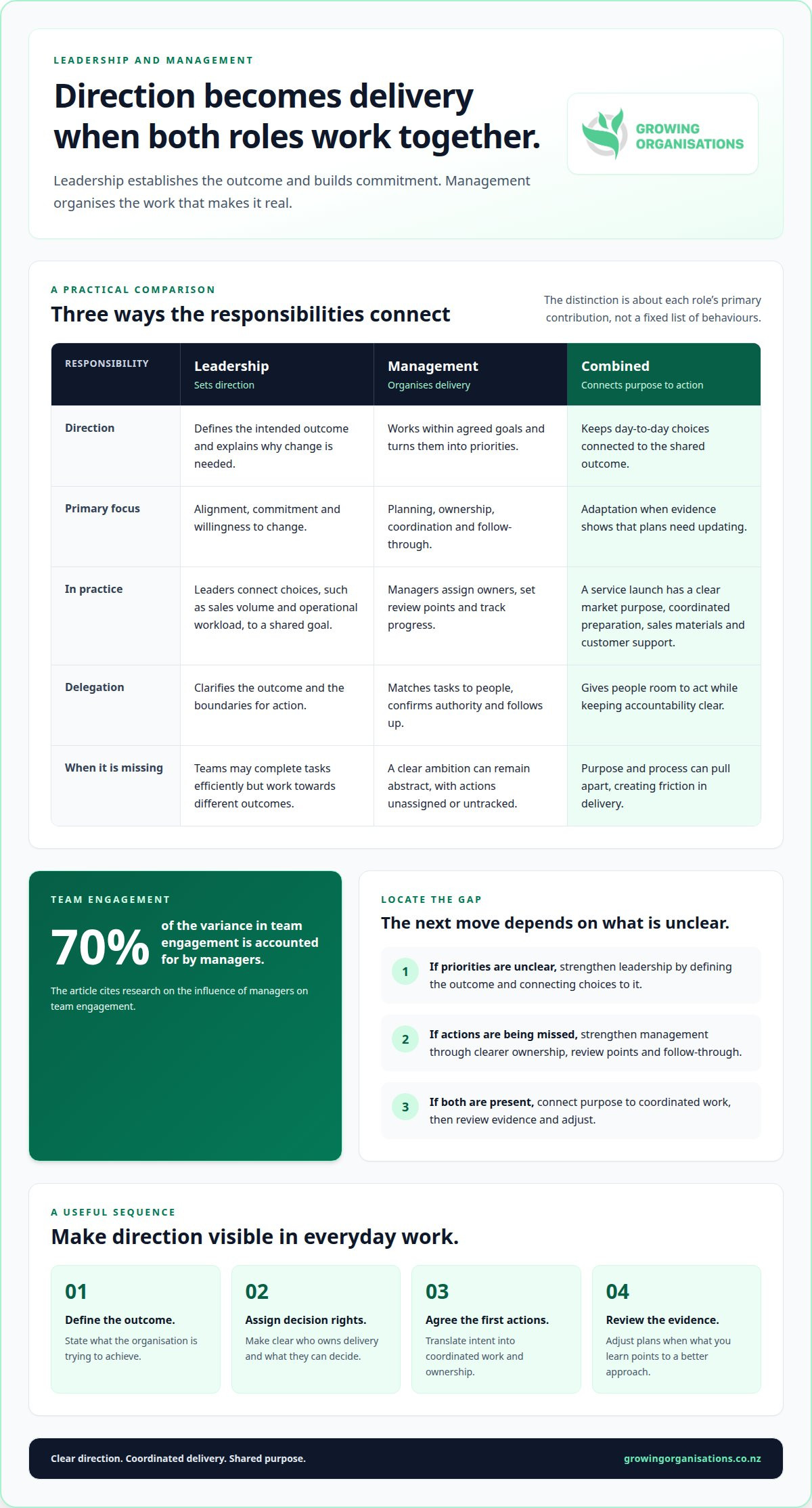
A vision gives people a reason to prioritise one outcome over another. For example, a business aiming to become easier to buy from must define what that means. Leadership might set the direction: remove avoidable friction for customers. Execution then turns that statement into changes to sales, service and delivery. Leadership and management are not the same, but each helps determine whether this outcome becomes real.
Without clear direction, teams can complete tasks efficiently while working towards different outcomes. A sales team might pursue volume while operations focuses on reducing error rates. Leaders connect those choices to a shared goal, a common denominator of both outcomes. They explain the trade-offs and build commitment to the decision. A vision needs to guide real choices, not just feature in a presentation.
Management makes the goal workable. A manager translates the direction into actions, assigns owners, sets review points and tracks progress. If the goal is a smoother buying process, the manager might map each customer handover, identify common errors and delays and agree who will resolve them. These steps turn intent into coordinated work.
Delegation links the two, when leaders and managers are honest about their role and responsibilities. Leaders clarify the outcome and boundaries; managers match tasks to people, confirm authority and follow up. For instance, a sales manager gives a team member responsibility, train and coach for performance, improve lead follow-up procedures and tools. A sales leader maintains the team’s focus on the right segment, product-mix, and gross profit margins. Management without clear outcomes creates busy-work. Leadership without clear articulation slows execution to a hesitant crawl.
| Option | Direction | Primary focus | Typical contribution |
|---|---|---|---|
| Leadership | Defines the intended outcome | Alignment and commitment | Explains why a change is needed |
| Management | Works within agreed goals | Planning and coordination | Assigns task owners and tracks delivery |
| Combined | Connects purpose to action | Adaptation and follow-through | Updates plans when evidence changes |
Choose the emphasis by first locating the gap: unclear priorities call for leadership, while missed actions call for tighter management.
Processes should support the goal, not become the goal. A manager can document a sales handover, clarify the information required and review where prospects stall. If the process adds steps without improving the customer experience, leaders should question it. Challenging familiar routines is a leadership quality; redesigning and embedding a better process requires management.
There is overlap. A manager may need to explain a difficult change and build confidence, while a leader must ensure someone owns delivery. Consider a new service launch: leadership sets its market purpose, and management coordinates preparation, sales materials and customer support. Leadership and management are not the same, yet both contribute through distinct responsibilities.
I have used the sales context here because it is in sales that we see the distinctions between leadership and management most clearly. But what is true for sales is true for every part of the business.
When vision remains abstract or ambiguous, execution lacks a clear test for priorities. When processes run without purpose, teams can protect routines that no longer serve the goal. A practical sequence is to define the outcome, assign decision rights, agree the first actions, then review evidence and adjust. This makes direction visible in everyday work.
Leadership and organisational performance
Leadership and management affect employee performance and engagement by shaping purpose, clarity and working conditions. Research indicates that managers account for most of the variance in team engagement. Leaders also influence whether people understand organisational priorities and feel able to contribute to them.
Formal authority comes from a position in the organisation’s structure. Someone with a "manager" tag can allocate work, set priorities and make decisions within assigned responsibilities. That authority helps coordinate action, but does not automatically create trust or commitment. For example, announcing a revised service target without explaining its basis may leave employees unsure how to respond.
Leadership can also come from employees without formal authority. Someone who notices recurring errors in a reporting process can raise the issue, gather colleagues’ perspectives and propose a practical improvement. They may not control the process, but can influence how others understand the problem and whether they help address it.
Organising people means connecting outcomes, roles and responsibilities, not simply placing names on a chart. A customer issue might involve service staff, a technical team and account managers. If each group follows different priorities, the response becomes fragmented. Managers clarify ownership and escalation routes; leaders establish the shared standard those groups are expected to meet.
Alignment also means addressing conflicting measures. A department rewarded for reducing handling time might close cases before resolving the underlying issue. Leaders make the broader customer outcome clear. Managers then organise measures and responsibilities around it, so local targets do not undermine organisational performance.
Developing people strengthens capability beyond immediate tasks. A manager can delegate a decision, explain its limits and review the result. A leader can encourage that person to consider how the decision affects other teams. Both approaches build judgement: one sets clear accountability, while the other broadens an employee’s influence and perspective.
A school offers a useful comparison. A principal may set a direction for student learning, while a department head organises teaching plans and resources. The roles can overlap when leaders review progress or managers motivate staff. The distinction lies in each role’s primary contribution, not a fixed list of behaviours.
Executives can diagnose performance problems by examining authority, priorities, coordination and initiative. If decisions wait for approval at every stage, decision rights may be unclear. If people understand their authority but avoid raising concerns, leaders may need to build trust and invite open discussion. The response should address the actual constraint.
When teams lack coordination, valuable time can be lost between responsibilities. When employees see problems but cannot influence decisions, opportunities to improve may go unaddressed. Identify where the gap sits, then strengthen the relevant leadership or management practice. This clarifies accountability and gives people a more direct contribution to organisational performance.
The Role of Human Resources, Especially Recruiters.
Recruiters will serve the company better as they become skilled at building role profiles starting from outcomes through to tasks, and screening for rightly qualified (competent) candidates. Claimed or perceived experience is a notorious deceiver; proof of competence is the ultimate arbiter. After that comes team-fit and cultural alignment. This is no more true and important than in the appointment of leaders and managers.
Leadership vs Management: What’s the difference?
Workplaces around the world now distinguish more clearly between leadership and management by their contribution, not simply their job titles. Quite simply, leaders influence direction and commitment; managers organise responsibilities and oversee delivery.
Leadership behaviours and responsibilities
Leaders help people understand the purpose behind a decision and build commitment to it. They listen, consider different perspectives, challenge outdated practices and encourage people to take responsibility beyond immediate tasks. A team member who instinctively brings colleagues together to address a recurring customer problem shows up as a leader.
The difference lies in the scope of influence. Leadership focuses on direction, relationships and developing organisational capability. It can involve emotional intelligence, resilience, emotional regulation, moral integrity, and the ability to make difficult choices. A manager may use these qualities too, but leadership is reflected in the influence and commitment created, not only in formal authority.
Managers’ roles and responsibilities
Managers plan work, allocate resources, delegate tasks, monitor operations and adjudicate performance. They make decisions within their responsibilities and the organisation’s rules. For example, a service manager might set a roster, coordinate customer handovers and address missed service standards. These actions give teams the structure to implement agreed plans, follow procedures, maintain psychological and physical safety, and achieve defined goals.
Management differs from leadership through its immediate focus on coordination and reliable delivery. Managers maintain processes, identify operational problems and act on performance information. Their mood can raise or lower staff motivation, but the role has specific accountability for the people, resources and results within its remit.
Effective leader and manager characteristics
An effective leader:
- Communicates clearly
- Builds trust and
- Enables people to raise concerns early.
These behaviours help a team discuss problems before they become entrenched. Leaders also connect present decisions with longer-term organisational purpose, particularly when change requires people to reconsider familiar ways of working.
Effective managers also:
- Set clear expectations
- Make sound decisions and
- Follow through on commitments.
They notice when workloads, resources or processes prevent delivery then address the constraint.
Leadership and management overlap in communication and problem-solving, but one builds shared direction while the other secures consistent action.
Developing leadership skills as a manager
Managers can develop leadership skills to a limited extent by explaining the purpose behind decisions, inviting challenge and listening carefully before acting. They can also influence beyond their own team by bringing colleagues together around a shared problem. These practices build trust and broaden a manager’s perspective beyond immediate operational delivery. Call that leadership if you wish.
Apply these ideas to a live issue. For example, ask a team to identify why customer handovers fail, then support them to propose and test improvements. Becoming a stronger leader does not mean abandoning management responsibilities. It means pairing clear execution with the ability to build commitment, develop others and question processes that obstruct organisational goals.
But the team may ask: "Why?" A Leader answers that comprehensively while standing on their head.
Differences between leadership and management that actually matter.
Workplace examples
Consider a business receiving repeated complaints about late orders. Leadership might bring sales and operations together, explain the customer impact and encourage them to investigate the causes. Management would map the order process, assign owners to each handover and track agreed improvements. One contribution frames the response; the other organises the work needed to deliver it.
A change to a sales approach offers another example. A leader explains its purpose and listens to concerns from the sales team. A manager updates the work plan, clarifies responsibilities and reviews progress. If staff understand the rationale but actions stall, the immediate gap is coordination and rests with the management. If teams follow instructions without understanding their purpose, morale will drop, and that rests with the leadership.
For executives, identify the gap before choosing a response. If people lack the signs of a sense of shared purpose, strengthen leadership behaviours. If they understand priorities but tasks stall, errors persist, or deadlines are missed, improve coordination and accountability. Where both problems exist, as often they do, address direction and delivery together. This distinction helps identify whether the organisation needs a change in judgement, working practices or both.
Summary: The key characteristics of effective leaders and managers
Effective leaders and managers combine sound judgement with clear communication, but apply those qualities differently.
A leader facing a proposed restructure, for example, explains its purpose and listens to concerns. A manager clarifies affected roles, coordinates the transition and maintains essential work. Each contribution is evident in how people understand decisions and act on them.
Trust is built through consistent behaviour, not slogans. A leader who invites difficult questions about a new direction shows that disagreement can be raised openly. A manager who responds fairly when a deadline is missed makes expectations and accountability credible. Together, these actions help create psychological safety, so people can identify problems before they damage delivery.
Effective leaders also pay attention to what employees say about their work. The European Commission describes leaders as listening to employees’ feelings and problems, seeking to understand them and helping them realise their goals. In practice, a leader hearing that a team lacks confidence with a new process can acknowledge the concern and establish support for learning.
For managers, reliability means making work manageable and decisions timely. Consider a production team whose equipment issue delays orders. A capable manager clarifies immediate priorities, allocates available resources and communicates changes to affected teams. They also follow the issue through, rather than assuming a decision alone has resolved the operational problem.
Both roles require clear communication, problem-solving and sound decision-making. The difference appears in the question each person leads with. A leader asks whether the current direction still serves the organisation’s purpose. A manager asks which people, resources and actions are needed to deliver the agreed work. Those questions prevent strategic review and operational control from becoming confused.
Adaptability is another shared quality, but it serves different needs. If customer expectations change, a leader considers whether the organisation’s approach remains relevant. A manager assesses the effect on workflows, capacity and staff responsibilities. During stable periods, managers sustain dependable operations. During change, leaders help people understand what is changing and why.
Executives can assess these qualities through specific behaviours, and this is where behavioural assessments prosper while personality assessments fail. In a project review, does the leader welcome evidence that challenges the plan? Does the manager identify an owner and a next action? A leader who listens but avoids setting direction leaves uncertainty. A manager who tracks tasks without questioning a failing approach preserves activity, not progress.
Build capability by reviewing an actual decision, such as a delayed product launch. Examine whether the team lacked a clear rationale, decision rights, resources or follow-through. Then address the gap directly. Better leadership develops trust and judgement; stronger management makes responsibilities and delivery dependable. Organisational performance relies on both, applied to the problem at hand.
Growing Organisations: Sales Leadership
Growing Organisations works with business leaders throughout a business. We do, however, have particular strength when working with those who need clearer alignment between commercial direction and sales execution.
Our Sales Leadership offering is relevant when sales activity is not translating into consistent results. Typically, a "Sales Manager" or "Sales Director" carries the combined weight of both leadership and management expectations, and herein lies the majority of performance issues in any salesforce.
Those familiar with Alec Baldwin‘s depiction of a typical sales manager in the movie, "Glengarry Glen Ross" (1992) will remember a manager who simply raises his voice and ferocity (somehow making him a leader?) while over-emphasising one step in the selling process – closing the deal. The character is clearly a manager and no amount of shouting and bullying can make him a leader.
We would only use that clip to illustrate HOW NOT TO DO IT!
Through Consultancy, Advisory, Development, Business Growth Strategy and Implementation Support, and Executive Performance Coaching, Growing Organisations helps address management and leadership challenges affecting performance. The focus is practical, to clarify what is holding results back, strengthen leadership and management capability and connect Executive decisions with effective implementation.
If your sales direction and daily execution are pulling apart, contact Growing Organisations at hello@growingorganisations.co.nz to discuss that or another situation with a Professional Advisor.
Make the distinction useful in your next decision
Recognising that leadership and management are not the same gives you a clearer way to diagnose what is holding performance back and a road map for fixing it. Apply that distinction to a live business priority. Are people unclear about the direction, or do they understand it but lack the ownership and coordination to deliver? The answer helps you decide where to focus, rather than adding another process or initiative as a silver bullet.
If you see a gap between the direction you intend and the results your organisation delivers, Contact Growing Organisations to discuss your needs. A considered conversation can help you clarify what needs attention and determine a useful next step for your business.
Frequently Asked Questions
What are a leader’s main responsibilities?
A leader’s main responsibilities include setting direction, explaining the reasoning behind significant choices and maintaining shared standards. For example, when an organisation considers withdrawing from a market, a leader frames the decision against its purpose and longer-term priorities. They make room for informed challenge, identify emerging leaders and take responsibility for difficult decisions. These actions help people understand what the organisation is working towards and why.
What is the difference between leadership and management?
Leadership concerns influence and direction; management concerns organising work and resources. Consider a business deciding whether to stop offering an unprofitable service. Leadership frames the strategic choice and its implications for customers and staff. Management assesses the operational steps, resource requirements and timing if the service ends. The distinction is about the contribution being made, not a person’s seniority. One executive may need to perform both functions.
How do leadership and management roles differ in organisations?
Leadership can operate across teams and levels, while management roles usually have defined responsibilities within an organisational structure. For instance, during a product quality issue, a manager may coordinate investigation and reporting within their function. A leader from another team could help colleagues raise concerns, share information and agree a wider response. The manager’s authority comes from assigned accountability; leadership influence can arise from initiative and trust.
Can someone be both a leader and a manager?
Perhaps, yes. A manager can learn to lead when they help people understand a difficult choice, invite useful challenge and build commitment. Naturally, though, they manage when they translate that choice into responsibilities, resources and follow-up. During a quarterly forecast review, for example, a manager might question assumptions about demand, then coordinate revised targets with teams. The balance depends on what the situation requires, and their real capabilities rather than on a separate title.
[The ideas in this content are the author’s own, drawn from what he and his colleagues observe every day in companies and the marketplace. Our AI editing tools make them more readable and generate the images that accompany them, including people who do not exist. Where repetition exists, it is not trimmed out because the sub-points around it are salient insights in themselves.]

Article by
Ross Wilson, MBA. Principal Advisor, Growing Organisations Ltd.
The moment before a hard call you need to make: this is where I do my best work. Maybe a business unit that's stopped performing; a sales team that plateaued two years ago and nobody's proud of it, or a culture that technically functions but has simply gone flat. Perhaps you "high performers" are strangely off their game. What do you do with these dilemmas?
These are the kinds of calls CEOs and boards bring me into, because by the time they call, they already know the comfortable options no longer work.
I've spent 30 years in advisory, most of it at CEO and Board level, across 35+ countries. I earned an Executive MBA degree from the University of Auckland which helps a little.
The point is, what happens now: businesses that were losing money find their margin again, teams that had stopped believing in targets start hitting them, and cultures people used to merely tolerate become ones they're proud to work in.
I don't do this alone. Growing Organisations is a niche team of professional advisors, by design, working globally, each with a specific field they've mastered and a track record that speaks for itself. What we work together and share a refusal to hand over a report and simply disappear. We stay, advise, support practically, coach if necessary, review, and redirect until the result is real and it's yours, not ours.