Organisational capability is an organisation’s collective ability to deliver its goals.
To build organisational capability, align people’s skills and behaviours with the strategy, then ensure systems and structures support goal-related work. Learning and performance measures help turn that alignment into consistent results.
Inevitably, due to the evolution of your market and your business, some of the skills of some of your people are now redundant; they are no longer required in the pursuit of your company’s updated purpose and goals. This is not a judgment of the person, only of the current relevance of certain competencies they bring to work. No doubt, in many cases, other competencies remain relevant and useful, and so, you will likely retain them on staff. However, if some necessary capabilities are absent from your company, then your business demands that you fill those gaps or risk the future of the whole business.
Filling those gaps may mean upskilling existing team members or hiring already-capable new players. Either way, you must effectively enable your business success. (Empowering the business is a different matter which I will return to in a future article.)
Most leadership teams recognise the value of skills. The harder question is whether the organisation can apply those skills to its priorities, adapt when conditions change and sustain performance beyond individual effort.
This article explains what organisational capabilities include, how an assessment can reveal strengths and gaps, and how to embed learning in day-to-day performance.
Many companies continue spending on training and coaching no-longer-critical competencies. When challenged about this, the Learning & Development unit within the People & Culture team look at me in consternation. They evidently wonder if I am questioning the value of their work.
And so, in this article, I will also explain how to connect capability development with business outcomes, so that leaders can direct effort where it will support the strategy.
Key Takeaways
- Connect the capabilities your organisation needs to its strategic priorities, including leadership, culture, innovation and talent.
- Compare current strengths with the capabilities required for future performance to pinpoint the gaps that matter. Update standing orders in the selection and hiring of new employees, and build and maintain evergreen training, coaching, and professional development of all staff, to ensure high performance throughout your company.
- Make learning part of day-to-day work, rather than an event or entitlement, then review whether new skills and behaviours are being applied.
- Choose performance measures that help teams act on commercial insight and adjust their approach to the expectations of those depending on them.
- Focus development effort where it can improve execution, productivity and business outcomes.
What are organisational capabilities?
Organisational capabilities are the combined abilities, behaviours and systems that help an organisation deliver its defined outcomes. They shape how senior leaders turn priorities into consistent work across teams and achieve consistent, high performance.
Examples of organisational capabilities
Culture, leadership, innovation, agility, process performance, mental toughness & resilience, and talent are distinct capabilities that influence how work gets done. A learning culture, for example, helps staff share lessons, while innovation capability helps teams test ideas and improve services. Agility helps an organisation adjust plans and processes as customer needs or market conditions shift. Talent capability brings together the skills, knowledge, mindset, and traits needed to deliver on priorities.
These capabilities are especially important when strategy depends on more than a plan. A business seeking to improve customer experience needs staff who understand customer needs, manage interpersonal relationships, define and resolve problems, and work collaboratively, along with managers who support sound decisions and systems that make feedback useful. A gap in any one area can weaken the overall result.
Leadership as an organisational capability
Leadership capability is the ability of leaders at every level to guide, enable and align teams with organisational values and strategy. It includes setting clear direction, making decisions, communicating priorities and addressing barriers to performance.
Consider a business introducing a new service. Senior leaders need to explain its commercial purpose, while team leaders translate it into daily decisions and coaching. Conflicting messages leave staff unsure how to act. Strong leadership capability helps teams work consistently and learn from delivery.
Capability development should account for employment practices, privacy and safe work. Training records, for example, contain personal information, while practical training needs to account for hazards associated with the work.
Leadership alignment and competitive advantage
Leadership alignment means senior leaders share a clear view of organisational priorities and reinforce them through decisions and resource choices. This gives teams a coherent basis for action and can support competitive advantage through reliable execution and faster responses to customer needs.
Management is the discipline of running the system that delivers today’s results: allocating resources, organising work, controlling performance against plan, and keeping operations predictable and efficient. This gives teams and individuals confidence that they are doing the right thing on time and with excellence.
Alignment is important when a strategic priority requires changed behaviour across functions. If leaders disagree about whether growth, service quality or cost control comes first, teams may receive competing targets. Agree the intended business outcome, identify the capabilities it requires, then assign ownership for developing them.
The price depends on the case and is provided after a quote request; key cost factors include scope, delivery format, specialist input and time away from work.
To build capability, clarify the strategy, identify the abilities it requires, assess current strengths and gaps, then prioritise learning and track how it is applied to ensure the gaps are closed. A capability framework can organise this work across people, processes, systems and leadership.
Common risks include unclear priorities, weak leadership support, abdication to the HR department, disconnected systems, and in turn, training that does not change work practices. A course alone, for example, will not close a skills gap if staff lack the time, authority or incentive to apply what they learn.
Capability models serve different purposes. A practical framework maps the abilities needed to deliver a company-wide strategy. David J. Teece’s dynamic capabilities model focuses on sensing opportunities and threats, seizing opportunities, and managing assets to sustain competitiveness. It explains how a firm integrates, builds, and reconfigures its internal and external competencies to address rapidly changing, uncertain environments
Government workforce support is generally organised through programmes with eligibility and delivery criteria. The big players in the financial services industry have traditionally followed intransigent methods of capability development that worked well last century.
Before incorporating an option into a capability plan, assess it against the skills required today and in the foreseeable future as well as the eligible learners, contemporary learning models, and learning format.
How does a capability assessment work?
A capability assessment compares what an organisation can do now with what its objectives will require. It turns strategy into criteria leaders can assess against evidence.
Assessing current and future capabilities
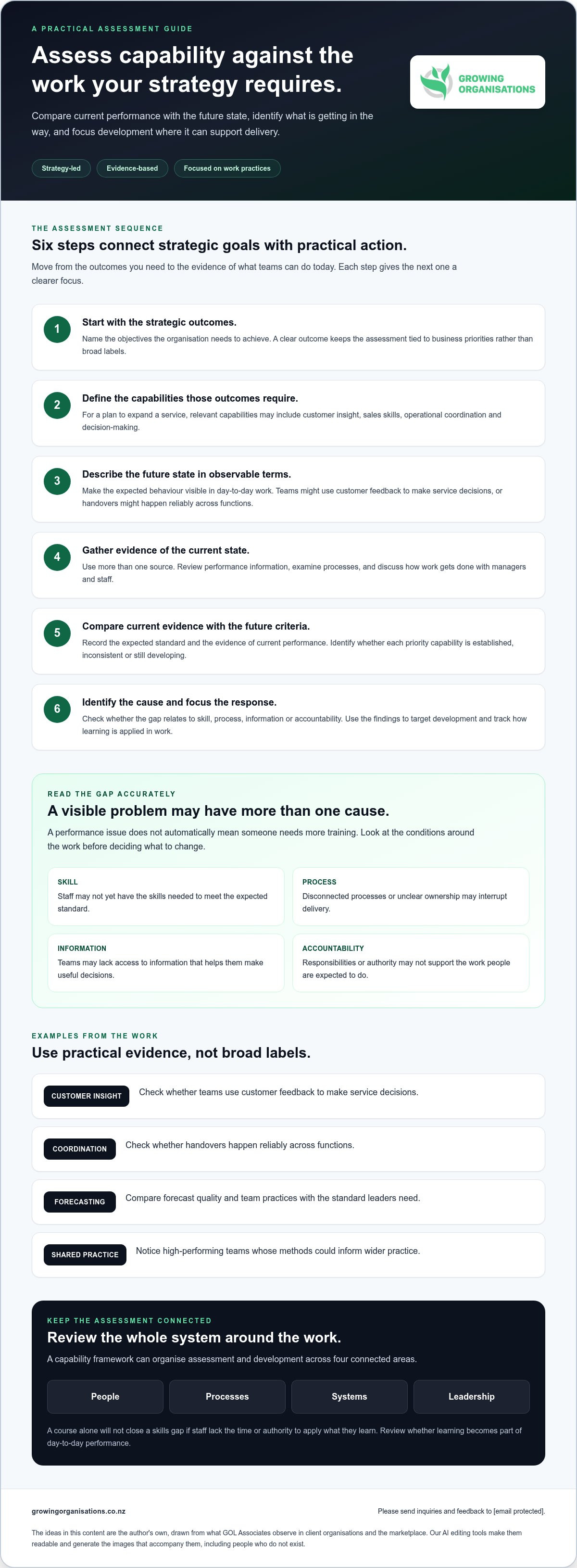
Start with the strategic outcomes, then define the capabilities needed to achieve them. A plan to expand a service, for example, may require stronger customer insight, sales skills, operational coordination and decision-making. Defining capabilities first gives the assessment a clear scope and keeps it tied to business objectives.
Next, describe the future state in observable terms. For customer insight, this might mean teams use customer feedback to make service decisions. For operational coordination, it might mean handovers happen reliably across functions. Clear descriptions help managers assess actual work rather than rely on broad labels such as “strong communication”.
Assess the current state using more than one source of evidence. Leaders can review performance information, examine processes and discuss how work gets done with managers and staff. Compare these findings with the future-state criteria to determine which capabilities are established, inconsistent or still developing.
Identifying capability gaps
A capability gap assessment identifies the difference between current performance and the capabilities required for future objectives. A visible performance problem can have several causes. Staff may lack skills, but unclear responsibilities, disconnected processes or limited access to useful information can also constrain delivery.
For each priority capability, record the expected standard, the evidence of current performance and the gap. If a strategy depends on consistent sales forecasting, for example, compare forecast quality and team practices with the standard leaders need. Then determine whether the main issue is skill, process, information or accountability.
Separate root causes from symptoms. Missed handovers might reflect unclear ownership rather than poor individual effort. A capability assessment can also identify high-performing teams whose methods could inform wider practice. This evidence helps leaders target development instead of prescribing the same training for everyone.
Prioritise gaps by their effect on strategic outcomes, not by how easy they are to discuss. A useful assessment produces focused decisions: which gaps require learning, which call for changes to systems or responsibilities, and who owns the response. It should also establish what evidence will show progress, such as improved consistency in a critical process.
Keep the assessment current as objectives or operating conditions change. A capability that supports today’s delivery may not be sufficient for a new service or market. Reassessing against revised requirements gives senior leaders a basis for adjusting development priorities and directing effort towards execution.
The success of your growth initiative depends on your careful selection of the right capability-building partner.
Definition of organisational capabilities
Organisational capability is the collective ability to deliver an organisation’s goals. It combines knowledge, skills, behaviours, systems and structures, rather than describing one person’s competence. Reliable customer service, for example, depends on staff judgement, useful information, clear processes and managers who support sound decisions.
Helfat and Peteraf (2003) highlight a foundational principle in strategic management: a true organisational capability cannot be a fluke or a lucky one-time accomplishment. Instead, it must be a highly reliable and repeatable pattern of activity that an organisation can perform systematically to achieve a desired outcome. The practical test is whether the organisation consistently turns resources into valuable outcomes.
For example, a sales team’s ability to turn customer insight into relevant offers in a fair and reasonable exchange of value is a capability. A strategy document alone is not.
Capabilities connect strategic intent to execution. A business pursuing growth through a new service needs more than technical expertise. It may also need customer research, pricing decisions, coordinated delivery and effective sales conversations. If one element is missing, the overall capability is weakened. Capability belongs to the organisation, not simply to a list of individual skills.
Dynamic capabilities describe how an organisation responds as conditions change. Michael Ehret of Walmart International is an authoritative voice on this theme.
In practice, a business might use customer feedback to spot a changing need, commit resources to a new offer, then adjust its people and processes to deliver it.
To define capability requirements, work backwards from strategic objectives. Set out the outcome, the work required and the conditions that enable it. For a faster customer response, requirements might include sound judgement, clear decision rights, accessible customer information and a workable handover process. This makes the requirements specific enough to guide investment and accountability.
- Outcome: State the result the strategy requires, such as retaining customers through better service.
- Work: Identify the activities that produce it, such as resolving issues and sharing feedback.
- Enablers: Specify the skills, behaviours, technology and processes those activities need.
- Evidence: Describe what effective performance looks like in actual work, not in a framework alone.
A capability framework organises requirements so leaders can see dependencies. It might group customer insight, service delivery and leadership decision-making, then show how each supports a strategic objective. The framework should clarify priorities, not become a catalogue of every possible skill. Michael Ehret recommends focusing on the two or three critical capabilities needed to deliver strategic priorities.
That focus also supports alignment. If the executive team prioritises growth but measures only cost reduction, teams receive conflicting signals. Define the capabilities that support the chosen direction, then align responsibilities, learning and performance measures with them. This gives leaders a clearer basis for deciding where to strengthen competitive advantage and where existing capability already supports delivery.
Embedding learning in performance management
Learning supports performance when people consistently apply new skills to priority work. Link development to strategic objectives, then review whether it changes delivery.
Workforce learning and feedback loops
Workforce learning develops individual skills, whilst organisational learning turns experience into shared improvements. Both are needed. A staff member may learn to identify recurring production defects, but the organisation also needs to use those patterns to improve work instructions.
Build a feedback loop into regular performance reviews. Teams can agree an objective, try a new approach, examine the result and adjust their next action. A team testing an updated quality check, for example, can review recurring defects and revise its shared process. Continuous learning can support productivity while people develop through their work.
Managers reinforce learning by discussing evidence, not attendance alone. Ask what changed in the work, where staff used the skill and what blocked its application. If a team completes training but still struggles with a process, the cause may be unclear responsibilities or limited access to information.
Development opportunities can also influence retention: 94% of employees say they are more likely to stay with their employer when given development opportunities. Treat learning as part of performance, not a separate event, and connect each activity to a work objective and follow-up discussion.
Choosing workforce learning approaches
Choose a proven learning format that suits the expertise and context required. One type of format serves knowledge transfer; another serves competency development, while performance coaching serves the consistent application of what’s already learned.
Internal training works for organisation-specific processes; external courses can provide structured subject learning or generic industry-related processes. The right consultants can help address complex capability or implementation challenges.
Leaders can build workforce skills by defining the required performance, selecting an appropriate learning approach and giving people opportunities to apply it. A course on customer analysis, for example, can be paired with a live review of customer feedback and a manager discussion about decisions taken.
Use internal training when experienced staff can teach a clear, repeatable method, such as a sales handover. Choose an external course when employees need knowledge or practice beyond the organisation’s existing expertise. Consider a consultant when the issue requires diagnosis, tailored development or support connecting learning with business execution.
Whichever approach you choose, set an application task before learning begins. A manager might ask a participant to use a new forecasting method in the next planning cycle, then review the result together. This makes learning visible in performance and helps distinguish a knowledge gap from a process barrier.
Connect development to objectives and existing strengths. If a team’s strength is customer knowledge, learning can help members use that insight in service decisions. If delivery is inconsistent, managers can identify the behaviour or process to reinforce, then check whether the change holds in day-to-day work.
Performance measurement and growth metrics
Capability measures are useful when they show whether an organisation can achieve its vision. Pair commercial outcomes with indicators of the work and decisions that produce them. Revenue alone may show the result, but not whether teams have the skills, information or structures to sustain it.
Start with the growth objective. If senior leaders want to improve profitability, they might track margin alongside pricing decisions, discount use and sales conversion. If the priority is customer retention, combine retention measures with service quality and the causes of repeat complaints. Each measure should help explain what is driving performance.
Use a small set of connected measures rather than a dashboard crowded with unrelated figures. For a new service, leaders could review customer uptake, delivery quality, sales feedback and the team’s ability to fulfil demand. Together, these measures show whether the organisation can deliver the offer effectively, not simply whether it has launched.
Make relevant commercial insight accessible to the teams able to act on it. Pricing dashboards, promotion return-on-investment analysis and customer behaviour data can inform decisions when staff can interpret them and have the authority to respond. A sales manager might use promotion results to adjust campaign focus, while senior leaders review whether the change supports the growth objective.
Separate leading indicators from outcome measures. A leading indicator shows an activity or condition that may influence a later result. The quality of sales conversations, for example, may affect conversion, while conversion records the commercial outcome. Reviewing both helps leaders identify whether the issue lies in the sales approach, the offer or the market response.
Set a review cadence that turns measures into decisions. At each review, compare results with the agreed objective, identify what changed and decide what action follows. If a pricing change improves conversion but reduces margin, the next decision may be to refine discount rules rather than expand the promotion.
Measurement can distort behaviour when teams are rewarded for one figure in isolation. A sales target focused only on volume may encourage deals that weaken margin or strain delivery. Balance measures, clarify decision rights and check whether incentives reinforce the wider vision.
Capability measures should test whether improvement holds in everyday work. If staff receive training in commercial analysis, leaders can review whether forecasts, pricing decisions or promotion choices improve. The aim is not to count learning activity, but to see whether teams use new capability to deliver better business results.
If your growth measures reveal a gap between ambition and execution, discuss your growth strategy and the practical support needed to act on it.
Growing Organisations: Consultancy and Development
Growing Organisations provides Consultancy and Development for leadership teams seeking to strengthen execution and support growth. Its Business Growth Strategy and implementation support helps turn strategic priorities into coordinated action. Executive Performance Coaching supports leaders addressing performance challenges and reinforcing accountability. A Fractional CEO, Deputy CEO, or MD can provide senior leadership capacity when the business needs it.
Turn to Growing Organisations when capability gaps affect commercial priorities, or when plans need focused implementation over a longer period of embedding and culture transformation to support the growth. The work centres on your organisation’s needs and the outcomes it is pursuing. To discuss your priorities or share feedback, email hello@growingorganisations.co.nz.
The Next Step: Make capability a leadership priority
The next step is a leadership decision: which capability matters most to the strategy now? Assign an executive owner, agree what stronger performance will look like and include progress in business reviews. This keeps development connected to decisions, priorities and accountability.
To build organisational capability, treat it as an ongoing management discipline, not a separate project. As customer expectations, technology and strategy shift, revisit whether the organisation can deliver what it has committed to. A clear priority gives teams a practical focus for action.
If you want an experienced perspective on your organisation’s next move, contact Growing Organisations to discuss your needs. You can also send inquiries or feedback to hello@growingorganisations.co.nz. Start with the business outcome you need to achieve, then make the next decision with purpose.
Frequently Asked Questions
What does building capability mean?
Building capability means strengthening the knowledge, judgement or working methods needed to perform a task well. It can involve coaching someone through a difficult decision, practising a process or improving access to information. A manager, for example, might help a new team leader prepare for performance conversations, then review how they go. The focus is on applying and improving ability through real work.
What does building organisational capability mean?
Building organisational capability means improving how different parts of a business work together to achieve its aims. It goes beyond developing individual employees. A company introducing a new service, for example, may need its sales, operations and customer support teams to coordinate handovers. The organisation becomes more capable when those connections work reliably, not just when one team member gains knowledge.
What are the key organisational capabilities businesses need to develop?
Priority capabilities depend on how a business competes and what it needs to deliver. A company known for responsive service may need strong customer judgment and clear escalation practices. A business relying on complex projects may need disciplined planning and coordination across functions. Consider the value proposition, customer expectations and operating model, then identify the abilities that directly support them.
How do you assess an organisation’s capability gaps?
Compare the standard required for a key business outcome with evidence from the work itself. For example, review a completed project against its agreed scope, handovers and decision records. Ask people in different roles where delays or rework occur, then check their accounts against actual processes. Classify each issue as a skill, information, authority or workflow gap before deciding how to address it.
How do you measure the success and ROI of capability-building initiatives?
Set a baseline before development begins, then track whether the work and business results change afterwards. For a sales coaching initiative, measures might include the quality of customer conversations and subsequent conversion outcomes. To assess return on investment, compare the financial value reasonably linked to the initiative with its costs. Also examine other influences, such as pricing changes or shifts in customer demand, before attributing results to learning.
[The ideas in this content are the author’s own, based on what GOL Associates observe in client organisations and the marketplace. AI editing tools help make them readable and generate accompanying images, including depictions of people who do not exist.]

Article by
Ross Wilson, MBA. Principal Advisor, Growing Organisations Ltd.
The moment before a hard call you need to make: this is where I do my best work. Maybe a business unit that's stopped performing; a sales team that plateaued two years ago and nobody's proud of it, or a culture that technically functions but has simply gone flat. Perhaps you "high performers" are strangely off their game. What do you do with these dilemmas?
These are the kinds of calls CEOs and boards bring me into, because by the time they call, they already know the comfortable options no longer work.
I've spent 30 years in advisory, most of it at CEO and Board level, across 35+ countries. I earned an Executive MBA degree from the University of Auckland which helps a little.
The point is, what happens now: businesses that were losing money find their margin again, teams that had stopped believing in targets start hitting them, and cultures people used to merely tolerate become ones they're proud to work in.
I don't do this alone. Growing Organisations is a niche team of professional advisors, by design, working globally, each with a specific field they've mastered and a track record that speaks for itself. What we work together and share a refusal to hand over a report and simply disappear. We stay, advise, support practically, coach if necessary, review, and redirect until the result is real and it's yours, not ours.