Growth is not a single move. You know that. A commercial growth strategy sets the direction for how a business wins and retains customers, builds capability and creates value. Some describe the process in four phases: analysis or assessment, strategy formulation, strategy execution, and evaluation or management. We agree.
The route is important, though. Organic growth, strategic partnerships, internal development, and acquisitions each require different capabilities, investment and leadership attention. The right path depends on the business’s position, its customers, and its capacity to deliver without exhausting capability.
This article explains how growth strategies work, how priorities move around the business lifecycle, and why customer retention and competitor monitoring belong in the discussion. It compares the main routes to growth so your leadership team can assess which options fit the organisation’s objectives and operating realities.
Key Takeaways
- Use market and competitor research to identify changing customer needs and commercial openings, not just to track rival activity.
- Match growth priorities to the business lifecycle, from proving value early to improving efficiency and finding new opportunities at maturity.
- Use customer feedback and retention patterns to locate friction and strengthen the value customers receive.
- Monitor direct and indirect competitors for shifts in positioning, customer expectations and the alternatives buyers consider.
- Compare organic growth, partnerships, internal development and acquisitions against your organisation’s capabilities, resources and ability to execute.
What is a business growth strategy?
A business growth strategy sets out how an organisation will create demand, create value to serve customers, and capture value for shareholders. It connects market evidence to make sound decisions about products, pricing, capability, and execution.
Researching markets and competitors
Market and competitor research examines customer needs, buying behaviour and competing offers to identify credible growth opportunities.
For example, Leaders need to distinguish unmet demand from assumptions before committing resources. Therefore, start with what customers are trying to achieve, then compare those needs with your offer and competitors’ positioning. Track changes in purchasing habits, service expectations and available alternatives. A competitor’s price is evidence, not an instruction to copy it.
As a fractional CEO myself, with a mandate to increase profit margins, recently I had to call out the B2B sales leadership and remind them of our pricing model and policy. They had been discounting "to get the business" and "beat the competition", which sounds noble but isn’t. In effect, they had recently been stripping the profit out of our offerings in the market. There was a clear gap in their knowledge about pricing for profit and the balance between value offered and value captured, and that gap posed an existential threat to the business.
Expanding products, markets and partnerships
Expansion means taking an existing business into new offers, customer groups, channels or markets. It can involve extending product lines, adopting technology, entering new markets or forming partnerships that add reach or capability. Each route changes the work required. A new product needs a clear customer use; a new market needs evidence of demand; technology must improve delivery or customer value. Partnerships can open access, but need aligned objectives and workable processes.
Aligning business development with marketing and sales
Business development identifies and shapes opportunities; marketing builds awareness and interest, while sales turns qualified demand into profitable revenue. These functions need a shared view of the customer and the value on offer. Align product, pricing, marketing and sales around a specific customer problem. For example, if a product promise requires support the operation cannot provide, sales may win an order but damage retention and reputation. Leaders need to make the whole commercial engine work together.
Acquiring customers and supporting growth
Customer acquisition brings suitable buyers into the business through channels that match their behaviour. Search engine optimisation, content, email and social media can support discovery and follow-up; select them based on researched prospect needs, not habit or trendiness. Measure whether each channel attracts customers the business can serve profitably, and connect marketing activity to sales processes within delivery capacity.
Tax, employment, competition and consumer laws in each market can shape decisions about business structure, hiring, market conduct, pricing, advertising and customer terms. Identify applicable obligations before implementing a growth plan, particularly when entering a new market or changing how the business sells.
Growth can be funded through retained earnings, borrowing, equity investment or partnerships. The appropriate option depends on cash flow, risk tolerance, repayment capacity, ownership priorities and the timing of expected returns. Forecast these factors before committing, and compare the funding approach with the required investment and the business’s ability to service it.
Strategy is usually implemented in four phases: analysis or assessment, strategy formulation, strategy execution, and outcomes evaluation or management. This cycle connects research to action and gives leaders a basis for adjusting the plan as market evidence evolves.
Business lifecycle stages
Growth priorities change as a business moves through startup, growth, maturity, and renewal or decline. A useful plan fits the organisation’s current stage, while enabling a well-formulated future version.
Recognising business lifecycle stages
The business lifecycle describes how an organisation’s needs shift from launch through growth and maturity, then renewal or decline. Recognising the stage helps leaders set priorities that match current capability and customer demand.
Early-stage businesses need to build value and find product-market fit. The central challenge is proving that customers want the offer and that the business can deliver it consistently. During expansion, revenue can rise quickly, but systems, people and cash flow can come under pressure. Scaling without protecting quality can weaken the offer driving demand.
Mature businesses face different demands. They can improve efficiency, defend their position and explore new opportunities. Renewal may involve adapting an offer or operating model as customer expectations change. Decline calls for a clear-eyed review of demand, costs and whether the business can regain relevance. Strategy must evolve with these transitions.
Professional services businesses also need to account for how trust and expertise shape buying decisions. Hinge Marketing studied 770 professional services firms; its study identified high-growth firms as growing at greater than 20% compound annual growth over three years. That benchmark is useful context, not a universal target. A firm’s service capacity, client mix and delivery model determine what sustainable growth looks like.
Choosing tactics for business growth
Growth tactics are the specific choices and activities used to advance a business objective. They matter because relying on familiar channels alone can limit opportunity, while adding activity without a clear purpose wastes effort.
Develop a plan by defining the business challenge, setting a measurable objective, choosing tactics that address it, assigning responsibility and reviewing results. For example, a professional services firm seeking more qualified enquiries could test referral activity alongside researched digital channels, then assess which produces suitable prospects.
For a smaller business, useful options include strengthening customer referrals, improving the core offer, building a clear company culture, using social media deliberately and involving team members in financial information and decisions. Choose tactics that fit available capacity and customer behaviour. Avoid increasing the workload before delivery processes can maintain quality.
Set objectives that are specific, measurable, achievable, relevant and time-bound. Begin with short periods, such as months or quarters, then track outcomes against deadlines. Review enquiries, conversion, repeat business and delivery quality together. Growth creates value only when the organisation can serve demand and retain the capability that supports it.
Customer satisfaction and retention
Customer satisfaction supports growth when the value customers receive also works for employees and suppliers. Retention shows whether that value lasts beyond the first sale.
Measuring retention and customer lifetime value
Retention measures how well a business keeps customers, whilst churn records customers who leave. Customer lifetime value estimates the revenue a customer relationship generates over time. Together, these measures help leaders assess whether customer relationships support sustainable revenue, rather than relying only on new sales.
Define the customer groups and period you’ll track before comparing results. Then review repeat purchases, cancellations, complaints and reasons for leaving. A drop in repeat business may point to a product issue, a service gap or changing customer needs. Identify the cause: a discount might delay a cancellation without addressing the problem.
The value stick framework considers customers’ willingness to pay, the price charged, delivery cost, and suppliers’ and employees’ willingness to sell. The framework offers one way to think about the value customers receive and the costs of delivering a product or service. Use customer feedback and delivery costs to find where value can improve without shifting pressure onto employees or suppliers.
Retention work should target a defined issue. A SaaS company reduced churn by 31% through segmented retention flows. The relevant lesson is to match responses to customer circumstances, rather than sending every customer the same message. For example, a new customer struggling with setup needs a different response from a long-standing customer reporting a service failure.
Connecting acquisition costs with customer value
Customer acquisition brings new buyers into the business; acquisition cost is the spending required to win them. Comparing that cost with customer lifetime value helps leaders judge whether a campaign attracts customers likely to generate sufficient revenue over time.
Segment offers around customer needs, then compare conversion and subsequent retention. A telecom brand lowered customer acquisition cost by 17% by matching offers more closely to customer segments. The practical point is to test whether each offer attracts the intended buyers, not simply to count responses or initial sales.
Employee experience also shapes customer value. Employees with clear expectations, the right information and workable processes can deliver more consistent service. If sales promises exceed delivery capacity, customers face delays and employees absorb the strain. Track customer feedback alongside workload and service issues to identify where delivery needs attention.
Use these insights to define a retention priority, assign an owner and review the result against customer behaviour. For example, if feedback identifies a recurring handover problem, improve the process and monitor repeat complaints and renewals. Acquisition can attract customers; retention tests whether the business continues to earn their trust.
Monitoring direct and indirect competitors
Competitor monitoring compares your offer with the alternatives customers can choose. The aim is to make better positioning decisions, not to copy every move in the market.
Researching audiences and competitors
Competitor research identifies who serves the same audience and which alternatives solve the same customer problem. Direct competitors offer similar products or services; indirect competitors meet the need another way. For example, a customer choosing between a specialist adviser and an online learning programme is comparing different delivery models.
Start with a defined audience: what they need, what they value and what influences their buying decision. Then review competitor offers, public pricing, sales messages, customer reviews and service terms. Compare those findings with customer interviews and lost-sale feedback. A gap between what buyers value and what businesses promote can reveal an opportunity.
Track changes that could affect your position, such as a competitor adding a service, changing its terms or entering a new channel. Separate evidence from interpretation. A new social media campaign may signal a shift in focus, but customer feedback and enquiries help establish whether it affects buyer behaviour. This keeps monitoring tied to commercial choices.
Assessing competitive advantages
A competitive advantage is a capability or offer that helps a business win customers or deliver value better than alternatives. Growth can strengthen an advantage when added demand improves expertise, reach or delivery processes without eroding quality.
Test each claimed advantage against customer evidence. If a firm says it is faster, compare actual turnaround times and ask whether customers value the difference. If the advantage is specialist expertise, check whether buyers can see its relevance before they purchase. A benefit customers cannot recognise rarely supports a durable position.
Growth can also expose weaknesses, and often does so. More orders may stretch service teams, increase handover errors or make delivery less consistent. Compare customer outcomes before and after expansion, then identify the process behind any decline. Sustainable advantage depends on preserving the feature customers choose, not simply increasing volume.
Establishing competitive positioning
Competitive positioning defines the customer group you serve, the value you offer and the alternatives against which buyers judge it. Competitor monitoring helps keep that position credible as offers and expectations change.
Write a clear positioning statement, then test it against real customer decisions. For example, a firm serving complex projects might position itself around tailored advice rather than competing on the lowest price. Check whether customers understand the distinction, whether delivery supports the promise and whether sales conversations reinforce it consistently.
Use a simple review to turn observations into decisions: record the market change, its likely effect on your target audience and the response worth testing. A competitor’s lower price could prompt a review of packaging, service levels or customer segments, rather than an automatic price cut. Revisit the evidence as customer feedback and win-loss patterns develop. This keeps competition in view without letting rivals set your direction.
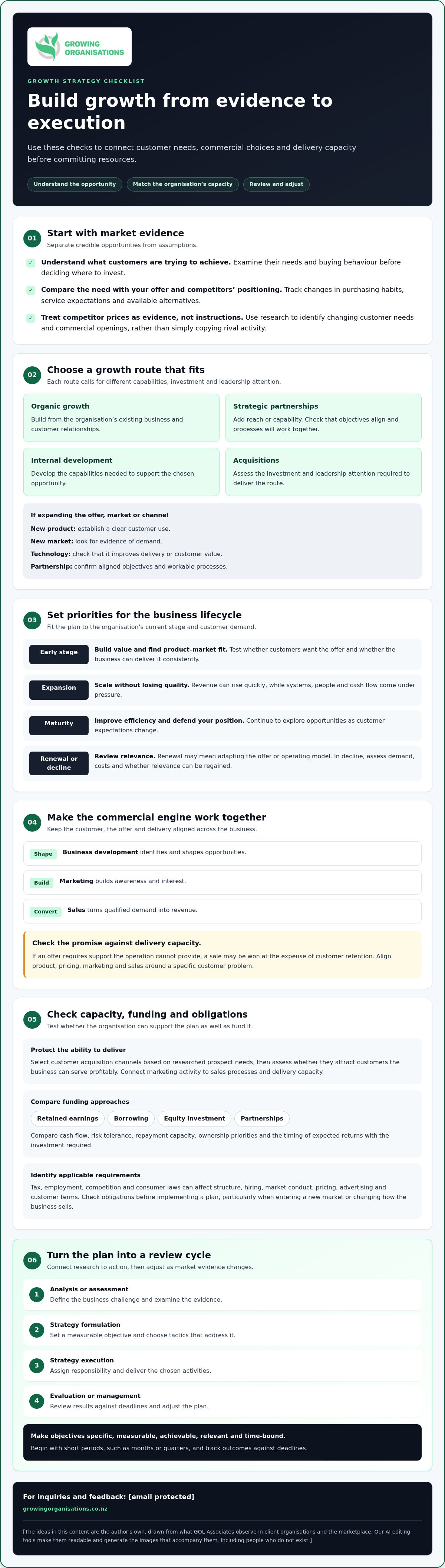
Organic, strategic, internal, and acquisition growth
Growth has distinct routes, each requiring different investment, effort and leadership attention. The key question is which route fits the business’s capabilities and audiences.
Growing organically
Primarily, organic growth increases revenue through the business’s own customers, offers and operations. It suits leaders who want to expand without relying on a merger or external partner.
A firm might deepen relationships with existing customers, encourage referrals or improve its core service. It can also use social media to reach relevant audiences, strengthen its company culture or focus effort on core operations. These methods build on assets already inside the organisation. Their value depends on customer demand and whether the team can deliver more without compromising quality.
Organic growth is not automatically low-risk. More sales can strain workloads, service standards and cash flow. Before expanding an offer, assess whether current processes and capacity can support extra demand. If repeat customers respond well but delivery teams face bottlenecks, improving capacity may be more useful than increasing promotion.
Pursuing strategic growth
Strategic growth uses deliberate choices, such as partnerships or entry into new markets, to reach a defined objective. It matters when the business needs capabilities or access that would take too long to build alone.
A partnership could combine one organisation’s specialist expertise with another’s established customer relationships. Both parties need a clear purpose, contribution and measure of success. Otherwise, coordination can consume effort without creating customer value. Strategic expansion can also involve a new customer segment or product line, provided research supports demand.
Assess the fit before committing resources. Identify what the organisation will gain, what it must invest and how the arrangement affects existing customers. For example, a new distribution partner may extend reach, but unclear service responsibilities can damage the customer experience. Strategic growth works when the route strengthens the business’s position and delivery capability.
Building internal growth
Sometimes designed under the broader heading of "Organic growth", internal growth develops capability within the existing organisation, including its people, processes and technology. It suits businesses that can create a stronger offer by investing in their own capacity. I refer to this as qualitative growth.
Examples include training employees to deliver a new service, improving a handover process or adopting technology that reduces repetitive work. Involving team members in financial information and decisions can also help them understand the commercial consequences of their work – as I did with the sales leaders I mentioned earlier. These actions turn a growth objective into changes employees can apply in daily operations.
Internal development takes sustained attention. Leaders need to set ownership, connect investment to a specific customer or operating need, and review whether the change works. If a new process reduces avoidable errors but creates customer delays, adjust it. Internal growth is strongest when capability improvements support reliable delivery and profitable demand.
Side note: I sometimes discover senior leaders who seem to forget that growth initiatives almost always adds cost to the existing budgets, besides the consultants’ fees. Often, those OpEx increases outweigh the professional fees. Last week, I had to remind the MD of a new client during the proposal and negotiation stage. In his case, (a smaller business) the incidental costs almost matched the professional fees, effectively doubling the required investment. We’re not awaiting a capital investment decision from the Board Chair, but I’d rather wait than field the complaints at a later stage. And the better news is that this matter caused a rethink about the real ROI (the true financial value) of the growth initiative before we start the work.
Growing through acquisition
Acquisition growth expands a business by purchasing another organisation or its assets. It can suit a business when a purchase could provide capabilities, customers or market access faster than building them internally.
The purchase itself does not create lasting value. Leaders must understand how the acquired offer, people and processes will fit the existing business. For example, combining two service teams may broaden expertise, but unclear roles can disrupt customer relationships. Define the commercial purpose first, then assess integration demands and the resources needed to achieve it.
Compare acquisition with organic, strategic and internal routes before choosing. Consider the time required, delivery capacity, customer impact and leadership effort each route demands. If you’re weighing these paths, discuss your growth implementation options with an experienced adviser.
Growing Organisations: Consultancy and Development
Growing Organisations helps leadership teams turn growth priorities into practical commercial action. Its Business Growth Strategy and implementation support can help when direction is clear but execution lacks ownership, alignment or momentum. Consultancy and Development supports organisations working through the broader changes required to grow.
Where leadership capacity or decision-making constrains progress, Executive Performance Coaching or a Fractional CEO or MD can provide focused support. The right starting point depends on the challenge: translating strategy into action, strengthening leadership effectiveness or extending executive capacity.
If your team is weighing its next growth move, contact Growing Organisations to discuss the work ahead.
Turn the next growth decision into action
The next step is not to add more initiatives. Decide which commercial move deserves leadership attention, what must change to support it and who will own delivery. A commercial growth strategy becomes useful when those choices shape priorities, investment and everyday decisions across the organisation.
Put the decision in front of your leadership team. Name the outcome, the trade-offs you are prepared to make and the evidence that will show whether progress is real. Set clear ownership and create a regular forum to address obstacles before they become embedded. This discipline keeps ambition connected to execution.
Growing Organisations works with leadership teams on growth and organisational development. If an external perspective would help your team sharpen its direction or move from intent to implementation, contact Growing Organisations to discuss growth.
Choose the next move carefully, then give it the leadership focus needed to make progress.
Frequently Asked Questions
What are the best ways to attract new customers?
Start by identifying the buyers most likely to value your offer, then make the reason to choose you clear. Review recent enquiries and successful sales to find common needs, decision triggers and objections. Use those insights to sharpen your message and make the first conversation useful. For example, a professional services firm could replace a general capability statement with a focused explanation of how it handles a specific client problem.
Can interim leaders help execute the strategy?
Yes. An interim or fractional leader can provide executive capacity when priorities are clear but internal ownership is stretched. They can help turn decisions into accountable work, resolve cross-team obstacles and keep delivery connected to commercial objectives. A fractional CEO or MD—or senior marketing leadership from specialists like Budget Boosters—may suit an organisation that needs experienced direction without appointing a permanent executive. Agree the role, decision authority and expected contribution before work begins.
How is it different from a marketing plan?
A growth strategy sets the organisation’s commercial direction; a marketing plan defines how marketing will support it. For example, a strategy may prioritise entering a new customer segment, while the marketing plan identifies the message, channels, campaigns and resources for reaching that segment. This distinction helps executives test alignment: marketing activity should support the chosen commercial priority, rather than operate as a separate list of promotional tasks.
What are the best cost-free methods of growing a business?
They are few, but use existing relationships and knowledge before committing new cash. Ask satisfied customers for introductions, follow up suitable past enquiries and review why previous proposals either succeeded or stalled. Team members may also identify service improvements that make repeat business easier. These actions still require time and clear ownership. Track which activity generates worthwhile conversations, rather than treating every referral, post or enquiry as evidence of growth.
What is a commercial growth strategy and what should it include?
A commercial growth strategy is a set of linked choices for increasing business value through customers, offers and delivery. It should define the intended customer, the value proposition, the route to growth, required resources, key risks and accountable owners. It also needs measures that reveal whether the underlying economics work. For instance, a new service needs a clear customer need and a delivery model the organisation can sustain.
How can a business identify and prioritise new markets and customer segments?
Compare each potential segment against customer need, fit with your existing offer, ease of access and delivery demands. Then test the strongest assumptions through sales conversations, customer feedback or a limited offer. A specialist firm might compare adjacent industries to see where its current expertise solves a similar problem. Prioritise segments where evidence supports demand and the organisation can serve customers without weakening existing commitments.
How should businesses set commercial growth goals, KPIs, and revenue targets?
Build revenue targets from the business model, not aspiration alone. Work backwards from the desired revenue using expected deal size, sales conversion and delivery capacity. Pair the revenue measure with leading indicators, such as qualified opportunities or proposal progression, so leaders can act before results arrive. Assign each KPI an owner and review its assumptions regularly. If capacity limits sales, the plan needs an operational response as well.
How do organic growth, qualitative growth, partnerships, acquisitions, and franchising compare?
Organic growth develops existing offers and customer relationships; partnerships combine complementary access or capability. Acquisitions buy an existing business, adding integration work alongside potential market access. Franchising applies a repeatable operating model through other operators, making consistency and oversight central considerations. Compare each route by control, speed, required capability and effect on customers. The best fit is the route whose demands match the organisation’s resources and leadership capacity.
[The ideas in this content are the author’s own, drawn from what GOL Associates observe in client organisations and the marketplace. AI editing tools help make them readable and generate accompanying images, including images of people who do not exist.]

Article by
Ross Wilson, MBA. Principal Advisor, Growing Organisations Ltd.
The moment before a hard call you need to make: this is where I do my best work. Maybe a business unit that's stopped performing; a sales team that plateaued two years ago and nobody's proud of it, or a culture that technically functions but has simply gone flat. Perhaps you "high performers" are strangely off their game. What do you do with these dilemmas?
These are the kinds of calls CEOs and boards bring me into, because by the time they call, they already know the comfortable options no longer work.
I've spent 30 years in advisory, most of it at CEO and Board level, across 35+ countries. I earned an Executive MBA degree from the University of Auckland which helps a little.
The point is, what happens now: businesses that were losing money find their margin again, teams that had stopped believing in targets start hitting them, and cultures people used to merely tolerate become ones they're proud to work in.
I don't do this alone. Growing Organisations is a niche team of professional advisors, by design, working globally, each with a specific field they've mastered and a track record that speaks for itself. What we work together and share a refusal to hand over a report and simply disappear. We stay, advise, support practically, coach if necessary, review, and redirect until the result is real and it's yours, not ours.