Leadership development can support organisational change when it builds the capability leaders need to turn strategy into action.
As a specialist leadership development consultant, Growing Organisations helps tailor programmes, performance coaching, and personal development plans to leaders at different stages. The work should connect directly to the changes the organisation needs to make.
Change places practical demands on leaders. They need to set direction, make decisions and help their teams adapt, not simply endorse a new plan. Development is most useful when it addresses those demands and links individual growth to organisational priorities. Call it "targeted development", if you like; making sure your spending on people development is an investment with a commercial ROI not simply an expense.
This article explains how to shape leadership development around organisational challenges, how coaching and personal development plans can support leaders at different stages, and how to assess whether development is helping change take hold. It also considers when consultancy can turn leadership development into focused, practical work.
Key Takeaways
- Start programme design with the organisation’s challenges, strategic priorities and intended outcomes.
- Connect leadership development to the behaviours and decisions that will help change take hold.
- Use coaching and personal development plans to turn individual insight into practical leadership action.
- Shape development around each leader’s responsibilities and stage, from emerging talent to established executives.
- Bring in consultancy or executive coaching when leadership capability needs to support a wider growth or change agenda.
How do you design a leadership development programme?
Design starts with the organisation’s challenges, strategic priorities and intended outcomes. Various Leadership Frameworks align Purpose, People and Performance, offering one way to connect development with organisational needs. Choose the one that will deliver to your priorities, or allow a qualified Consultancy and Advisory team to build a bespoke, proprietary framework for your company.
A useful programme makes the connection explicit. It identifies which leaders need to work differently, what support they need and how progress will be assessed. A leadership development consultant should show how the work reflects those priorities, rather than relying on a standard sequence of workshops.
Bespoke Programme Design
For more than 50 years and among thousands of leadership "experts" there has been a disturbing lack of alignment concerning leadership in any context. However, the good news is that the right model of leadership is the one closely aligned with your company and the foreseeable demands of your future business.
Building a bespoke model and programme begins with diagnosis, not a catalogue of books or workshops. Map the change ahead, the decisions leaders must make and the behaviours currently slowing progress. A restructure, for example, may require clearer delegation, while a growth strategy may call for stronger commercial conversations. These are distinct leadership challenges, so each needs relevant practice and support.
Build the development work around those findings. Set objectives for each leadership group, then choose relevant activities, coaching and personal development planning. Distinguish shared priorities from individual gaps: a senior team may need to align on direction, while emerging leaders practise giving feedback. Agree intended outcomes and review measures at the outset, then assess progress against them rather than attendance alone.
In-Person and Online Delivery
In-person sessions can support live discussion, peer challenge and practice. Online delivery may be more practical for leaders working across locations or demanding operational schedules. Choose the format to suit the work: sensitive team conversations may benefit from direct interaction, while focused coaching can work well online.
A blended design can combine in-person workshops with online coaching, provided each format serves a clear objective. Compare accessibility, confidentiality, interaction and the need for group practice before deciding. A team might meet face to face to work through a difficult decision, then use online sessions to reflect on how leaders applied the agreed approach.
Leadership development should reflect the organisation’s strategy, team structure and change priorities. A growing organisation may focus on delegation and decision-making, while a business introducing new processes may prioritise communication and consistency.
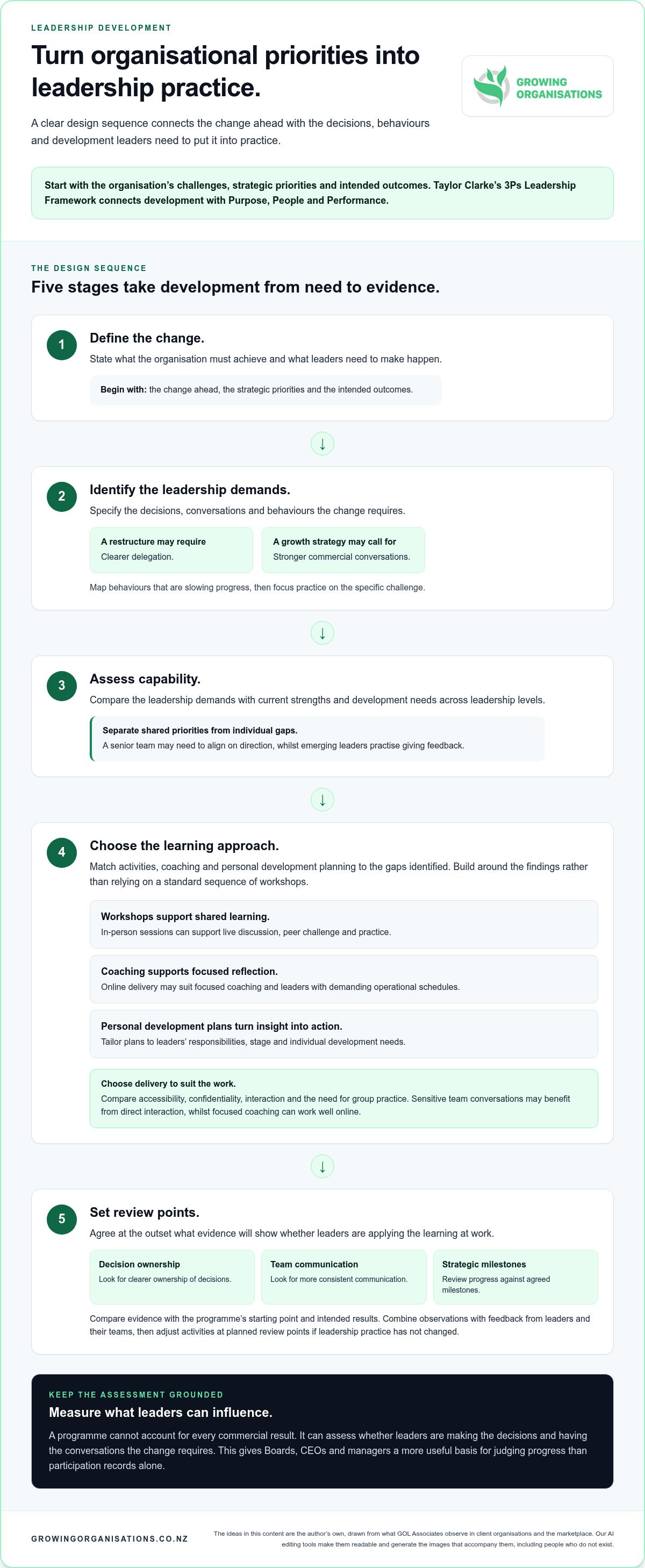
Use a clear design sequence to turn those priorities into development:
- Define the change. State what the organisation must achieve and what leaders need to make happen.
- Identify the leadership demands. Specify the decisions, conversations and behaviours the change requires.
- Assess capability. Compare those demands with current strengths and development needs across leadership levels.
- Choose the learning approach. Match workshops, coaching and individual plans to the gaps identified.
- Set review points. Agree what evidence will show whether leaders are applying the learning at work.
Measure outcomes against the programme’s starting point and intended results. Choose indicators linked to the change, such as clearer decision ownership, more consistent team communication or progress against agreed strategic milestones. Combine these observations with feedback from leaders and their teams. Review the evidence at planned intervals, then adjust activities if leadership practice has not changed.
Keep measures within leaders’ influence. A programme cannot account for every commercial result, but it can assess whether leaders are making the decisions and having the conversations the change requires. This gives Boards, CEOs and managers a more useful basis for judging progress than participation records alone.
Can leadership development support organisational change?
Yes. Leadership development supports change when leaders build the capability to put it into practice. During a restructure, managers may need to clarify responsibilities, communicate decisions and address uncertainty consistently. These actions help teams understand what is changing and what remains within their control.
Consultant experience matters because change rarely stays within one function. A leadership consultant should understand how decisions affect governance, operations, sales and people. Ask about work involving challenges like yours, then examine the approach and lessons applied. Sector experience can provide context, but the key test is whether the consultant connects leadership behaviour to your priorities and understands how decisions across functions affect one another.
Leadership consulting experience should extend beyond delivering workshops. Online training works well for sharing knowledge but not so good for competency development and performance change. In-person workshops tied to performance coaching deliver superior outcomes.
Look for work with executives and managers, such as facilitating difficult discussions, coaching leaders through decisions or helping teams establish accountability. During a growth transition, for instance, a consultant might help a leadership team agree who owns key decisions, then support managers to communicate new responsibilities. The work should clarify what leaders need to do differently.
Choose a consultant by assessing the fit between their experience and your change agenda, and their capacity for delivery through all the channels available today. Ask how they diagnose leadership needs, involve decision-makers, support implementation, and assess progress. A sound approach links activities to observable changes in practice rather than promising generic transformation. The consultant should explain how their method fits your organisation’s situation and leadership responsibilities.
For a small business, leadership development needs to fit the team and the owner’s priorities. A practical focus might be helping a new manager delegate work, set expectations and handle performance conversations. Development should address immediate operational demands while building capability for growing responsibilities. For example, the owner and manager could agree which decisions the manager can make independently.
Credentials can inform your assessment, but they do not replace relevant experience. Consider a consultant’s training alongside their method, professional judgement and examples of applied work. Ask how they adapt their approach to your organisation and handle confidential discussions with leaders. Relevant experience should help them understand your business’s pressure points, not assume every organisation faces the same problem.
Use these checks to compare consultants:
- Change relevance: Can they explain how leadership development addresses your specific transition?
- Sector understanding: Can they recognise operational pressures in your field without forcing a standard model?
- Practical method: Do they connect coaching, team work and individual development to real leadership responsibilities?
- Evidence of progress: Can they describe how leaders and decision-makers will review changes in practice?
These questions help distinguish credible consulting from a course barely connected with the work. If the challenge is unclear, identify the decisions, relationships or routines that need to change. This gives the organisation and consultant a workable basis for shaping support. It also helps senior decision-makers judge whether the proposed work addresses the cause rather than a visible symptom.
Where leadership capability is central to a wider change or growth agenda, explore organisational development support as a way to connect leadership work with execution.
Coaching and personal development plans
Coaching turns a leadership challenge into focused reflection and action. A manager struggling to delegate, for example, can examine what they retain, why they retain it and how that affects team decisions. The coach should connect the discussion to the leader’s actual responsibilities. Insight is useful when it changes behaviour at work.
A personal development plan makes that work specific. It records the capability to strengthen, the action the leader will take and the evidence that will indicate progress. For a newly appointed team lead, an objective might be to set clearer expectations in weekly team meetings. The plan can identify opportunities to practise, sources of feedback and a review point with their manager.
Keep the plan selective. A long list of aspirations competes with daily demands and obscures the priority. Choose development areas linked to the organisation’s direction and the leader’s role. An executive responsible for a major change may focus on communicating trade-offs, handling challenge and maintaining decision clarity. A people manager may need to improve delegation or address performance concerns promptly.
We build each plan around practical evidence:
- Capability: Name the behaviour to develop, such as listening before deciding.
- Application: Identify a real meeting, project or conversation where the leader can practise.
- Feedback: Agree who can observe the behaviour and offer useful, candid input.
- Review: Revisit the example and decide what to sustain or change next.
Coaching sessions work best when the leader brings live issues. A difficult stakeholder discussion can become a focus for preparation, reflection and follow-through. The coach can help the leader test assumptions, consider options and plan a response. Afterwards, the leader reviews what happened, how others responded and what they would adjust.
Confidentiality and accountability need clear boundaries. Leaders should understand what remains between coach and participant, and what progress information may be shared with the organisation. A useful review reports development against agreed objectives without turning private reflection into a performance transcript. This distinction supports honest coaching while keeping organisational outcomes visible.
Boards and executives can assess whether coaching is working by looking for changes in leadership practice. They might observe clearer decision ownership, more direct feedback or stronger follow-through on agreed actions. Combine these observations with the leader’s reflection and relevant team feedback. If the same issue persists, adjust the plan, practice opportunity or support rather than simply adding sessions.
Personal development plans should remain active documents. After a role change, a new project or a shift in strategy, revisit the leader’s priorities. A plan that reflects current work can guide coaching and make development visible in everyday decisions. The practical test is whether the leader can identify what they are changing, where they will apply it and what evidence they will review.
Leadership development for senior, established and emerging leaders
Leadership development should reflect the decisions each leader owns, not just their job title. A chief executive setting direction faces different demands from an emerging manager coordinating daily work. Treating both groups as one audience can leave senior leaders with inadequate, basic material and new managers without practical tools.
For senior leaders, focus development on organisation-wide judgement. A board-level change may require executives to set priorities, manage trade-offs and maintain alignment across functions. Use real strategic decisions as learning material. Ask leaders to test assumptions, surface disagreements and communicate the rationale behind difficult choices. The aim is stronger leadership practice where organisational direction is set and reinforced.
Established leaders translate strategy into coordinated action. A functional manager, for example, may need to resolve competing priorities between sales and operations. Development can strengthen cross-team decision-making, delegation and accountability. Use current projects to practise these skills, then review whether managers clarify ownership, address delays early and keep teams focused on agreed outcomes.
Emerging leaders need a different foundation. A newly appointed supervisor may be confident in technical work but inexperienced in setting expectations or giving feedback. Build capability through practical rehearsal: prepare for a performance conversation, practise delegating, then reflect on the result. This gives emerging leaders tools they can apply immediately, rather than abstract guidance detached from their responsibilities.
Keep the pathways connected. Senior leaders can agree the behaviours they expect, established managers can reinforce them in team routines, and emerging leaders can practise with support. If the organisation needs faster decisions, for example, executives must clarify decision rights, managers must avoid unnecessary escalation, and new leaders need confidence to act within their remit. Without alignment, development messages can conflict.
A useful programme starts by mapping leadership demands across these groups. Identify what each group must decide, communicate and deliver, then define the shared behaviours that should remain consistent. This helps the organisation avoid a common design error: offering separate learning experiences without connecting them to the same strategic priorities.
- Senior leaders: Develop strategic judgement, alignment and clear communication of trade-offs.
- Established leaders: Strengthen coordination, delegation and follow-through across teams.
- Emerging leaders: Practise core management conversations, including feedback and expectation-setting.
Review progress through work, not attendance. A chief executive can assess whether the executive team makes clearer decisions; a manager can observe whether a new supervisor handles feedback directly. Keep evidence relevant to each role. When development reflects both the person’s stage and the organisation’s needs, it creates a clearer link between strategy and daily action, with leaders prepared for their responsibilities.
Leadership performance coaching and training services for organisations
Leadership support can take several forms, each addressing a defined business need. Executive coaching suits an individual facing a demanding role or decision. A workshop can help a leadership team practise a shared approach. Sales leadership development focuses on the management behaviours needed to improve direction and accountability across sales activity.
Start with the problem, not the format. If a senior leader is balancing competing priorities, coaching can provide a focused space to test decisions and responses. If managers are giving inconsistent direction during a change, a team session can establish common expectations. If sales conversations lack clear leadership, development can address pipeline discussions, coaching sales staff and ownership of follow-through.
Executive performance coaching is most useful when the leader brings a live issue. A chief executive might work through a difficult stakeholder conversation; a newly promoted manager might prepare to delegate a critical project. Agree the focus at the outset, connect sessions to the person’s responsibilities and review what happened in practice. This keeps coaching grounded in decisions rather than general discussion.
Sales leadership needs its own emphasis. A sales manager may need to set clear standards, coach individual performance and lead reviews that produce decisions. Development should use real management situations, such as preparing for a sales meeting or responding to a missed commitment. The aim is to strengthen the leader’s approach, not supply a script detached from the team’s commercial context.
Training and coaching serve different purposes. Training can introduce a method or establish shared language across a group. Coaching helps an individual examine how they apply learning in practice, while under pressure. A business might use a team session to align managers on delegation, then coaching to address how one leader handles a specific accountability issue.
Before choosing an approach, define the required change and match it to the format:
- Individual leadership challenge: Use coaching to examine decisions, behaviour and practical next steps.
- Shared management practice: Use a group development session to build consistency across leaders.
- Sales team leadership: Focus on coaching conversations, performance reviews and follow-through.
- Wider organisational change: Connect development activities to the responsibilities leaders must carry out.
Consider the working context before choosing a format. A dispersed leadership team may benefit from online sessions, while a group addressing strained relationships may need direct discussion. The choice should reflect the session’s purpose, the sensitivity of the subject and leaders’ ability to participate fully. A format is useful only if it supports the work.
For a discussion about our bespoke executive performance development, get in touch about leadership support. Bring a current leadership challenge, the role involved and the change the organisation needs to see. That gives the conversation a practical starting point, whether the need is individual coaching, sales leadership development or work with a wider leadership group.
Growing Organisations: Consultancy and Development
Growing Organisations helps leadership teams connect development with the work organisational change requires. Its Consultancy and Development supports leaders when strategy is clear but execution needs stronger alignment, decision-making or accountability. Business Growth Strategy and implementation support connects commercial priorities with practical action. Executive Performance Coaching gives senior leaders space to work through role-specific challenges, while Fractional CEO or MD support adds leadership capacity when the organisation needs it.
The right starting point is the challenge itself: what must change, who needs to lead it, and where execution is stalling. Share that context with Growing Organisations to discuss a practical next step. You can email hello@growingorganisations.co.nz with an enquiry or feedback.
Make leadership change part of the work
Leadership development has purpose when treated as an operating commitment, not a separate initiative. Board members and executives can identify the leadership practice that must change, then make space for leaders to apply it in live decisions. This keeps development connected to organisational direction and makes leadership accountability part of everyday management.
The next step is to identify where leadership capability is constraining progress. Name the decisions, relationships or routines that need attention, then consider whether a leadership development consultant can help leaders act differently in those situations. Clear priorities create a stronger basis for a focused conversation than a broad request for training.
Growing Organisations can discuss the organisational challenge and the leadership support that may fit. Contact Growing Organisations today to start that conversation. A clear next step can turn leadership intent into deliberate action.
Frequently Asked Questions
What do leadership development consultants do?
Leadership development consultants help organisations strengthen how leaders make decisions and put priorities into practice. Growing Organisations provides Consultancy and Development for leadership teams working on commercial growth and organisational capability. A leadership team preparing to enter a new market, for example, can use consultancy to clarify decision ownership, identify capability gaps and connect development priorities with the work ahead. The focus is practical leadership action, not training detached from business needs.
Yes, Growing Organisations supports clients in the Northern Hemisphere. Many of our longest-standing clients have been UK or EU-based, international or regional businesses.
Assess a consultant’s training alongside their method, professional judgement and examples of applied work. Credentials do not replace relevant experience.

Article by
Ross Wilson, MBA. Principal Advisor, Growing Organisations Ltd.
The moment before a hard call you need to make: this is where I do my best work. Maybe a business unit that's stopped performing; a sales team that plateaued two years ago and nobody's proud of it, or a culture that technically functions but has simply gone flat. Perhaps you "high performers" are strangely off their game. What do you do with these dilemmas?
These are the kinds of calls CEOs and boards bring me into, because by the time they call, they already know the comfortable options no longer work.
I've spent 30 years in advisory, most of it at CEO and Board level, across 35+ countries. I earned an Executive MBA degree from the University of Auckland which helps a little.
The point is, what happens now: businesses that were losing money find their margin again, teams that had stopped believing in targets start hitting them, and cultures people used to merely tolerate become ones they're proud to work in.
I don't do this alone. Growing Organisations is a niche team of professional advisors, by design, working globally, each with a specific field they've mastered and a track record that speaks for itself. What we work together and share a refusal to hand over a report and simply disappear. We stay, advise, support practically, coach if necessary, review, and redirect until the result is real and it's yours, not ours.