Agreement in the boardroom is not alignment. Don’t use strategy to align your team. Align your team to give your strategy its superpowers.
To align your leadership team around strategy, leaders first need a shared purpose, clear priorities and a common view of success well embedded before you initiate a significant change or a transformation. If not, you will blow up your business.
But, when that foundation is solid, then focus on a small set of strategic objectives, then connect aall decisions to both resources and leadership behaviours.
Strategy execution depends on more than a plan. It requires leaders to:
- Make consistent, high-drive decisions
- Help their teams work across functional boundaries, particularly when growth creates competing demands.
Don’t over-complicate this to boost your self-importance. It is very simple.
This article explains how alignment strengthens execution and organisational performance, and how to turn strategic intent into practical accountability.
You’ll learn how to clarify priorities, define leadership responsibilities and establish a rhythm for reviewing progress. You’ll also see how consistent communication and cross-functional collaboration keep strategy present in day-to-day decisions, rather than leaving it as an agreement made in a meeting. Then let your people get on, together.
Key Takeaways
- Make strategic priorities specific enough to guide everyday decisions and resource allocation.
- Clarify each leadership role’s authority, scope and accountability so important work has clear ownership.
- Build leadership capability around the demands of the strategy, not just individual development goals.
- Set shared expectations for how leaders communicate, follow through and work across functions.
- Use regular reviews to spot where execution is drifting and agree on practical adjustments.
What Is Leadership Team Alignment?
Leadership alignment means leaders share a purpose, understand the same priorities and make decisions that reinforce them. To align a leadership team around strategy, first and always turn those priorities into clear choices about action, resources and progress.
-
Clarify the shared purpose
Agree why the organisation exists and what it must achieve next. Ask each leader to describe the purpose in their own words, then compare the answers. Differences can expose competing assumptions before they shape plans. Use a specific example, such as deciding whether customer retention or expansion takes precedence when both demand attention.Check that purpose guides trade-offs, not just presentations. If a proposed initiative does not support the agreed direction, leaders should explain why it remains a priority. Common barriers include vague ambition, functional agendas and reluctance to make choices. Name these directly, and do not treat consensus as proof of shared understanding.
-
Set shared strategic priorities
Choose a focused set of strategic objectives that drive long-term business value. For each, state the intended outcome, why it matters and what leaders will prioritise to achieve it. This clarifies choices when time, people or funding cannot support every initiative. Adding objectives without stopping or changing other work weakens those choices.Ask leaders to identify which priority takes precedence when objectives compete. For example, a growth objective may require redirecting capacity from lower-value activity. Record the decision and its rationale. This makes resource allocation deliberate and gives the team a consistent basis for judging progress, rather than letting each function define success independently.
-
Build a shared understanding
Test whether leaders interpret each priority in the same way. Ask every member to explain one key priority in a sentence, then compare the answers. Differences can reveal assumptions about the goal, scope or measure of progress. Resolve them before communicating the strategy to teams.Translate each objective into decisions and actions people can recognise. Invite teams to shape how priorities are delivered while keeping the strategic direction intact. Explain the core message consistently in team meetings and one-to-ones. Adapt examples for each audience without changing the meaning. Repetition reinforces shared understanding across functions.
-
Resolve strategic disagreements
Surface disagreement early and anchor the discussion in purpose, priorities and evidence. Ask each leader to state the decision they support, the trade-off they see and the risk they consider most significant. Separate disagreement about the destination from disagreement about the route. This helps the team address conflict without making it personal.Agree how the decision will be made, who holds authority and what evidence would justify revisiting it. Record the outcome and each leader’s commitment. If consensus remains out of reach, the decision-maker must choose and explain why. Don’t allow leaders to leave a meeting supporting different strategies; inconsistent follow-through creates mixed messages and erodes trust.
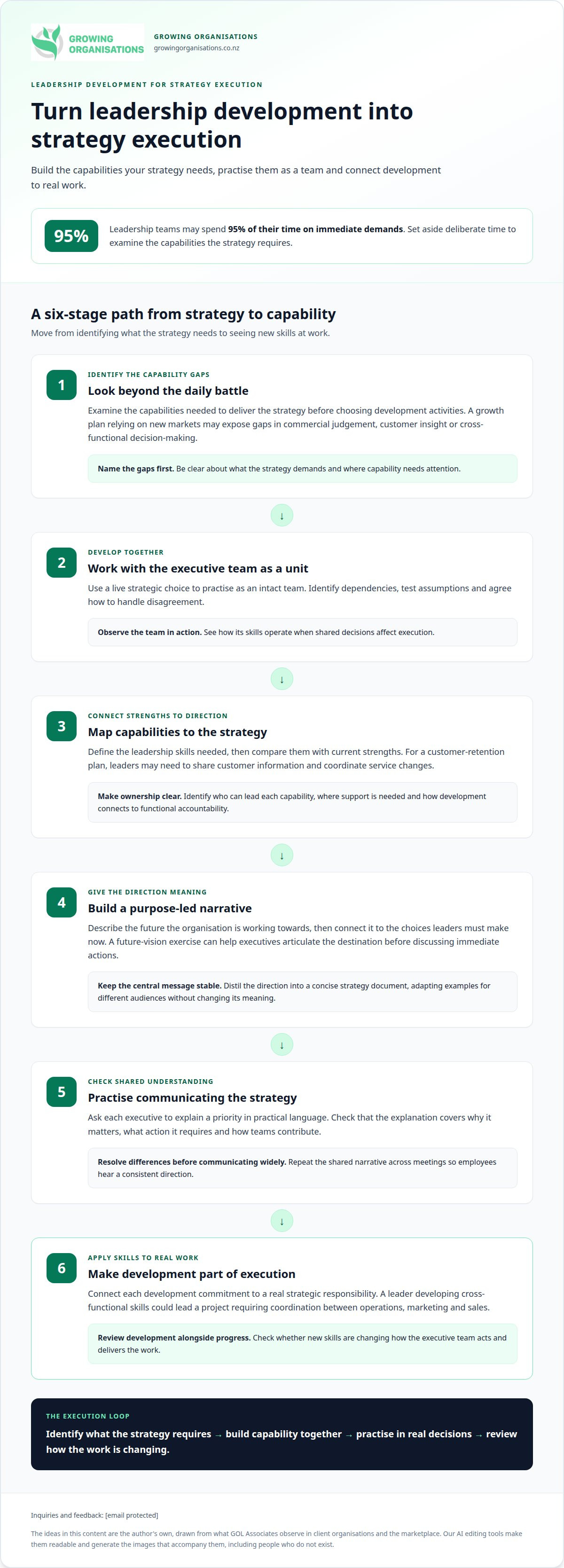
Leadership development for strategy execution
Communicate the direction in plain language, then develop the skills leaders need to deliver it. Use a shared narrative, clear role expectations and practice based on real strategic decisions.
- Look beyond the daily battle. Leadership teams may spend 95% of their time on immediate demands. Business as usual. Set aside deliberate time to examine the capabilities the strategy requires. For example, a growth plan relying on new markets may expose gaps in commercial judgement, customer insight or cross-functional decision-making. Name the gaps before choosing development activities.
- Develop the executive team as a unit. When alignment is the goal, develop the intact team, not only individuals separately. Drop the titles, the job profiles. Instead, call out the best in your people. Don’t put labels on things; intead, use people’s first names, and talk about what has to be done. Watch who steps forward. Work through a live strategic choice together. Ask leaders to identify dependencies, test assumptions and agree how to handle disagreement. This reveals how the team’s skills operate – co-operate – in the room, where execution depends on expertise and shared decisions.
- Map capabilities to the direction. Define the leadership skills needed to deliver the strategy, then compare them with current strengths. Fill the gaps from within your xompany, or contract certain capabilities in. A plan to improve customer retention, for instance, may require leaders to share customer information and coordinate service changes. Identify who can lead each capability, where support is needed and how development connects to functional accountability.
- Build a purpose-led narrative. Describe the future the organisation is working towards, then connect it to the choices leaders must make now. A future-vision exercise can help executives articulate the destination before discussing immediate actions. Distil the direction into a concise strategy document. Keep the central message stable while adapting examples for town halls, team meetings, one-to-ones and onboarding.
- Practise communicating the strategy. Ask each executive to explain a priority in clear, practical language. Check whether the explanation covers why it matters, what action it requires and how teams contribute. If leaders describe a priority differently, address the gap before communicating more widely. Repeat the shared narrative across meetings so employees hear a consistent direction, not competing interpretations. Be the unifying voice, not the only voice.
- Make development part of execution. Connect each development commitment to a real strategic responsibility. For example, a leader developing cross-functional skills could lead a project requiring coordination between operations, marketing and sales. Review the commitment alongside work progress. This keeps development grounded in delivery and shows whether new skills are changing how the executive team acts. Don’t waste money & time coaching people who are already competent. Tear down barriers to performance instead.
Development should connect to the work of execution.
Organisations need to identify leadership skill gaps and build the capabilities required for future performance. Strong executive teams and clear strategy are closely connected, so development should address how senior leaders work together as well as the skills each leader lacks. Structured facilitation helps senior leaders align around strategy, priorities and their approach to leadership.
Alignment is more than intellectual agreement with the strategy. It means coordinating decisions, resource allocation and how leaders lead their teams. Keep the strategic narrative present in all town halls, team meetings, one-to-ones and onboarding, adapting examples to keep it relevant.
Repeating the direction helps connect shared priorities with the decisions and leadership responsibilities needed to deliver them. Review development commitments alongside strategic work, and use facilitation when leaders need support aligning their choices and approach.
Organisational performance outcomes associated with alignment
Aligned leadership can support stronger execution, employee confidence and organisational performance. Assess results alongside the leadership behaviours and capabilities that shape them.
-
Measure leadership team alignment
Test alignment by asking each senior leader to explain the strategy’s intended outcomes, current priorities and personal contribution. Compare answers for differences in meaning, not just wording. Then review whether decisions, resource choices and team messages match those answers. A useful indicator is whether employees can connect their work to a strategic objective. Agreement in a meeting does not prove consistent action afterwards.
-
Review strategic progress
Use weekly tactical reviews to address immediate delivery issues, monthly strategic check-ins to assess progress, and quarterly board alignment to revisit direction. Keep each review focused on evidence, obstacles, decisions and ownership. A quarterly discussion should also test whether assumptions still hold. If progress stalls, identify the constraint and agree a response, rather than adding activity without changing the conditions affecting execution.
- Track performance and alignment together. Compare strategic measures with evidence of leadership effectiveness, employee engagement, customer satisfaction and retention. Reported comparisons associate strong leadership alignment with revenue growth 58% faster and profitability 72% higher than less-aligned companies. Highly aligned organisations also have customer retention 2.23 times higher and customer satisfaction 3.2 times higher. Treat these figures as reported associations, not promised outcomes for an individual organisation.
- Assess capability as well as results. Review whether teams have the skills, capacity and decision-making authority needed for the strategy. For example, if customer retention is a priority, examine how sales, operations and customer-facing teams share information and resolve service issues. Leadership effectiveness is reported as 8.71 times higher in highly aligned organisations, while employee engagement is 16.8 times higher. Use these comparisons as context, then examine your own performance and culture.
- Shape culture through senior behaviour. When it comes to culture, leadership directs 95% of it, so less talk and more doing.
- Identify the behaviours execution requires, such as sharing information, following through on commitments and raising risks early. Compare those expectations with what employees actually experience. Culture is stated to account for 40% of the performance gap.
- Use coaching and direct feedback to address behaviour that blocks progress. Recognise specific examples of cross-functional delivery, and make those actions visible in team discussions.
Consistent leadership behaviour and cross-functional collaboration
Strategy depends on what leaders do after agreement. Set shared behavioural expectations, then make them visible in decisions, meetings and cross-functional work.
- Define the behaviours execution requires. Identify actions that support the strategy, such as sharing information early, keeping commitments and raising delivery risks. Ask leaders to describe what each behaviour looks like in practice. For a customer-retention priority, sales and operations could share recurring service issues before more customers are affected. Avoid values that sound good but cannot guide a decision.
- Agree how leaders will work together. Document decision-making principles and non-negotiable standards. Specify who decides when functions disagree, what evidence informs the decision and how affected teams will hear the outcome. For example, leaders could agree to consider customer impact before a change to service delivery. Written standards give the team a reference point when behaviour drifts, rather than leaving expectations to memory.
- Build trust through follow-through. Use a structured conversation to establish how leaders will raise concerns, handle disagreement and honour commitments. A strategic planning session can reserve 20 minutes for the trust foundation. Each leader should name one commitment they will keep and one concern they need to surface. Trust builds through repeated actions, not declarations. If priorities need adjustment, explain the reason openly.
- Align systems with the culture you expect. Compare organisational structures, business practices and incentives with the behaviours strategy requires. If teams must collaborate to improve customer experience, examine whether handovers encourage shared ownership or reward functional results alone. Structures that leave important work between departments create friction. Adjust responsibilities and working practices so leaders have a clear route for resolving cross-functional dependencies.
- Model consistency in everyday leadership. Employees notice when executives agree in a meeting, then act differently afterwards. At each leadership meeting, review a recent decision and ask whether leaders communicated and followed through consistently. Acknowledge where actions diverged, identify the cause and agree the next step without blame. Use examples in team discussions to reinforce the expected behaviour and sustain it across functions.
- Make collaboration part of execution. Give cross-functional work a named owner, shared outcome and clear decision path. For a product improvement, product development can coordinate customer insight with marketing, sales and operations. Each function contributes its expertise, while the shared outcome prevents local priorities from taking over. Review obstacles together and make adjustments openly. Leaders build credibility by resolving dependencies instead of passing them between teams.
Give organisational teams a shared way to assess whether the agreed behaviours are evident in their work. Assess the current culture and identify the behaviours needed to execute the strategy. This gives leaders a basis for recognising where practice differs from expectations.
Misalignment among executives sends mixed signals, causes priorities to change frequently and makes it harder for teams to build trust. Leaders may agree in a meeting yet remain misaligned if their actions differ afterwards.
Model expected behaviours yourself. Follow through on commitments and communicate openly, including when priorities need adjustment. Align structures, systems, business practices and incentives with the behaviours leaders want to encourage.
Leadership alignment around growth strategy
Growth depends on connected choices, not one function acting alone. Leadership teams need to decide where to move forward, what to invest in and how organisational roles will support that direction.
- Define the growth destination. Agree where the business should be in three years and what must be true to get there. Be specific about customers, products, services and the organisation’s capacity to deliver. Ask five colleagues what success looks like, then compare their answers. If they describe different destinations, resolve that gap before committing resources or announcing new initiatives.
- Trace the growth path across functions. Map how each strategic choice translates into work. Marketing generates leads and prospects; sales converts them into profitable customers. Operations must then produce and deliver value. If a growth plan increases demand without considering delivery capacity, functions may pull in opposite directions. Map the dependencies and identify where coordination is essential.
- Make investment choices explicit. For every growth priority, identify the people, capability and cash it requires. Finance focuses on managing cash; operations focuses on using it to support production and added value. Test whether the proposed investment supports the priority and whether operational capacity can convert it into customer value. Name what will receive less attention.
- Revisit the growth logic as conditions change. Set a quarterly board alignment discussion to test whether the direction, investment and organisational structure still fit. Ask what has changed in customer demand, delivery capacity or team capability. If leaders pursue separate versions of success, surface the conflict and reset ownership. A growth plan should move forward through deliberate choices, not accumulated initiatives. A business scaling strategy for choosing markets and building capacity can also help leaders assess where to grow and what capacity expansion will require.
If priorities are clear but execution remains fragmented, business growth strategy and implementation support can help connect leadership decisions with coordinated action. For other business growth barriers, identify what is slowing progress before adding another initiative.
Growing Organisations: Consultancy and Development
Growing Organisations supports leadership teams when turning growth strategy into coordinated execution through Advisory and Development activities. This is a practical next step when priorities are agreed but ownership, decisions or cross-functional delivery remain unclear or slow.
Business Growth Strategy and implementation support connects strategic choices with accountable action. Executive Performance Coaching supports leaders working through the behaviours and decisions execution demands. Where the business needs additional senior leadership capacity to advance a strategy, a Fractional CEO or MD can provide leadership support.
The right focus depends on the obstacle. If the strategy needs sharper direction, start with growth strategy. If leaders understand the direction but struggle to execute together, focus on implementation and leadership performance.
To discuss your leadership team’s strategy and execution, and obstacles, contact hello@growingorganisations.co.nz.
Put the next decision into action
Growing Organisations works with leadership teams on strategy and execution. Contact Growing Organisations to discuss the challenge your team is facing.
Frequently Asked Questions
How do you turn strategic goals into leadership team priorities and KPIs?
Translate each strategic goal into an outcome, an accountable executive and a small set of measures. For a goal to increase repeat business, a priority might be improving the post-sale experience. Pair an outcome measure, such as repeat purchases, with an indicator of progress, such as completion of agreed customer follow-ups. Define how each measure is calculated and what decision it should inform. Otherwise, leaders may report different interpretations of the same KPI.
What workshops or exercises help align an executive team around strategy?
we use a strategy-to-work exercise. Give executives a realistic growth proposal, such as entering a new customer segment, and ask them to map the implications for sales, operations, finance and people. Then test the plan against limited capacity: what would the team stop, defer or change? This exposes hidden assumptions and competing commitments. Finish by recording unresolved decisions, an owner for each and what evidence would settle the issue.
[The ideas in this content are the author’s own, informed by observations from GOL Associates in client organisations and the marketplace. AI editing tools help make the content more readable and generate accompanying images, including depictions of people who do not exist.]

Article by
Ross Wilson, MBA. Principal Advisor, Growing Organisations Ltd.
The moment before a hard call you need to make: this is where I do my best work. Maybe a business unit that's stopped performing; a sales team that plateaued two years ago and nobody's proud of it, or a culture that technically functions but has simply gone flat. Perhaps you "high performers" are strangely off their game. What do you do with these dilemmas?
These are the kinds of calls CEOs and boards bring me into, because by the time they call, they already know the comfortable options no longer work.
I've spent 30 years in advisory, most of it at CEO and Board level, across 35+ countries. I earned an Executive MBA degree from the University of Auckland which helps a little.
The point is, what happens now: businesses that were losing money find their margin again, teams that had stopped believing in targets start hitting them, and cultures people used to merely tolerate become ones they're proud to work in.
I don't do this alone. Growing Organisations is a niche team of professional advisors, by design, working globally, each with a specific field they've mastered and a track record that speaks for itself. What we work together and share a refusal to hand over a report and simply disappear. We stay, advise, support practically, coach if necessary, review, and redirect until the result is real and it's yours, not ours.