Growth ambition is not a strategy. A business growth strategy must help the board and executive team decide where to focus, what evidence supports that choice, and what the organisation can realistically deliver. Without those decisions, opportunity lists expand, leaders define success differently, and commitments can outpace customer demand or organisational capacity.
The ambition to grow is often clear. The harder work is choosing between competing opportunities and making the trade-offs explicit. Growth should be grounded in customer value and commercial realities, not enthusiasm alone.
This article explains how to choose a direction, test its commercial fit, and assess whether the business has the capacity to act. It also shows how the Kairos framework can structure strategic choices and checkpoints, giving leaders a shared basis for action and for revisiting decisions as evidence changes. The framework supports leadership judgement; it does not replace it.
Key Takeaways
- Separate the desire to grow from the decision about which customers and markets to serve.
- Connect the choices in your business growth strategy so that each initiative supports a clear competitive position.
- Compare growth routes using customer evidence, strategic fit, and the capabilities they require.
- Identify the assumptions behind a commitment and agree what evidence will trigger a review.
- Give leaders a shared basis for decisions, and surface disagreement before it weakens strategic direction.
What a business growth strategy is meant to decide
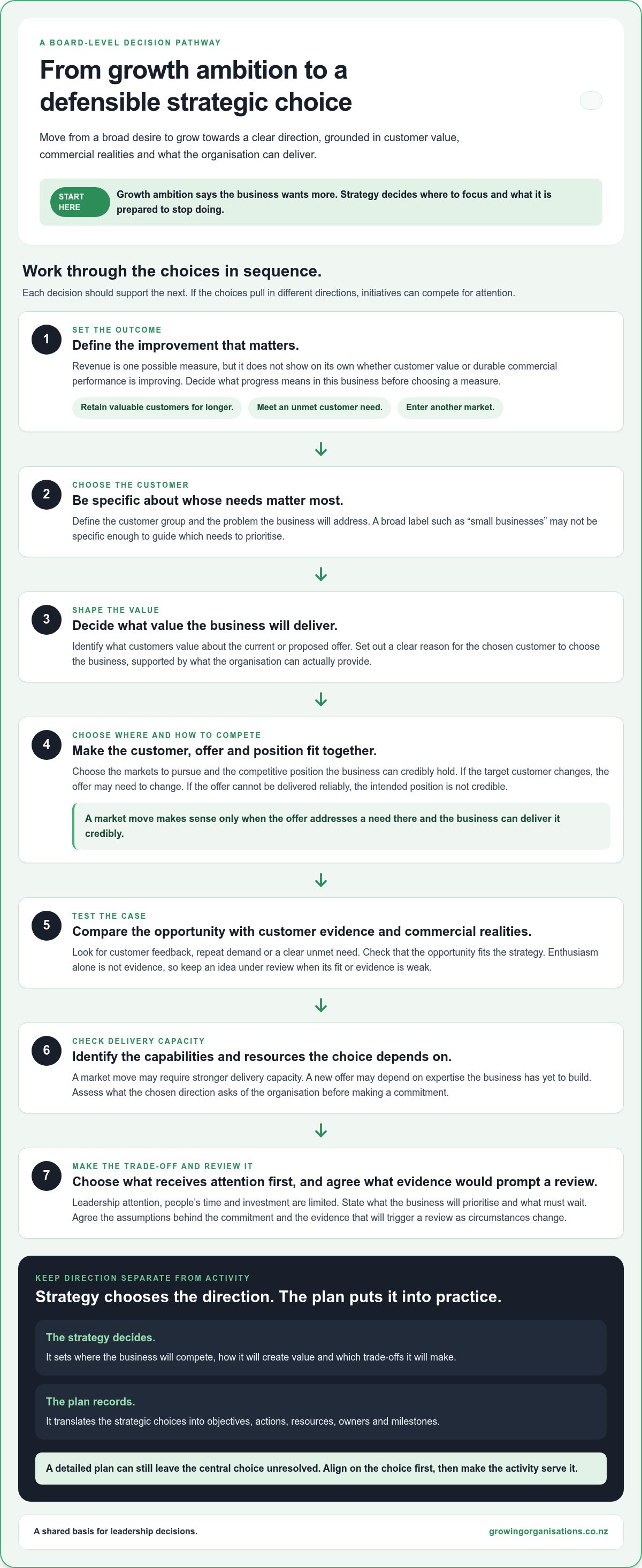
Wanting growth is an ambition, not a direction. It tells the board that the business wants more, but not what it will prioritise, where it will compete, or what it is prepared to stop doing. Without those choices, different leaders can back different opportunities while believing they are pursuing the same goal.
A business growth strategy makes those choices explicit. It defines which customers the business will serve, what value it will deliver, which markets it will pursue, and how it intends to compete. The decisions must connect. A move into a new market, for example, only makes sense if the offer addresses a need there and the business can deliver it credibly.
“A growth strategy chooses where a business will compete and how it will create value; a growth plan records the objectives, actions, resources, and timing that put those choices into practice.”
This distinction matters at board level. Strategy sets direction and trade-offs. The plan translates that direction into committed activity, project owners, allocated resources, and performance milestones.
A plan can be detailed and still leave the central choice unresolved. It may assign people to several initiatives without showing which customer or competitive position those initiatives are meant to strengthen.
The overview of growth planning offers background on how businesses plan for expansion. For leadership teams, the crucial question comes first: what specific choice should the plan serve? If the answer differs between departments, their activity is unlikely to create a coherent direction.
How a growth strategy differs from a growth plan
Consider a hypothetical service business planning to enter a new region, launch an offer, and increase sales to existing customers. Its plan might list campaigns, staffing needs, and target dates. But if leaders have not decided which customer group matters most, or what advantage the business will offer, the plan is a schedule of work rather than a strategy. This example illustrates the distinction; it is not a claim about a proven result.
What growth means for a specific business
Revenue growth is one possible measure, but it does not show on its own whether the business is creating customer value or improving durable commercial performance. The right outcome depends on the business context and the problem it needs to solve. Growth could mean retaining valuable customers for longer, developing an offer that meets an unmet need, or entering another market. Each route calls for a different strategic choice. Define the improvement that matters before selecting a measure, so reported progress reflects the intended direction rather than activity alone.
Build a business growth strategy around deliberate choices
A coherent strategy links the customer a business wants to serve with the value it can provide and the position it can credibly hold. If those choices pull in different directions, initiatives compete for attention rather than reinforcing one another. A new offer for a particular customer group, for example, should fit a real need and give that group a clear reason to choose the business.
Start with the customer, not the internal wish list. Define whose needs matter most, what problem the business will address, and what customers value about the current or proposed offer. Then consider how the business can deliver that value in a way that distinguishes it from alternatives. A value proposition is not a slogan. It is a reason for a particular customer to choose the business, supported by what the business can actually provide.
Decide where to compete and how to create value
Be specific enough to guide decisions. “Small businesses” may be too broad to identify which needs to prioritise. A sharper focus might identify a customer type with a particular service need, then test whether the business can meet that need reliably and on commercially sound terms. The strategy should also say what it will not prioritise. Without that boundary, every adjacent opportunity can appear equally compelling.
Work through the connections. If the target customer changes, the offer may need to change. If the offer depends on a level of service the organisation cannot sustain, the intended competitive position is not credible. A business growth strategy should hold together under those tests, not just read well in a board paper.
Make strategic trade-offs explicit
Focus has a cost. Choosing to deepen relationships with existing customers may mean delaying a move into a new market. Developing an offer may draw capability away from improving the current one. These are not reasons to avoid opportunity. They are decisions about what receives scarce leadership attention, people’s time, and investment first.
“Strategic focus means backing the opportunity that best fits the business, and being clear about what must wait.”
Test each priority against the evidence and the work it requires. Customer feedback, repeat demand, or a clear unmet need may support an opportunity. Enthusiasm alone does not. Then identify the capabilities and resources it depends on. A market move may require stronger delivery capacity; a new offer may depend on expertise the business has yet to build. Where the fit or evidence is weak, keep the idea under review rather than treating it as a commitment.
A detailed implementation programme is not necessary at the strategy stage. An honest view of what the chosen direction will ask of the organisation is. Growing Organisations provides tailored strategic advisory services to help leadership teams examine those choices while keeping responsibility for the decision with the team. Explore business growth strategy support.
Compare business growth strategy routes before choosing one
Growth routes differ in what they ask the business to prove and what the organisation must be able to deliver. Comparing them makes assumptions visible before leaders commit. The Ansoff Matrix organises options according to whether the offer or market is existing or new. It is a starting point for discussion, not a decision rule. Strategic fit and evidence still matter.
Use the comparison to focus the discussion. “Customer evidence” means signs that intended buyers have a need or are likely to value the offer. “Capability demand” means the skills, delivery capacity, relationships, and resources the route will require.
| Growth route | Customer evidence to examine | Strategic fit and capability demands |
|---|---|---|
| Market penetration | Look for further demand among current customers or within the current market. | This route builds on an established offer and market. It may require stronger sales, service, or customer retention capability. |
| Market development | Test whether customers in a new segment or market share a need the existing offer can meet. | This route builds on the current offer, but it demands knowledge of new customers, channels, or market conditions. |
| Product development | Look for evidence that existing customers have a need the current offer does not meet. | This route builds on existing customer relationships, but it may require product expertise and changes to delivery. |
| Diversification | Look for evidence of demand for a new offer in a new market. | This route extends beyond familiar territory and may demand new customer knowledge, expertise, and operating capacity. |
Compare market penetration, market development, and product development
Market penetration seeks more business from a market the organisation already serves. It is not automatically the safest or best route. Leaders need evidence that demand remains available and that pursuing it will not undermine customer experience or commercial returns. Market development takes an existing offer to new customers. Product development creates a new offer for customers the business already knows. Each tests a different assumption: available demand, whether the offer can transfer to a new market, or whether customers have an unmet need.
Assess diversification with care
Diversification combines a new offer with a new market. The business has fewer direct grounds for confidence because both the customer and the offer are unfamiliar. Test its strategic fit against what the organisation can credibly learn or deliver, then consider the downside if demand or capability assumptions prove wrong. A compelling idea is not yet a sound priority. Compare it with routes where customer evidence is stronger and existing strengths can be used.
No route is universally superior. The right choice depends on the strength of customer evidence, fit with the business’s direction, capability demands, and exposure if assumptions fail. The matrix helps leaders see the differences, but it cannot make the trade-off for them.
Proof-test a business growth strategy before committing
A promising opportunity is not yet a sound commitment. Before backing it, test what must be true about customer demand, the organisation’s ability to deliver, and the commercial return. Internal confidence can help generate a direction, but it cannot substitute for evidence from customers and the market.
Use a clear sequence to challenge the choice before committing significant attention and resources.
- State the choice. Describe the customer, need, and offer the business intends to focus on.
- Identify the assumptions. Name what must be true about demand, market access, delivery capability, and commercial returns.
- Test the evidence. Compare assumptions with customer feedback, existing demand, and relevant market information.
- Assess the downside. Consider what happens if uptake is slower than expected, delivery strains the organisation, or the return is weaker than planned.
- Set a review trigger. Agree in advance what evidence will prompt leaders to continue, adapt, or stop.
Challenge the assumptions behind the growth choice
Be precise about the unknowns. Does the target customer have the need the business believes it has? Is there evidence of willingness to buy, or only interest in principle? Can the organisation reach those customers through channels it understands? Customer conversations and buying behaviour can test internal assumptions. Market information adds context, but it does not prove that a particular offer will work for a particular business.
Separate material risks from testable uncertainty. A limited trial may help reveal whether customers respond to an offer before the business makes a larger commitment. It will not remove every risk. If the choice depends on a capability the organisation does not have, leaders need to face that constraint directly rather than treating it as a minor detail.
Set decision thresholds before action begins
Agree what evidence would justify continuing, changing the approach, or stopping. Thresholds should reflect the business’s customer evidence, resource limits, and commercial requirements. Avoid borrowed benchmarks that ignore the organisation’s context. A useful trigger could be a defined level of customer uptake, a delivery constraint that persists, or a return that falls short of the case leaders approved.
Keep measurement focused on whether the strategic assumptions are holding. The purpose here is to decide what would change the strategic choice, not to set out every operational measure. Revisit the decision when the agreed trigger is reached, rather than waiting for a routine review.
Growing Organisations provides tailored growth strategy support to help leadership teams test their assumptions. Explore the support.
Make leadership ownership part of a business growth strategy
A business growth strategy has force when leaders take ownership of its choices. The board, chief executive, and executive team need a shared understanding of which customers matter, what the business will prioritise, and which trade-offs it accepts. That does not require agreement on every detail. It does require clarity about who owns each decision and how the leadership team will resolve differences that affect strategic direction.
Unresolved disagreement has a cost. If one leader backs expansion while another prioritises existing customers, decisions about time and resources can pull in opposite directions. Teams then receive mixed signals about what matters. Surface the disagreement directly. Is it about customer evidence, the level of risk the business should accept, or the capability needed to deliver? Naming the issue gives leaders something concrete to decide.
Align leaders around the choices they own
Shared ownership is especially important for choices that shape the business beyond one function. Agree who the priority customer is, which opportunities take precedence, and what the organisation will defer. Leaders can then make consistent decisions within their areas while keeping the agreed direction intact. Advisers can question assumptions and help structure the discussion, but responsibility for the decision remains with the leadership team.
Alignment does not mean avoiding challenge. A board member may question whether the evidence supports the chosen market. An executive may identify delivery pressure that changes the trade-off. Hear those views before treating the decision as settled. The aim is not artificial consensus. It is a considered choice that leaders understand, can explain, and will uphold unless new evidence warrants a review.
Use structured advisory support where it adds value
Independent strategic challenge can help when leaders are too close to competing proposals or need a more disciplined way to reach alignment. Growing Organisations provides tailored strategic advisory for commercial growth choices. Its Kairos framework brings together a decision tree, a strategic checkpoint, and Business Model Canvas methodology to help leadership teams examine options and make their reasoning visible.
That support should strengthen leadership judgement, not replace it. The team brings knowledge of its customers, organisation, and commercial realities. A structured external perspective can test whether those realities support the direction being considered and expose assumptions that have gone unchallenged. Once leaders have made the choice, implementation support can help put it into practice across the organisation, keeping priorities and decisions connected.
Leaders should be able to explain the chosen direction, the trade-offs behind it, and what would cause them to reconsider. To discuss a live growth decision with Growing Organisations, describe the growth challenge your leadership team needs to resolve.
Turn the next growth decision into a clear commitment
The next step is not to add another initiative. Bring one live growth decision into the room and make the unresolved question clear. Which choice is holding progress back? What would the board or executive team need to understand before making that call with confidence?
A business growth strategy earns its place when it helps leaders decide and act with intent. That does not mean every uncertainty must disappear. It means the leadership team knows what it is committing to, what it is prepared to learn, and when it will reconsider the direction. Clear ownership makes it easier to respond to new evidence without drifting into a different priority by default.
For a candid, structured discussion about your team’s growth decision, speak with Growing Organisations.
Frequently Asked Questions
Is a business growth strategy useful for a small business?
Yes. A business growth strategy can help a small business make sound choices without creating a large planning exercise. A firm with a small team, for example, might need to decide whether to prioritise deeper relationships with current customers or pursue a new type of work. A short written statement of the chosen priority, what it depends on, and what will wait makes the decision easier to revisit.
Can a business growth strategy include acquisitions?
Yes, after appropriate evaluation. An acquisition can support a growth direction if leaders can explain why it fits the business’s commercial aims. The rationale might be access to a customer group or a capability that complements the existing operation. Test whether evidence supports that rationale, and consider the demands of integrating the acquired operation. Buying another company is a strategic option, not proof that growth will follow.
How often should a business growth strategy be reviewed?
Review it when significant evidence or conditions change, rather than relying on a fixed interval alone. A shift in customer buying behaviour, an important supplier change, or sustained pressure on delivery capacity could warrant an earlier discussion. However, review triggers of a change in strategy; don’t reopen a strategic choice on a whim. Focus on whether the assumptions behind the current direction still hold and whether new information calls for a revised decision.
What happens if a growth strategy is based on an incorrect assumption?
Reassess the decision using the evidence now available. Suppose a business expected a new customer group to buy through an existing sales channel, but enquiries show that customers need a different route to market. Leaders can adjust the approach, gather further evidence, or stop the initiative.
Record which assumption changed and why. This gives future decisions a clearer basis without treating the original choice as a failure to conceal.
Should a business growth strategy prioritise revenue or profitability?
It depends on the commercial objective and the demands of the proposed growth. Revenue can rise while the extra work strains delivery or weakens returns. Conversely, a choice that protects profitability may not meet the business’s broader growth aims. A business growth strategy should specify, early on, the outcome leaders are pursuing and examine how the opportunity contributes to it. The board can then judge progress against the stated objective, rather than relying on a headline figure alone.
What should a board expect to see in a growth strategy?
A board should expect a clear explanation of the decision it is being asked to support and the reasoning behind it. That includes the evidence leaders consider persuasive, the main uncertainty that remains, and the organisational pressure the choice could create. In a closely held business, directors may also want clarity on which decisions require board oversight as new information emerges. The discussion should help directors test judgement, not simply approve a list of activity.
[The ideas in this content are the author’s own, drawn from what GOL Associates observe in client organisations and the marketplace. Our AI editing tools make them readable and generate the images that accompany them, including people who do not exist.]

Article by
Ross Wilson, MBA. Principal Advisor, Growing Organisations Ltd.
The moment before a hard call you need to make: this is where I do my best work. Maybe a business unit that's stopped performing; a sales team that plateaued two years ago and nobody's proud of it, or a culture that technically functions but has simply gone flat. Perhaps you "high performers" are strangely off their game. What do you do with these dilemmas?
These are the kinds of calls CEOs and boards bring me into, because by the time they call, they already know the comfortable options no longer work.
I've spent 30 years in advisory, most of it at CEO and Board level, across 35+ countries. I earned an Executive MBA degree from the University of Auckland which helps a little.
The point is, what happens now: businesses that were losing money find their margin again, teams that had stopped believing in targets start hitting them, and cultures people used to merely tolerate become ones they're proud to work in.
I don't do this alone. Growing Organisations is a niche team of professional advisors, by design, working globally, each with a specific field they've mastered and a track record that speaks for itself. What we work together and share a refusal to hand over a report and simply disappear. We stay, advise, support practically, coach if necessary, review, and redirect until the result is real and it's yours, not ours.