A strategy can be sound on paper and still fail in execution. The gap is often not effort. It is whether the organisation has the capabilities to turn priorities into consistent decisions and results.
Organisational capability development is often discussed in broad terms, but without evidence of what is missing, training and change activity can drift away from the work that matters.
Leaders know capability matters. The harder question is how to identify the few capabilities that will make the greatest difference and how to tell whether they are improving.
Activity alone is not proof. Development must connect to business priorities and show up in how work gets done.
This guide sets out a practical definition of organisational capability development, a defensible way to diagnose and prioritise gaps, and an approach to strengthening capability through everyday work. A structured decision process, such as the Kairos framework, can connect strategic priorities to practical checkpoints.
You’ll also see how to track progress against business outcomes rather than simply count projects completed. The aim is to build the conditions your organisation needs to execute its strategy reliably.
Key Takeaways
- Organisational capability development is about strengthening how the organisation works, not simply adding individual training.
- Start diagnosis with a strategic priority, then map the work and decisions needed to deliver it.
- Compare capability gaps by strategic relevance, observable impact, ownership and the organisation’s capacity to act.
- Embed development in real work with clear ownership and regular review, so new practices can take hold in daily operations.
- See how Growing Organisations uses its Kairos decision-tree and strategic checkpoints, integrated with the Business Model Canvas, to support capability development in Scotland.
What organisational capability development means for business leaders
Organisational capability development builds the conditions that let a business execute its priorities reliably. It connects work design and decision-making with clear responsibility, so the organisation can deliver results consistently rather than relying on individual effort or exceptional circumstances.
This is broader than training. A course may improve someone’s knowledge, but it won’t necessarily change how the business performs. Capability becomes visible when people apply expertise through repeatable work, make sound decisions in familiar situations and produce operating results that support the strategy. The related concept of Capability management offers a broader foundation for understanding how organisations identify and use their capabilities.
Consider a business that plans to grow sales by entering a new market. The strategy can stall if teams cannot assess incoming opportunities consistently or agree which prospects to pursue. They may also lack shared expectations for delivering a coherent customer experience. The problem may not be a lack of effort. The organisation may need a clearer process or correct decision rights for the work.
Closing that gap doesn’t always require a large transformation programme. It may mean clarifying who makes a decision, agreeing a workable process or improving how teams share information. The right intervention depends on what is preventing execution, not on the scale of the development activity.
How organisational capability differs from individual skills
Individual expertise is valuable, but it doesn’t automatically create a dependable organisational capability.
If results rely on one experienced employee remembering what to do, the business has a person with expertise, not a method the wider team can use. Shared expectations and practical working methods allow knowledge to be used across roles and remain useful when responsibilities change.
For example, a salesperson may be skilled at interpreting customer feedback. To turn that insight into a repeatable sales process, the business needs an agreed way to capture what customers say, decide how it should shape an offer and apply the learning in future conversations.
The aim is not to remove judgement. It is to make good judgement easier to apply consistently.
Why capability development is a leadership concern
Capability choices affect whether agreed priorities can be delivered. The Board and executive team set direction, make trade-offs and assign ownership for building what the strategy requires. They need to know where execution is faltering and who is accountable for addressing the cause.
Discuss gaps in commercial terms. Instead of saying that a team needs more training, identify the work that is inconsistent, the decisions that are delayed or the result that is being missed. This gives leaders a basis for choosing a proportionate response and judging whether it has improved execution.
That is the practical purpose of organisational capability development: connecting leadership intent to the way the business operates. The test is not how much activity took place. It is whether the organisation can now deliver a priority more consistently.
How to diagnose the capabilities your organisation needs
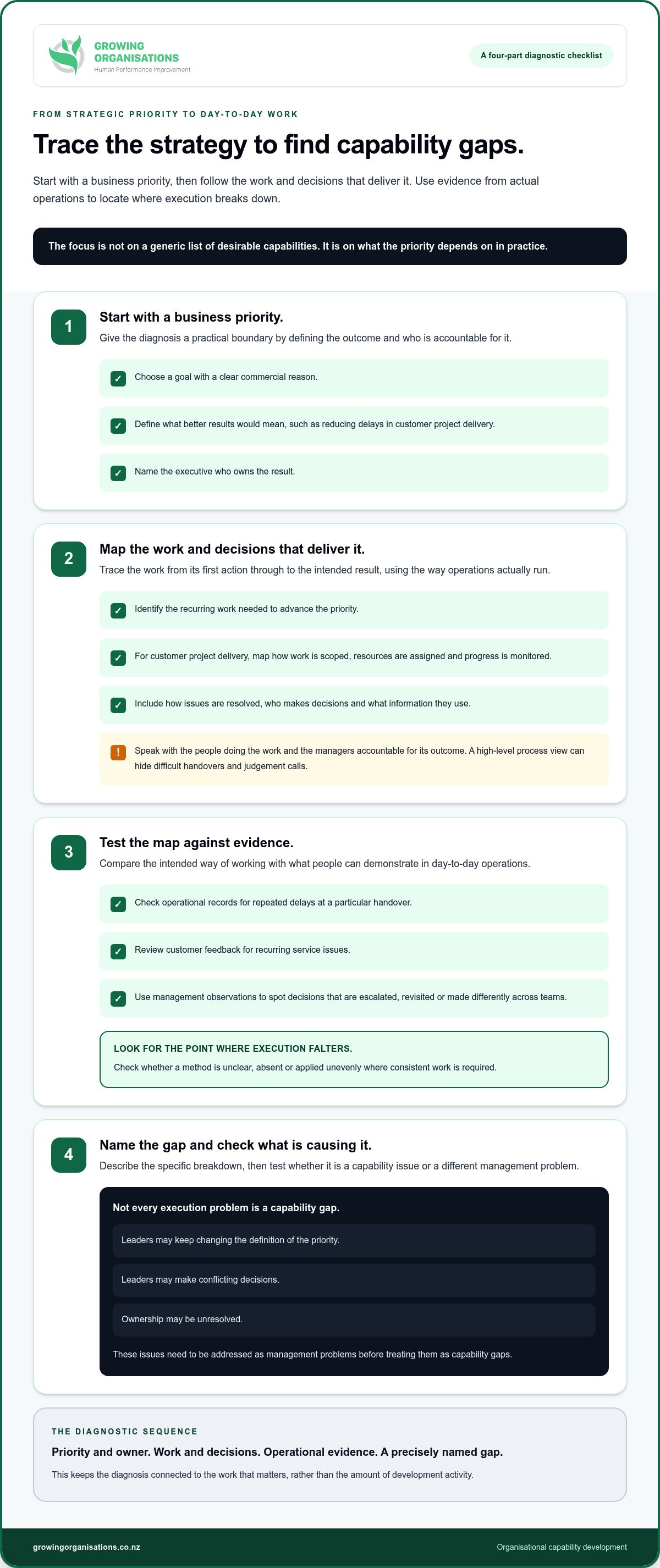
Start with a business priority, not a generic list of desirable capabilities.
Choose a goal with a clear commercial reason and an executive who owns the result. For example, if the priority is to reduce delays in delivering customer projects, define what better delivery means and name the leader accountable for it. This gives the diagnosis a practical boundary.
Map strategic priorities to the work that delivers them
Trace the work from the first action to the intended result.
For the delivery example, map how work is scoped, how resources are assigned and how progress is monitored. Include how issues are resolved. Identify the decisions at each point, who makes them and what information they use. Then ask where progress depends on consistent work, but the method is unclear, absent or applied unevenly.
Keep the map close to actual operations. A high-level process diagram can hide the handovers and judgement calls where execution falters. Speak with the people doing the work and the managers accountable for its outcome.
The question is not whether a capability sounds useful in principle. It is whether the priority depends on it in practice.
Use evidence to locate capability gaps
Test the map against evidence already available. Operational records may show repeated delays at a particular handover. Customer feedback may reveal a recurring service issue. Management observations can point to decisions that are escalated, revisited or made differently across teams.
Compare the intended way of working with what people can demonstrate in day-to-day work.
Use a sequence to keep the diagnosis disciplined:
- State the priority, its commercial rationale and the executive owner.
- Map the recurring work and decisions needed to advance it.
- Check where execution breaks down, using operational information and direct observations.
- Name the gap precisely, then test whether it is a capability issue or a different management problem.
That last test is important. Teams cannot execute a priority consistently if leaders keep changing its definition, make conflicting decisions or leave ownership unresolved. Those problems need leadership action, not a training intervention.
Likewise, a lack of time or access to essential information may be an operating constraint rather than a capability gap.
Separate the causes before deciding how to respond.
Maturity frameworks can help leaders frame questions and compare aspects of a capability. They cannot determine what matters most to a particular business. The Molloy University paper A Novel Framework for Building Organizational Capabilities considers how organisations build capabilities in response to changing conditions. Use frameworks as prompts, then apply business judgement to the evidence in front of you.
A sound diagnosis gives organisational capability development a specific target: a gap in the work or decisions that is limiting a stated priority. If you’re connecting a strategic goal to practical implementation, business growth strategy support can help structure that work.
How to prioritise organisational capability development
A diagnosis can produce several valid gaps. That does not make them equal priorities.
Trying to address every weakness at once spreads leadership attention, disrupts day-to-day work and makes it harder to see what is changing execution. Prioritisation is a commercial choice: direct effort towards the gaps that most constrain agreed priorities, and defer the rest with a clear rationale.
Compare capability gaps against business priorities
Assess each gap against the same criteria. Consider whether it affects a stated priority, what observable consequence follows if it remains unresolved, who can own action and whether the organisation has capacity to act under current operating conditions. Research such as Harvard Business School’s Six Core Capabilities for an Effective Organization can broaden the questions leaders ask, but the final judgement must reflect the organisation’s strategy and evidence.
Use the comparison below to make trade-offs visible. The examples are illustrative. Replace them with gaps established through your own diagnosis.
| Criterion | Reliable forecasting | Manager delegation |
|---|---|---|
| Strategic relevance | Direct if a growth priority depends on planning stock or delivery capacity against demand. | Direct if a growth priority depends on decisions being made closer to the work. |
| Observable impact | Forecasts vary between teams, making plans difficult to rely on. | Decisions wait for senior approval, slowing routine work. |
| Ownership | A named executive can align the planning process across teams. | Leaders can clarify which decisions managers own and where escalation is needed. |
| Organisational capacity | A focused change to planning routines may be workable alongside current operations. | Clear decision boundaries may be possible, but managers may need support to use them consistently. |
The comparison should expose dependencies.
If managers cannot act because decision rights are unclear, delegation is not merely a desirable improvement. It may be a prerequisite for faster execution.
By contrast, refining a process that already supports the priority may be worthwhile, but less urgent. Look at the consequence of delay, not just how visible or familiar the gap feels.
Make deliberate choices about sequence and scope
Prioritisation need not create a major programme. Organisational capability development can proceed through staged decisions, each tied to a defined part of the work.
Start with the foundational gap that blocks progress, agree who owns the change and set a review point. Then assess what remains before widening the scope.
Record what leaders will defer and why. A capability may be relevant but have less effect on the current priority, lack clear ownership or exceed the organisation’s present capacity. Write down the decision and the evidence that would prompt a review. This is disciplined sequencing, not neglect.
Keep the scope narrow enough to act on. Define the teams, decisions or working practices in scope, and separate them from wider improvements that can wait. That gives the executive team a credible basis for allocating attention and checking whether the chosen intervention is addressing the constraint that matters.
How to embed capability development in everyday work
Capability improves when people use a better way of working in the conditions they actually face.
A new process that adds unnecessary steps, conflicts with existing responsibilities or relies on information people cannot access will soon be bypassed. Build development around the work itself. Clarify the required practice, make it practical to follow and review what happens when teams apply it.
Give leaders ownership of application
Name an executive accountable for the capability and its intended contribution to a business priority. That leader should give managers clear expectations about what changes in day-to-day work, where teams can use judgement and when decisions need escalation.
Managers then need the authority and time to make the change workable. Set a review point to examine evidence, resolve obstacles and adjust the approach where needed.
Consider a business seeking more consistent customer handovers. The executive owner might set the expected standard, while managers agree how teams record outstanding actions and transfer responsibility.
The practice should fit the existing flow of work, not sit in a separate document that people rarely use. Ask staff to test the process in live work and identify friction before extending it more widely.
Measure application rather than activity
Choose measures that show whether the new practice is being used and whether execution is improving.
For handovers, that could mean checking whether required information is consistently passed on, then monitoring an existing measure of delays or rework. Use information the organisation already collects where it is relevant. Establish a baseline before making changes, so leaders can compare later evidence against a clear starting point.
Training completed, projects finished, boxes ticked, guidance issued or meetings held can show that activity took place. They don’t prove that capability has improved.
Pair any record of development activity with evidence from the work: what people now do, whether decisions are clearer and whether the intended operational outcome is moving in the right direction. Avoid claiming a result the available evidence cannot support.
At each review, ask whether the practice is being applied as intended, what is getting in the way and what the evidence says about execution. If adoption is weak, the issue may be an impractical process, unclear accountability or competing demands.
If the practice is in place but the outcome has not shifted, revisit the original diagnosis. Change the intervention when the evidence points to a different constraint.
This is how organisational capability development becomes part of normal management rather than a standalone initiative. Keep ownership visible, review progress at agreed intervals and adjust the approach based on what teams can demonstrate. Growing Organisations’ organisational development consultancy connects capability priorities with practical implementation.
How Growing Organisations approaches capability development in Asia
For a leadership team in S.E. Asia, for example, organisational capability development needs to connect commercial priorities with the work required to deliver them. Growing Organisations provides organisational development and business growth strategy consultancy, including hands-on implementation support.
The focus is the client organisation’s context: which capabilities support its priorities, how local culture influences actual priorities and behaviour, what decisions need attention and how agreed changes can be put into practice.
The same questions apply to businesses elsewhere. Australia and New Zealand differ in some of these areas, as do Canada and the United States. India is different again, and in multi-state nations, those differences may apprear state by state.
The operating context may differ, but leaders still need clarity about the strategic choices in front of them and how those choices translate into action. Advisory work is useful when it helps the executive team make those connections, rather than leaving leaders with a broad capability ambition and no practical route to act on it.
Use Kairos to structure strategic decisions
The Kairos framework is a decision-tree and strategic checkpoint methodology integrated with the Business Model Canvas (TM). It is not software or a preset sequence of stages. Its purpose is to structure decisions and checkpoints in relation to the organisation’s business model and strategic priorities.
That structure can help a leadership team examine the choices behind a priority and make its reasoning more explicit.
For capability development, the discussion can stay anchored in what the strategy requires from the organisation, where a decision or capability needs attention and how leaders will review progress.
The framework supports judgement. It does not replace it or prescribe a result.
Connect advisory work with implementation
Growing Organisations tailors its consultancy to the organisation’s priorities and supports practical implementation. The work stays tied to the client’s commercial context: the capabilities the organisation needs to strengthen, the people responsible for putting changes into practice (including ethnic and corporate culture) and how leaders will assess whether the work remains aligned with the priority.
The starting point is not a promise of a predetermined outcome. It is a clear conversation about what the business is trying to achieve and what is getting in the way. From there, advisory work can help leaders clarify choices and support execution in a way that reflects the organisation’s circumstances.
The emphasis is on commercial clarity, confident decisions and practical application, rather than activity for its own sake.
Growing Organisations expresses its approach as “Platinum Advisory. Measurable Results.” For leaders, the useful test is whether the advice helps clarify what matters and supports disciplined action. Measures should reflect the client’s own priorities and available evidence, not an assumed result.
When your leadership team is weighing capability priorities against its strategy, start with the priority you need to deliver and the organisational conditions that will make execution more reliable.
Make capability a standing strategic decision
Give capability a place in the next strategic review, not as a separate people initiative but as a question of execution.
Which priority is most exposed if the organisation keeps working as it does now? What evidence would show that the exposure is changing? Who will bring that evidence back to the leadership team?
These questions keep organisational capability development tied to decisions leaders can own.
The discussion does not need to produce a sweeping plan. A clear decision about what to address now, what to defer and when to review the choice is a sound starting point. Keep the work connected to the strategy as conditions and priorities shift.
To bring a specific capability priority into focus, discuss your organisation’s capability priorities with Growing Organisations. The conversation can help you consider the issue in its commercial context and decide what deserves attention next.
Frequently Asked Questions
What is organisational capability development?
Organisational capability development makes strategic intent usable across roles. Leaders translate a priority into the decisions and routines teams need to handle, including exceptions. For example, a service team may need a shared threshold for when to resolve a customer issue or escalate it. This gives managers a practical basis for discussing how work should be handled, beyond a list of individual courses.
Is organisational capability development the same as organisational development?
No. The terms overlap, but organisational development can address broader questions about how a business operates and adapts. Capability development focuses on what the organisation needs to do well for a particular priority. A business reviewing its decision-making culture may take a broad organisational development approach. If it needs stronger investment decisions, capability development can focus on the commercial information and judgement those decisions require.
Can a business develop capability without restructuring?
Yes, a d many do so. A business can work within its existing structure by adapting a regular operating meeting, for example. Managers could use the meeting to review recurring issues, agree how teams should handle them and decide which issues need senior attention.
This can create a practical place to apply new expectations without launching a separate initiative. The change should fit the organisation’s existing responsibilities and routines.
How often should leaders review organisational capability priorities?
Review priorities at established management points and when a change in direction or operating conditions could make them less relevant.
A new supplier arrangement, for example, may alter the assumptions behind existing planning practices. Leaders can then decide whether to maintain the current priority or reconsider it alongside other business demands.
The right frequency depends on how quickly the organisation’s circumstances change, rather than a universal timetable.
Is organisational capability development only relevant during business growth?
No. It can also help when a business needs to stabilise performance, adapt to new demands or make better use of its existing strengths.
Quqlity improvement is a legitimate and often a critical growth priority.
A company facing recurring service delays, for instance, may need to improve how it schedules work even if expansion is not on the agenda.
Start with the business issue leaders need to address. Growth is one possible driver, not a prerequisite.
How long does organisational capability development take?
There is no fixed duration that applies to every capability. The timescale depends on the number of teams involved, how closely their work is connected and whether existing routines need to change.
Leaders can plan the work in stages, allowing time for teams to become familiar with a new practice before extending it.
Avoid setting an end date simply to make a plan look definite. Scope and dependencies should guide timing.
Can an owner-managed business benefit from organisational capability development?
Yes, definitely. Owner-managed business are prone to calcification.
The approach can be scaled to the business and its immediate priorities. An owner-managed firm might examine how it prepares quotations, then identify which decisions require the owner’s judgement and which can be handled by others using agreed guidance. This can help the business use its limited management time deliberately, while building a clearer basis for consistent work as responsibilities evolve.
[The ideas in this content are the author’s own, drawn from what GOL Associates observe in client organisations and the marketplace. Our AI editing tools make them readable and generate the images that accompany them, including people who do not exist.]