Fix a stalled business by identifying the main constraint and focusing effort on it, rather than adding more activity. To understand how to fix a stalled business, review leadership decisions, team capability, staff retention and cash-flow visibility together. Set a clear priority, assign an owner and check whether the action is changing results.
When growth slows, it is easy to blame the market or launch another initiative. Yet leadership behaviour can clear the path or become part of the blockage: unclear priorities, limited delegation and weak follow-through keep teams busy without moving the business forward. This article explains how to identify the real barrier and make practical changes. It covers signs of a growth ceiling, ways to assess leadership and team capacity, and how forecasting can reveal pressure early. The aim is not to do more for its own sake. It is to make better decisions, focus execution and build a business able to sustain its next stage of growth.
Key Takeaways
- Review marketing performance against sales, then stop spending on campaigns that are not producing useful results.
- Set a clear direction, limit competing initiatives and delegate decisions so leaders do not become the bottleneck.
- Look for warning signs such as dependence on a small group of customers or processes that cannot handle more demand.
- Use staff feedback to identify capability gaps and retention pressures before making major changes.
- Forecast cash flow and weigh margins, customer acquisition costs, retention and available runway alongside revenue.
1. What steps can a business take today to break through a growth barrier?
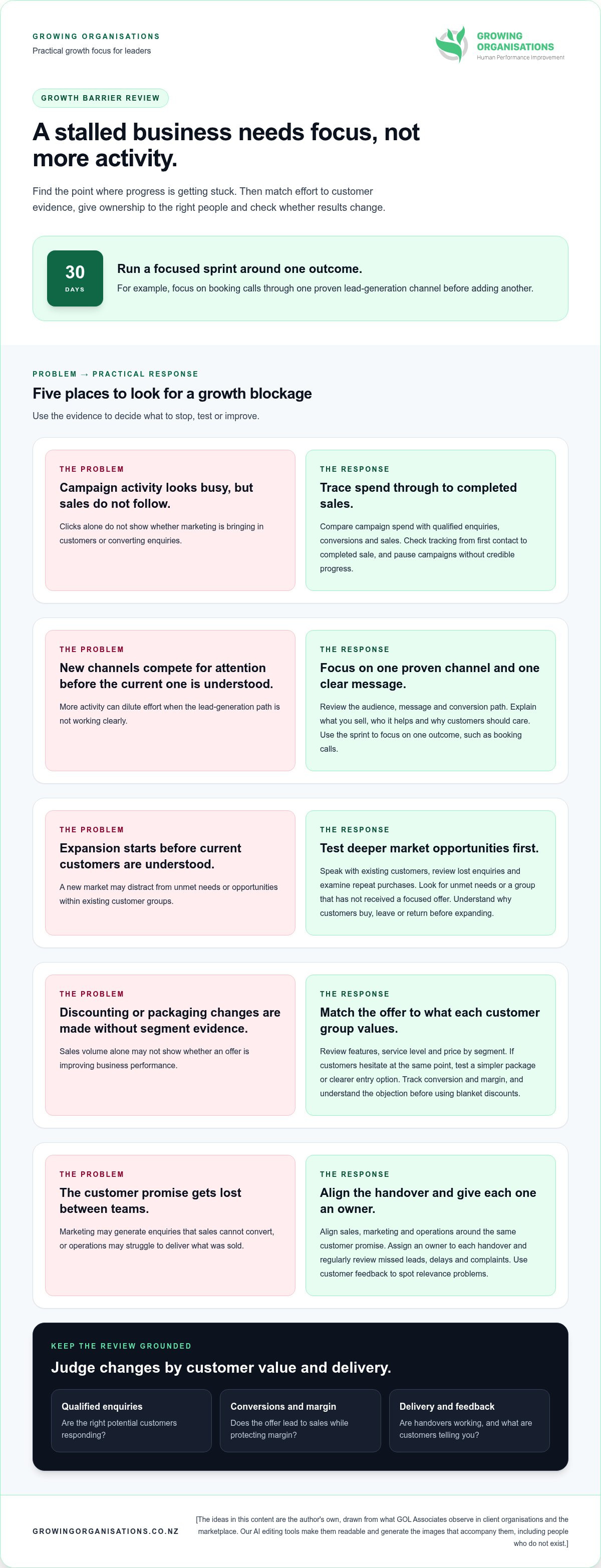
Start with the results behind each marketing campaign. Compare spend with qualified enquiries, conversions and sales, then identify which activity brings in customers. Pause campaigns that use budget without credible progress. Check that tracking captures the full journey, from first contact to completed sale. A high click rate means little if enquiries do not convert.
Focus on one proven lead-generation channel before adding another. Review its audience, message and conversion path, then run a 30-day sprint around one outcome, such as booking calls. Clear messaging should explain what you sell, who it helps and why customers should care. This disciplined review is a practical way to understand how to fix a stalled business.
Test deeper market penetration before entering a new market. Speak with existing customers, review lost enquiries and examine repeat purchases. Look for unmet needs among current segments, or a group that has not received a focused offer. Delay expansion until the business can explain why its current customers buy, leave or return.
Review pricing and packaging by customer segment. Compare what each group values with the features, service level and price in its offer. If customers hesitate at the same point, test a simpler package or a clearer entry option. Track the effect on conversion and margin, not just sales volume. Avoid blanket discounts until you understand the objection.
Align sales, marketing and operations around the same customer promise. Marketing should generate enquiries that sales can convert, while operations must deliver what was sold. Assign an owner to each handover and review missed leads, delays and complaints regularly. Customer feedback can expose a relevance problem before another campaign amplifies it.
How do you reduce business costs without harming sales or quality? Match campaign spend and operating effort to evidence of customer value. Remove duplicated work or ineffective promotion first, then monitor conversion, delivery standards and complaints after each change.
What are the best ways to attract new customers and increase repeat sales? Make the offer clear, focus on a channel that already brings qualified enquiries and make buying easier. Use customer feedback to improve follow-up and give existing customers a relevant reason to return.
When should a stalled business change its products, services or target market? Change direction when customer evidence repeatedly shows weak demand, poor conversion or unmet needs the current offer cannot address. Test a revised offer with a defined segment before committing to a broader pivot.
When should a business seek advice from an accountant, turnaround consultant or insolvency practitioner? Involve an accountant when margins, cash forecasts or campaign returns are unclear; seek turnaround advice when commercial and operational barriers span teams. If forecasts indicate difficulty meeting obligations, speak promptly with an insolvency practitioner.
2. How can leadership behaviour help or hinder growth?
Leadership becomes a growth constraint when decisions stay with one person. According to the Corporate Executive Board (CEB), management error rather than the economy accounted for 87% of company stalls. Treat that as a prompt for scrutiny, not a diagnosis of your own business. Review where decisions wait, which priorities compete, and whether leaders act on evidence or habit.
Start by setting a clear direction for the next 3-5 years. The board and executive team should agree what growth means, which customers matter, and what the business will not pursue. Then test current work against that direction. If an initiative cannot show how it supports the agreed priorities, stop, defer or redesign it.
Too many initiatives dilute attention. Choose a small number of outcomes, name an accountable executive for each and review progress in regular leadership meetings. A sales director might own conversion, while an operations lead owns delivery capacity. Shared visibility reveals trade-offs early and prevents departments from celebrating local results while overall revenue stays flat.
Delegation means transferring authority, not just tasks. Define the decision, its limits, the expected result and when to escalate. For example, a manager could approve routine customer adjustments within agreed commercial boundaries. If every decision still returns to the founder, the team has responsibility without control, leaving the founder as the bottleneck.
Owner workload offers a practical test. List recurring decisions and tasks that take up leadership time, then separate work requiring the owner’s judgement from work others can own. Transfer one repeatable responsibility, document the standard and agree how results will be reviewed. Keep oversight of risk and direction, but stop approving routine steps capable managers can handle.
Mindset matters. An owner who treats delegation as loss of control will keep the organisation dependent. A leader who treats feedback as challenge can miss market shifts and competitor moves. Ask managers where approvals stall, what decisions they can safely make, and which commitments leadership has failed to resolve. Use their examples to revise authority and meeting routines.
Professionalising management does not require extra layers. It requires clear roles, reliable reporting and follow-through. One technology consultancy reduced operational costs by 15% over the next 18 months after delegating accountability and implementing automated CRM and reporting tools. The lesson is to assign ownership before adding systems. If direction, decision rights and execution need a coordinated reset, consider a business growth strategy and implementation.
3. What are the early warning signs that a business is hitting a growth ceiling?
A slowdown can hide behind healthy-looking revenue. A business growing at 70% may see growth fall to 30%, a decline that can sharply reduce its valuation. Treat that change as a warning, not as a reason to launch another initiative. Compare performance with the business’s own previous results, then identify where momentum has weakened.
Short-term decisions become risky when they repeatedly displace long-term strategy. A promotion may lift sales briefly while weakening margins or distracting the team from a more durable offer. Set a clear direction, then test urgent requests against it. Record which decisions advance growth and which merely address this week’s pressure.
A strategy that worked two years ago may now limit the business. Revisit its assumptions about target customers, pricing, delivery and routes to market. If those assumptions no longer match buying behaviour, test a change before committing fully. A plateau across sales, customer retention and delivery capacity points to a deeper issue than one weak campaign.
Customer concentration is another warning. Depending on the same 5–10 clients for most revenue leaves growth exposed to changes in their priorities. Review sales by customer and track whether new business replaces lost or reduced accounts. Ask whether the business could serve twice as many clients next month without chaos. If onboarding, delivery or account management would fail, fix that constraint before pursuing more demand.
Use data to distinguish a temporary dip from a persistent pattern. Review revenue, margin, repeat sales, conversion and delivery delays across comparable periods. Break results down by customer segment and offer, rather than relying only on company-wide totals. If sales rise while margins fall, volume alone is not progress. Assign an owner to investigate each adverse trend and report the action taken.
Base staffing decisions on evidence about the work, not frustration with an individual. Identify which roles support the strategy, where capability is missing, and whether workload or unclear expectations explain poor outcomes. Speak with affected staff and gather team feedback before making drastic changes. When responsibilities have shifted, reset targets and support rather than leaving outdated measures in place.
Review onboarding alongside performance. If new employees take longer to contribute, examine role clarity, training and manager availability. If experienced staff repeatedly handle essential work, map the dependency and build cover. A business reliant on a few people may struggle to grow, even with strong demand. Treat repeated bottlenecks as operational evidence, not isolated complaints.
Set a regular review that connects long-term intent with current results. At each meeting, compare planned outcomes with actual results, identify the gap and agree who will act. A strategy stays useful only when leaders adjust it to customer evidence and delivery capacity. Waiting for a sharper downturn can turn a manageable plateau into an entrenched one.
Team capability, leadership and staff retention
Growth depends on people who can make sound decisions and deliver reliably. Yet 77% of organizations report a leadership gap. Treat that figure as a prompt to examine capability, not as proof that every business needs more managers. Map the decisions, skills and relationships essential to moving work forward. Then identify where capacity depends on one or two people.
Dependence creates a bottleneck when decisions, customer knowledge or specialist work sit with one person. Record which tasks stop during absence or overload. Name a capable deputy, share critical information and give that person authority to act. Accountability means one owner for each outcome, clear decision boundaries and regular review, not simply assigning more tasks.
Assess leadership capability against the work ahead. A manager strong in technical delivery may need support with coaching, prioritisation or commercial judgement. Build development around an actual responsibility, such as leading a project review or resolving customer escalations. Agree what good performance looks like, then give timely feedback based on specific examples from the work.
Hiring adds capability only when the role addresses a real gap. Define the required outcomes first, such as stronger customer retention, improved delivery planning or clearer team leadership. Separate essential skills from preferences, and assess candidates against realistic work scenarios. Recruitment cannot compensate for unclear authority or conflicting priorities. Fix those conditions before expecting a new appointment to create momentum.
Retention also signals whether the organisation is set up to perform. Ask staff what obstructs good work, where decisions stall and what makes responsibilities unclear. Compare feedback across teams with patterns in turnover, absence, workload and customer delivery. Speak directly with people before making drastic changes. Repeated concerns about excessive approvals point to a management issue, not a motivation problem.
Align leadership teams around shared outcomes. Marketing, sales, finance and operations each need relevant measures, but their KPIs must support the same business priorities. For example, sales targets should not reward commitments that operations cannot deliver. Review a short set of measures together, assign one accountable owner to each and discuss exceptions rather than defending departmental results.
Use weekly execution reviews to keep commitments visible. Each leader should report the agreed measure, the current obstacle and the next action. If a KPI moves in the wrong direction, decide whether the cause is capability, capacity, authority or process. Record the decision and follow up at the next review. This makes accountability practical and exposes gaps before they undermine team effort.
Build the capability the strategy requires. If managers lack the skills or authority to own results, clarify roles and develop those skills before adding another layer. If key work remains concentrated, build cover and transfer knowledge. A team with clear ownership, useful feedback and aligned measures can sustain progress without constant intervention from the top.
5. Cash-flow forecasting and financial visibility
Growth can stall even while reported revenue looks healthy. Cash arrives after sales, while wages, suppliers and tax payments still fall due. Build a forward forecast that records expected receipts and payments by date. Compare it with actual bank movements, then investigate material differences. This gives directors a clearer view of pressure before it disrupts decisions.
Start with the cash position, confirmed customer receipts, supplier commitments, payroll and other known outgoings. Separate contracted income from hoped-for sales. Record when invoices are expected to be paid, not just when they are issued. A forecast based on optimistic collection assumptions can hide a shortfall. Assign an owner to update assumptions when payment dates or trading conditions change.
Model more than one trading scenario. Set out what happens if a major customer pays late, sales soften or costs rise. Then identify which decisions protect cash in each case. For example, delaying a discretionary purchase may preserve working capital, while cutting customer support could harm retention. Compare the cash effect with the likely commercial consequences before acting.
Revenue alone cannot show whether growth is sound. Track gross margin, customer acquisition costs, retention and cash runway alongside sales. A campaign may increase orders while acquisition costs exceed the contribution those customers generate. A large contract may lift revenue but require delivery spending before payment arrives. These measures help leaders judge whether growth creates usable cash.
Use the forecast to test timing as well as totals. Map customer payment terms against supplier deadlines, stock purchases and delivery costs. If cash leaves before receipts arrive, review deposits, billing milestones and collection practices. Treehouse had five months of cash remaining in the bank during its turnaround. That example shows why available runway must shape priorities and pace.
Funding decisions should support a defined plan for the next six or twelve months. Set out the intended use, expected cash impact and repayment effect before choosing a route. Compare funding needs with the forecast, not just the latest sales figure. If the plan depends on uncertain income, show that exposure clearly and identify what management will change if receipts fall short.
Make financial visibility part of commercial oversight. Review forecast changes, margin movements and overdue receipts together, then record decisions and owners. If the numbers keep changing without a clear explanation, investigate the underlying assumptions and reporting process. Where the forecast exposes a growth barrier requiring coordinated action, discuss a business growth strategy to turn the financial picture into practical priorities.
Growing Organisations: Consultancy and Development
Growing Organisations works with leadership teams through Consultancy and Development and Business Growth Strategy and Implementation. Turn to this support when your diagnosis points to connected barriers across priorities, team capability, retention or cash-flow visibility. The work focuses on shaping practical growth initiatives and putting them into action, rather than adding another disconnected plan.
Bring the evidence your team has gathered: performance measures, customer feedback, capability gaps and forecast assumptions. This gives leadership a concrete basis for deciding what to address first, who owns the work and how progress will be reviewed. If your executive team needs help turning its findings into coordinated action, contact Growing Organisations through growingorganisations.co.nz.
Turn the diagnosis into a deliberate next move
The next step is not another plan for its own sake. Choose the constraint that most limits progress, agree who owns addressing it and decide what evidence will show whether the response is working. That discipline turns how to fix a stalled business from a broad question into a sequence of accountable decisions.
Growing Organisations offers Consultancy and Development alongside Business Growth Strategy and Implementation. This support is relevant when your leadership team needs help translating its diagnosis into coordinated commercial action. Keep the priority clear: make deliberate choices, assign ownership and follow through.
Contact Growing Organisations to discuss the growth barriers your organisation needs to address. A candid assessment can help your team identify a practical next move and put it into action.
Frequently Asked Questions
How can leadership behaviour help or hinder growth?
Leadership behaviour supports growth when leaders make decisions visible and consistent. A board that changes priorities at each meeting teaches managers to wait rather than act. Keep a decision log with the issue, owner, rationale and review point. For example, if the executive team approves a new offer, record who may adjust delivery and pricing. This prevents mixed messages reaching teams and customers.
What are the early warning signs that a business is hitting a growth ceiling?
Look for recurring delays, declining service quality, missed commitments and unexplained discounting. These signals can show that demand is outstripping the business’s ability to deliver profitably. Compare customer complaints with delivery records and sales outcomes. If the same breakdown appears across different accounts, investigate the underlying process rather than treating each incident as a one-off.
What steps can a business take today to break through a growth barrier?
Choose one customer outcome to investigate, then speak directly with recent buyers and lost prospects. Ask what influenced their decision, what caused hesitation and what they expected after purchase. Record their answers without defending the current offer. Use the clearest recurring issue to shape a small change, assign an owner and agree what evidence will show whether customers respond differently.
When Business Growth Stalls: Persevere or Give Up?
Persevere when customers still value the core offer and the obstacle has a credible remedy. Stop or reshape an activity when repeated evidence shows weak demand, poor delivery economics or no strategic fit. Separate the viable core of the business from a product, channel or commitment that drains attention. This helps leaders choose deliberately rather than treating persistence as a strategy.
Why do some businesses plateau while others push through?
Businesses make progress when they adapt their operating model as customer needs and workload change. A founder-led firm may win early customers through personal attention, then struggle if every decision still needs the founder. Businesses that distribute knowledge and authority can respond without creating that queue. The difference often lies in whether the organisation changes how work gets done as it grows.
How do you diagnose why a business has stalled?
Compare what customers say with staff experience and operational records. If buyers describe a confusing handover, review the steps from enquiry to delivery and ask the staff involved where information gets lost. Look for causes that connect evidence from different parts of the business. A diagnosis is stronger when it explains several symptoms, not just one disappointing result.
What financial metrics should you review when a business stops growing?
Review contribution by product or service, overdue customer invoices, stock tied up in working capital and forecast accuracy. These measures can reveal whether sales are profitable, cash is arriving as expected and purchasing is aligned with demand. Compare each measure with the business’s own past performance. Investigate material changes by customer or offer before relying on a company-wide average.
How can a UK small business improve cash flow quickly?
For a small business in Scotland, start by checking which customer invoices are overdue and follow up with clear payment details. Invoice promptly when agreed work is complete, and review upcoming purchases against confirmed customer demand. Speak with suppliers about payment timing before a missed commitment becomes a problem. Prioritise actions that bring cash in sooner without damaging service or customer trust.