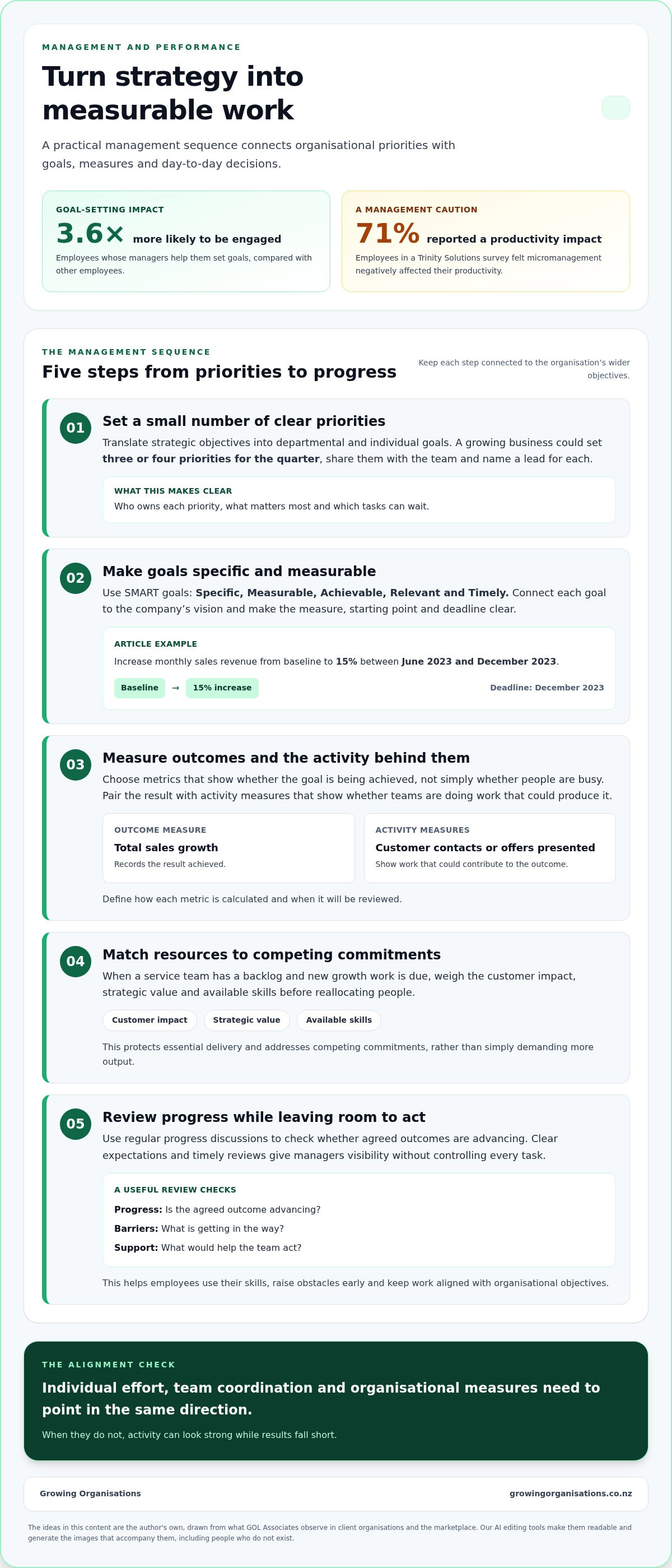
A strategy does not improve results on its own. Improving organisational performance depends on managers turning priorities into clear goals, communicating progress and giving people the support to act. Gallup research found that employees whose managers help them set goals are 3.6 times more likely than other employees to be engaged.
Performance is shaped at several levels. Individual effort, team coordination and organisational measures need to point in the same direction. When they do not, activity can look strong while results fall short.
This article explains how management, communication and change influence performance, and how to choose measures that connect daily work with strategic outcomes. It covers financial and operational results alongside less tangible drivers, including trust, collaboration and engagement. The focus is practical: identify where performance is being created, where execution is breaking down and what leaders can address next.
Key Takeaways
- Set a small number of clear priorities, assign ownership and connect individual goals to organisational objectives.
- Explain the purpose of change, make room for dialogue and give people the support needed to put decisions into practice.
- Choose performance measures that reflect strategy, combining indicators of future activity with results already achieved.
- Assess financial outcomes alongside operational and people factors to understand what is driving performance.
- Track performance at individual, team and organisational levels so leaders can spot gaps and act on their causes.
1. How does management affect organisational performance?
Management turns organisational objectives into work people can understand, prioritise and measure. Without that connection, departments may meet local targets while the organisation misses its wider goals. Improving organisational performance starts with managers clarifying priorities, assigning responsibility and reviewing progress against relevant measures.
Translate strategic objectives into departmental and individual goals. A growing business can set out three or four priorities for the quarter, share them with the team and name a lead for each. This makes ownership visible and helps employees distinguish essential work from tasks that can wait.
Goals should be measurable and attainable, with a clear link to the company’s vision. SMART goals are Specific, Measurable, Achievable, Relevant and Timely. For example, an organisation could set a SMART goal to increase monthly sales revenue from baseline to 15% between June 2023 and December 2023. The measure, starting point and deadline make progress easier to assess.
Choose metrics that show whether a goal is being achieved, not simply whether people are busy. If the objective is sales growth, managers might track total sales growth alongside customer contacts or offers presented. The first measure records an outcome; the activity measures show whether teams are doing work that could produce it. Define each metric clearly, including how it is calculated and when it will be reviewed.
Managers also influence performance through resource decisions. If a service team faces a backlog while new growth work is due, leaders should weigh customer impact, strategic value and available skills before reallocating people. This protects essential delivery and prevents improving organisational performance from becoming a demand for more output without addressing competing commitments.
A UK example is a retailer aiming to improve sales conversion. Managers could align store teams around that objective, build product knowledge and review customer interactions alongside sales outcomes. Improving organisational performance means checking whether the agreed outcome is advancing and whether the team can sustain the practices behind it.
Management style also affects how people use their judgement. A Trinity Solutions survey found that 71% of employees felt micromanagement negatively affected their productivity. Clear expectations and regular progress discussions give managers visibility without controlling every task. This balance lets employees apply their skills, raise obstacles early and keep their work aligned with organisational objectives. A disciplined approach to improving organisational performance makes accountability clear while leaving room for people to act.
2. Change management and communication
Change falters when leaders announce a decision but leave employees to interpret its purpose. Effective communication explains the reason, intended outcome and changes to daily work. For example, a business changing its customer service model should explain which customer problem it is addressing, what teams must do differently and how progress will be reviewed.
Leadership requires two-way communication, not a broadcast followed by silence. Set out the case for change, invite questions from affected teams and respond to practical concerns. Employees closest to the work often see barriers executives miss. A warehouse team, for instance, can explain how a new dispatch process affects handovers, workload and customer delivery before problems become widespread.
Timing matters. Share information while people can still influence implementation, then provide updates as decisions develop. A useful update states what has changed, what remains undecided and who owns the next action. If a project changes delivery procedures, a manager should tell staff before the new process begins, gather feedback during rollout and address confusion promptly.
Delegation turns communication into accountable action. Leaders should define the outcome, decision boundaries, resources and escalation route for each responsibility. A manager delegating a revised team schedule might clarify required coverage, identify who can approve swaps and set a point to review the arrangement. Clear boundaries let employees act while keeping managers informed of risks.
Communication should reflect different roles. The board may need a concise view of strategic risk, while a frontline employee needs practical instructions for the next shift. Keep the core message consistent, but translate it into relevant actions. A change plan can include an executive summary, team briefings and role-specific guidance.
Gartner research found leadership and management effectiveness was businesses’ most frequent top HR priority, followed closely by organisational and change management. That signals a practical leadership task: equip managers to explain decisions, listen well and delegate effectively. Trinity Solutions found that 79% of employees had experienced micromanagement. During change, excessive control can narrow collaboration and discourage employees from raising issues early.
Use regular coaching check-ins to surface obstacles while teams can still respond. Ask what is working, where the process is breaking down and what support would help. Record agreed actions and revisit them at the next discussion. This creates a clear feedback loop instead of waiting for a formal review to reveal unresolved problems.
When leadership teams need to connect strategic decisions with practical delivery, change implementation support can help clarify responsibilities, communication and follow-through. The test is whether employees understand the change, can contribute to it and know how their work moves the organisation toward its intended outcome.
3. Defining performance in line with organisational strategy
Performance measures are valuable when they show whether the strategy is working. Start with the intended outcome, then identify the operational changes and customer behaviours that should produce it. A business seeking sustainable sales growth, for example, might map how product availability, customer experience and repeat purchases contribute to revenue.
A strategic map makes these connections visible. It links organisational objectives to the work of functions and teams, showing where one result depends on another. A retailer could connect its customer-retention objective to service quality, staff capability and repeat purchasing. This helps leaders determine whether weak retention reflects a customer-facing issue or a gap elsewhere in delivery.
Key performance indicators (KPIs) should test those links. Conversion rate, average order value and total sales growth can indicate commercial performance, but each answers a different question. Conversion rate measures how effectively interest becomes a sale. Average order value indicates the value of each transaction. Total sales growth shows the broader result. Select indicators because they inform a decision, not just because the data is readily available.
Separate leading and lagging indicators. Lagging indicators show what has happened, such as sales growth over a completed period. Leading indicators help predict outcomes, such as customer enquiries or repeat visits. Use both to guide action: if leading indicators weaken, managers can investigate before the final results reveal the problem. Employee and customer feedback can explain what the figures alone cannot.
Management determines whether strategic measures influence daily choices. Leaders must assign responsibility for each KPI, agree how it is defined and review whether it still reflects the strategy. If a measure rewards short-term sales but the business depends on customer retention, managers may create pressure for transactions at the expense of lasting relationships. That is a strategy problem, not simply a reporting issue.
Technology investment should follow a clear performance need. A Gartner study cited in the research found that 70% of businesses were looking to increase investment in technology to boost productivity and efficiency. For executives, the decision is not whether technology is fashionable. It is whether a proposed investment removes a defined constraint, improves a process or gives managers better information for decisions.
Review the strategy map when market conditions, customer behaviour or operating capacity change. Check whether the indicators still measure the intended outcomes, then adjust priorities or resource allocation if the evidence points to a mismatch. Better measurement is useful only when leaders act on feedback. A clear chain from strategy to indicators helps teams understand what performance means and where their work contributes.
4. Financial, operational and shareholder-return measures
Financial measures show whether commercial activity is producing viable results. Common measures include return on investment, revenue growth and profit margins. Read them together. Revenue can rise while margins narrow, so growth alone may conceal rising costs or weak returns on investment.
Shareholder return offers another perspective. It helps owners assess the value created through business performance and decisions about distributing or reinvesting returns. The right measure depends on the organisation’s strategy and ownership priorities. A board should consider shareholder returns alongside the capacity to fund operations, development and future growth.
Operational metrics show how reliably work moves from input to outcome. A manufacturer might track production volume, rework and delivery performance; a service business might examine completed cases, delays and customer outcomes. These measures help identify where time, materials or employee effort are being lost. They also show whether a financial result reflects sustainable efficiency or short-term pressure.
Capacity planning connects demand with available people, equipment and processes. Compare planned and actual performance, then investigate each material variance. If a team misses delivery targets while demand rises, leaders should examine workload, handovers and bottlenecks before adding capacity. Root cause analysis helps distinguish a temporary disruption from a recurring process problem.
That diagnosis matters because productivity is not simply more output. If an organisation increases volume while errors and rework climb, apparent gains may be undermined by extra costs. McKinsey’s study cited in the research says top performers are 800% more productive than average performers. The useful management question is what enables stronger output, such as better processes, decisions or deployment of skills.
Bring relevant internal expertise to the problem. Finance support helps leaders understand margin movement, investment returns or the financial impact of a proposed response. Operational support can map work, test capacity assumptions and locate process constraints. HR input can clarify how workforce capability, role design or development needs affect delivery. Each function should address a defined cause, not add reporting without a decision attached.
Use a practical review sequence. First, identify the result that has moved, such as profit margin or delivery performance. Next, compare actual performance with the plan and locate the variance. Then ask which operational or workforce conditions explain it. Finally, agree corrective action and review whether it improves efficiency and the intended financial outcome.
For example, a UK service firm facing longer case times could compare workload and completion data with customer outcomes. Finance can assess the cost impact, operations can locate delays, and HR can identify relevant skills gaps. Leaders can then judge whether the response improves productivity without weakening service quality or shareholder returns.
5. Performance measurement at individual, team and organisational levels
Performance measurement works when leaders connect three levels: an employee’s contribution, the team’s delivery and the organisation’s results. Revenue and market share show tangible outcomes. Collaboration, trust and employee engagement reveal conditions that can shape those outcomes. Measuring only the final result leaves leaders with limited insight into how it was produced.
At individual level, agree goals linked to the employee’s role, then review results alongside development needs. A performance review gives a manager and employee time to discuss strengths, barriers and next steps. Personal development plans should be reviewed and updated regularly so actions reflect current responsibilities and performance, not an outdated role.
Team measures show whether people coordinate effectively. A sales team might review customer contacts, visits and offers presented every week, then compare activity with results. A project team could examine delivery progress alongside handover quality. These measures help identify whether a performance gap lies in an individual task, a team process or dependencies across functions.
At organisational level, leaders need measures that reflect both commercial outcomes and the workplace culture supporting them. Employee engagement surveys, pulse checks and 360-degree feedback can surface patterns in collaboration and trust. A 360-degree process gathers input from multiple sources to assess an employee’s performance. Used alongside business results, this feedback helps leaders see where behaviours support or impede delivery.
To identify performance gaps and their root causes, compare planned with actual results at each level, then trace the variance through the work and feedback behind it. Root cause analysis helps distinguish symptoms, such as missed deadlines, from causes, such as unclear handovers, capability gaps or competing priorities.
Keep measurement focused. Limiting each function to three or four key performance indicators reduces confusion and keeps priorities clear. Avoid vanity metrics that look impressive but reveal little about meaningful outcomes. If a team tracks output volume but ignores customer experience, professional development and colleagues’ contributions, its dashboard may conceal weaker performance.
Performance data should prompt decisions, not just fill reports. If individual targets are met while team results decline, examine incentives, workload and collaboration. If organisational results weaken despite strong team activity, review whether local measures reward the wrong behaviours. Regular performance controls give managers time to act when results diverge from plans.
Use this framework to connect everyday behaviour with organisational results, then agree corrective action where evidence shows a gap. For support aligning measures with practical business priorities, develop a performance improvement plan.
Growing Organisations: Consultancy and Development
Growing Organisations works with leadership teams through Consultancy and Development when strategy, communication and performance measures are not translating into consistent action. Its Business Growth Strategy and Implementation service helps organisations shape practical commercial growth initiatives and put them into effect.
This support is relevant when leaders have identified performance gaps but need a clearer route from diagnosis to delivery. That can involve aligning priorities across functions, strengthening execution or connecting measures with the work teams need to do. The focus is on the organisation’s specific challenges and the changes required to address them.
If your leadership team is ready to turn performance priorities into practical action, contact Growing Organisations or visit growingorganisations.co.nz.
Turn performance insight into the next decision
The next step is not to measure more. It is to decide what the evidence requires leaders to change. Choose a performance gap relevant to the organisation’s direction, identify a decision within your control and assign ownership for moving it forward. Then assess whether the action changes the underlying conditions, not just the reported result.
That discipline makes improving organisational performance an ongoing leadership responsibility rather than a periodic review exercise. It gives the board and executive team a stronger basis for deciding where to focus, what to stop and which capabilities need attention. Progress depends on making those choices clearly and following through.
Growing Organisations offers Consultancy and Development, alongside Business Growth Strategy and implementation, for leadership teams working through these challenges. Contact Growing Organisations to discuss the priorities your organisation needs to move forward. A clear next decision can give your team a practical starting point.
Frequently Asked Questions
How does management affect organisational performance?
Management affects how quickly an organisation responds to problems and opportunities. For example, a manager who clarifies which decisions a team can make locally can reduce avoidable delays. The manager should also specify which decisions need executive approval, such as changes affecting a major customer commitment. These boundaries help people act confidently while keeping decisions consistent with the organisation’s direction.
Why Focus on Organisational Goals and Performance Now?
Organisational goals give leaders a basis for choosing between competing demands. If a Scottish business is considering a new service, executives can assess whether it supports the business’s direction and whether the organisation has the capacity to deliver it. This makes trade-offs explicit and helps managers explain why some proposals proceed while others are deferred or stopped.
How can I improve team performance without micromanaging?
Agree the result, boundaries and decision rights, then let the team choose how to organise its work. A project manager might set acceptance criteria and a reporting point while allowing team members to divide tasks and adjust their approach. If a customer commitment or agreed scope is at risk, the team knows when to escalate. Review decisions and outcomes, not every movement.
What are some examples of good management practices that increase employee productivity?
Managers can improve day-to-day output by removing recurring obstacles and making priorities visible. For instance, if employees repeatedly wait for the same approval, a manager can clarify who has authority to decide. They can also pair an employee with an experienced colleague to build confidence in a specific task. These actions address practical constraints instead of adding activity without purpose.
What are the organisational benefits of effective management?
Effective management helps an organisation respond consistently when work crosses team boundaries. A manager who records a recurring customer issue and shares it with relevant teams can help prevent the same problem appearing elsewhere. Clear ownership also reduces duplicated effort. Over time, leaders gain a better view of where knowledge sits and which processes depend too heavily on individual employees.
What areas of an organisation are most impacted by management?
Management strongly influences decision-making, coordination, resource use and the employee experience. Consider a Scottish organisation where sales promises a delivery date without involving operations. This affects customer expectations and internal workload. Managers can address the problem by establishing a shared handover process and agreeing what information each team needs before making commitments.
What are the key measures of organisational performance?
Useful measures reflect the organisation’s priorities and the decisions leaders need to make. A service organisation might examine whether customers receive a complete resolution, rather than counting only cases closed. A board can also review whether teams are building capabilities needed for future work. Measures should be clear to the people responsible for acting on them.
What strategies improve productivity, efficiency and quality?
Choose a work process with a clear problem, then observe how it moves from start to finish. Ask employees where information is missing, approvals stall or errors first appear. Trial a focused change, such as a clearer handover record, and review whether it reduces rework without creating new problems. Keep the change only if it improves the result that matters.
The ideas in this article are the author’s own, informed by what GOL Associates observe in client organisations and the marketplace. AI editing tools help make them readable and generate accompanying images, including depictions of people who do not exist.