A growth strategy rarely stalls because the leadership team lacks ambition. It stalls when priorities meet limited capacity, competing initiatives and decisions that keep getting deferred. Growth strategy implementation is where strategic intent becomes owned work, or remains on paper.
A long list of priorities will not create focus. The harder task is agreeing what to pursue, assigning clear accountability and making trade-offs when the organisation cannot do everything at once. Progress meetings help only when they lead to decisions and action.
This article sets out a practical framework for translating growth priorities into initiatives with clear ownership and evidence of progress. It covers how to keep leadership attention on the work, resolve competing demands and review assumptions before teams invest further effort. The aim is sustained execution supported by the organisational capability to make progress over time.
Key Takeaways
- Turn each growth priority into a defined initiative with an accountable owner and a clear review point.
- Use growth strategy implementation to connect leadership choices with coordinated work across the business.
- When priorities compete, compare their strategic contribution, dependencies and capacity before committing resources.
- Make progress reviews lead to a decision: examine the evidence, resolve a barrier or revisit an assumption.
- Tailored consultancy can help leadership teams identify growth opportunities, establish actionable plans and build the capability to sustain execution.
What growth strategy implementation means beyond having a plan
Agreeing that the business should grow through existing customers is a strategic choice. It does not, by itself, change what teams do on Monday morning. Unless leaders define the work, assign responsibility and make room for it, existing commitments will continue to set the agenda.
Growth strategy implementation is the process of turning strategic choices into coordinated work, accountable ownership and leadership decisions that move the business towards its intended outcomes. It connects direction to the decisions and changes required across the organisation. Strategy sets the destination; implementation determines how the business will act and respond as work progresses.
The distinction between strategic direction and practical action is also reflected in discussions of a growth platform, which considers strategic and tactical approaches to growth. For leaders, the test is not whether a plan describes an opportunity. It is whether the organisation is making choices that pursue it.
How is implementation different from strategy formulation?
Formulation determines direction: which opportunities the business will pursue and what it will prioritise. Implementation establishes how the organisation will act. It clarifies who is accountable, what work must change and which decisions leaders need to make when delivery meets constraints.
For example, a priority to grow sales through existing customers could become an initiative to review account coverage and introduce a consistent process for identifying unmet customer needs. That initiative needs an owner and leadership attention. Without both, the priority remains an intention rather than a change in how the business works.
What does implementation look like in a working organisation?
Implementation is visible in the choices leaders make. Teams can explain which work supports the agreed growth direction. Initiative owners can raise dependencies or barriers, and executives can decide what to pause, change or resource. Priorities affect actual plans, not just presentations.
Activity alone is not progress. More meetings, reports or tasks may use capacity without advancing the intended outcome. Ask whether the work is producing evidence of movement, such as a validated customer need or a resolved delivery barrier, and whether leaders are responding to what that evidence shows.
Effective implementation aligns ownership, resources and decisions with the growth outcomes the organisation has chosen to pursue.
Implementation is not a one-off handover from the boardroom to delivery teams. Leadership remains accountable for the conditions around the work: competing demands, unresolved dependencies and assumptions that may no longer hold. When those conditions change, leaders need to decide how to keep the initiative relevant rather than letting it continue by default.
For the executive team, the practical measure is whether strategic intent changes operating choices. If teams cannot identify what takes priority, who owns the work or which leadership decision is needed next, the plan has not yet become implementation.
How to turn growth priorities into owned work
A priority becomes executable when leaders can trace a clear line from the result they want to the work someone is authorised and able to deliver. Keep that line visible. Otherwise, teams may stay busy while interpreting the same priority in different ways.
Translate a strategic outcome into a focused initiative
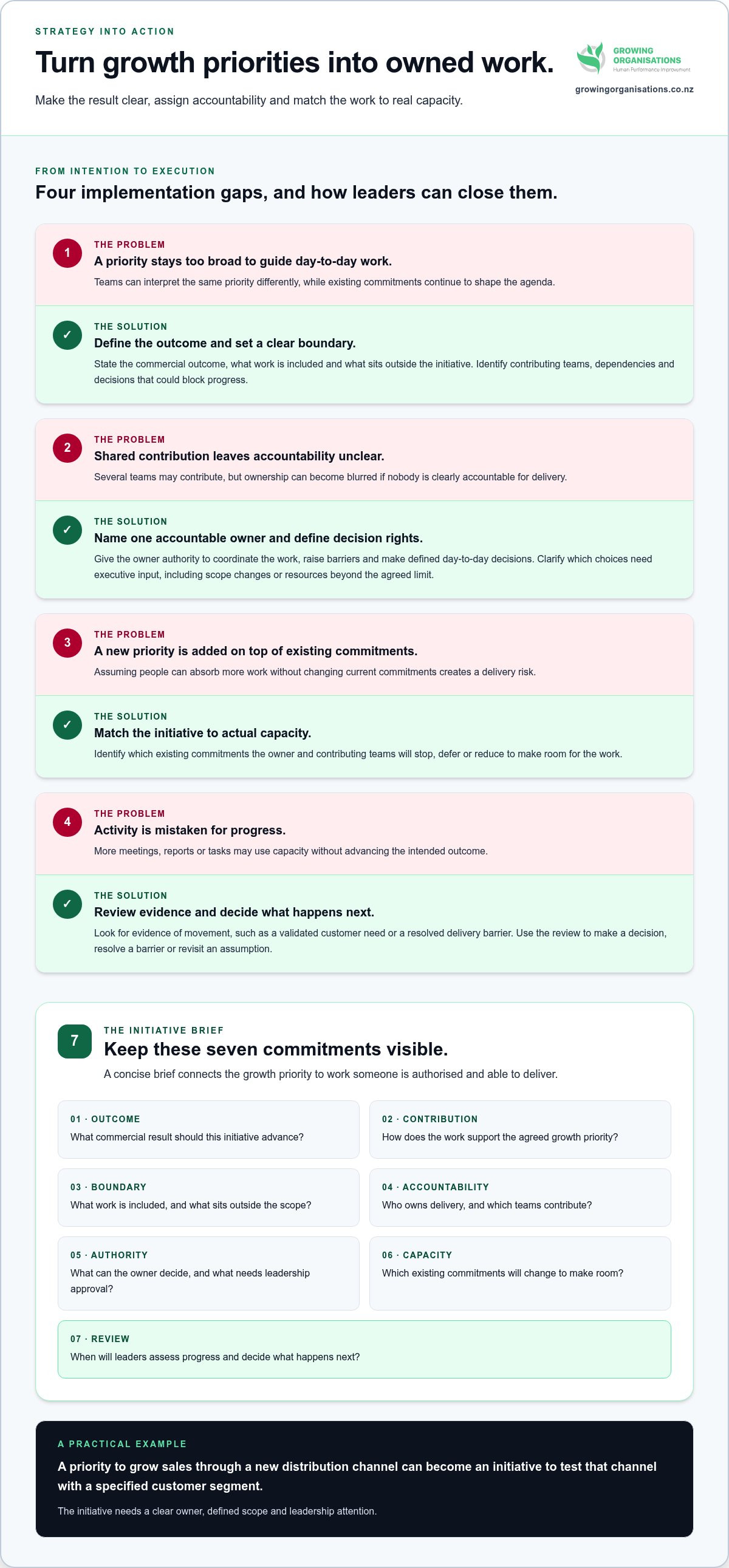
Start with the intended commercial outcome, not a task list. If the agreed priority is to increase sales through a new distribution channel, state the outcome the business is pursuing. Then define an initiative with a clear boundary, such as testing the channel with a specified customer segment. This is not a new strategy exercise. It is a practical definition of work that advances an existing choice.
Make the scope clear before work begins. What is included and what is not? Which teams need to contribute? What decisions or dependencies could block progress? A defined boundary helps teams focus and gives leaders a basis for deciding whether requests belong within the initiative or need separate consideration.
Assign ownership, decision rights and capacity
Name one accountable owner. Other teams may deliver essential parts, but shared contribution should not mean shared accountability. The owner needs authority to coordinate the work, raise barriers and make defined day-to-day decisions. Set out which choices require executive input, such as changing the initiative’s scope or committing resources beyond the agreed limit.
Then match the work to actual capacity. Identify what the owner and contributing teams will stop, defer or reduce to make room. Assuming people can absorb another priority on top of existing commitments is not a capacity plan. It is a delivery risk.
Use a concise initiative brief to keep the commitment practical:
- Outcome: What commercial result should this initiative advance?
- Contribution: How does the work support the agreed growth priority?
- Boundary: What work is included, and what sits outside its scope?
- Accountability: Who owns delivery, and which teams contribute?
- Authority: What can the owner decide, and what needs leadership approval?
- Capacity: Which existing commitments will change to make room?
- Review: When will leaders assess progress and decide what happens next?
Keep the connection to the strategic priority explicit. If a proposed task does not contribute to the intended outcome, resolve a dependency or answer a necessary question, it may be activity rather than implementation. This test helps prevent an initiative from expanding into loosely related tasks.
Clear ownership turns an agreed priority into practical execution by giving one person the mandate, capacity and decision path to move the work forward. This is the operating discipline at the heart of growth strategy implementation. A business growth strategy and implementation consultancy can help leadership teams shape initiatives around their priorities and organisational capacity.
How to protect implementation when growth priorities compete
Implementation can become extra work if leaders add initiatives without changing existing commitments. The answer is not to ask teams to stretch further. It is to decide openly which work deserves scarce capacity, what must wait and what should stop. Otherwise, every priority remains active on paper while attention is spread too thinly across the business.
How should leaders compare competing growth initiatives?
Compare each initiative against the agreed growth outcome, then make its demands visible. Consider the people and leadership attention it needs, the work it depends on and whether those dependencies are ready. A promising idea may still need to wait if another initiative is a direct prerequisite or if the same specialists are already committed elsewhere.
Use a comparison to inform judgement, not as a universal scoring formula. The purpose is to expose trade-offs and make the reasons for a decision clear.
| Assessment | Questions for leaders | Possible implication |
|---|---|---|
| Strategic contribution | How directly does the initiative advance the agreed growth outcome? | Proceed when the connection is clear. Rework or stop activity that has no credible link. |
| Dependencies | What decisions, capabilities or other work must be in place first? | Sequence the initiative if a necessary condition is not ready. |
| Capacity and attention | Which teams and leaders must contribute, and what current work will give way? | Proceed only when capacity is explicit. Defer if delivery depends on unavailable people or unresolved commitments. |
For instance, a business might be weighing a new route to market against improvements to its customer onboarding process. If the route depends on reliable onboarding, leaders may sequence the work rather than launch both at once. The decision should reflect the actual dependency and available capacity, not an assumption that one type of initiative is always more valuable.
What work should leaders defer or stop?
Review the current workload against the people and leadership attention required for the chosen growth work. Look for lower-priority projects, recurring tasks or requests that use the same capability without contributing as directly to the outcome. Make a specific choice: stop the work, reduce its scope or defer it until a stated condition changes.
A pause is not the same as abandonment. Record why the initiative is paused, what condition would justify restarting it and who will revisit the decision. Without that clarity, deferred work can continue to draw attention through informal requests or return to the agenda without fresh consideration.
Focus requires explicit choices about what will not receive capacity while the business pursues its agreed priorities. That discipline protects growth strategy implementation from becoming a longer list of simultaneous demands. It also gives teams a credible basis for raising conflicts early, before competing commitments undermine delivery.
How to review progress and adapt growth strategy implementation
A review is useful only if it changes what happens next. Reporting activity without resolving barriers or making decisions turns the meeting into an update, not a management tool. For growth strategy implementation, leaders need a simple cycle: examine evidence, address what is blocking progress, then agree and record the next decision.
What should an implementation review resolve?
Keep the discussion tied to the agreed strategic outcome. Ask whether the initiative still contributes to it, what the latest evidence shows and what is preventing the next step. The aim is not to inspect every task. It is to identify the issues that require leadership judgement or action.
- Examine the evidence. Consider what has changed since the previous review, what the team has learned and whether there is credible progress towards the intended outcome. Separate observed facts from interpretation.
- Resolve a barrier. Identify whether progress is constrained by a dependency, a resource decision, unclear authority or a delivery issue. Agree who will address it and what support or decision is needed.
- Make and record a decision. Confirm whether to continue as planned, change the activity, alter the sequence or investigate an emerging concern. Record the rationale, the accountable person and the next review point.
This is a leadership conversation, not a detailed metric-design exercise. Evidence should be relevant enough to support a decision, but the review does not need to settle every question about measures for a wider performance framework. Avoid allowing a debate about reporting detail to displace the decision the initiative needs now.
When should leaders adapt the work or revisit an assumption?
First distinguish a delivery problem from a change in the conditions the initiative relies on. If a team is delayed because a decision is outstanding, address the barrier. That alone does not show that the strategic assumption is wrong. If evidence suggests customer demand, access to a channel or another key condition has changed, leaders should examine whether the original rationale still holds.
Adapt the work in proportion to the evidence. A temporary constraint may call for resequencing or a change in execution. Strong evidence that a core assumption no longer holds may justify revisiting the initiative’s scope or its role in the growth priority. Do not abandon the intended outcome simply because the first route has become difficult. Equally, do not keep backing an activity just because the original plan was approved.
Record what evidence would trigger another review, rather than leaving the decision open-ended. This gives the team a clear basis for continuing, adapting or stopping the work and keeps leadership attention on the choices that need a decision.
Growing Organisations provides structured support to review decisions and keep execution connected to growth priorities. Explore practical strategy and implementation support.
How Growing Organisations supports growth strategy implementation in Scotland
For Scottish organisations, the challenge is not simply choosing an ambition. It is making that ambition workable across the business, with leadership decisions and operational effort aligned behind it. Growing Organisations works with leadership teams as a consultancy partner, helping translate growth priorities into practical commercial initiatives and supporting their implementation.
The starting point is the organisation’s circumstances. A growth opportunity may involve reaching a different customer group, developing an existing offer or improving how the business converts demand into sales. The right initiative depends on the strategic priority, the organisation’s capabilities and the constraints leaders need to address. Tailored advice helps leaders make these choices for their business.
What does tailored implementation support involve?
Tailored support connects an agreed priority with the work needed to pursue it. Growing Organisations helps leaders clarify the commercial opportunity, shape it into an actionable initiative and identify what must change for delivery to proceed. This can include clarifying the initiative’s purpose, identifying dependencies and bringing leadership attention to decisions that would otherwise hold up execution.
Growing Organisations works with leaders to put strategy into operation, not simply hand over a plan. The focus stays on practical questions: how the initiative fits current operations, where responsibilities need to be clear and what organisational constraints could affect progress. The approach is adapted to the business rather than built around assumed spare capacity or a fixed sequence.
For example, if a business has agreed to pursue a new customer segment, implementation work can help leaders turn that direction into a defined commercial initiative. The team can clarify the steps required to serve that segment, the internal contributions involved and the decisions that need executive input.
Hands-on support keeps attention on execution as conditions emerge. If a dependency is unresolved or the organisation needs to strengthen its ability to deliver, leaders can address that as part of the implementation work. This keeps the plan connected to the day-to-day reality of the business.
How does organisational development support sustained execution?
Growth depends on more than launching initiatives. Operational performance and internal capability influence whether the organisation can take on new work alongside existing responsibilities. Organisational development can strengthen how people work together and build the capability required for delivery. The needs differ by business, its priorities and the demands of each initiative.
Growing Organisations combines strategy and implementation consultancy with organisational development, addressing both the commercial work and the capability needed to sustain it. The focus is on strengthening performance and internal capability. For Scottish leadership teams, this means working on the organisation’s actual execution needs rather than assuming a solution designed elsewhere will fit.
If your leadership team is ready to turn growth priorities into actionable work, discuss your organisation’s growth priorities with Growing Organisations.
Make your next leadership decision count
Bring one growth priority into the next leadership conversation and make a firm commitment around it. Decide what the organisation is prepared to back, what will need to change and what evidence would cause you to reconsider. That conversation sets the standard for growth strategy implementation: focused choices backed by leadership action.
For Boards, Chairs, CEOs and executive teams, the test is whether those choices hold when new demands compete for attention. Consistent leadership gives teams a clearer basis for action and makes it easier to address issues before they become accepted operating constraints.
Growing Organisations works with leadership teams on the commercial choices and practical changes involved in growth. Use the initiative brief above to clarify ownership, capacity and the next leadership decision.
Frequently Asked Questions
How long does growth strategy implementation take?
There is no fixed duration for growth strategy implementation. Timing depends on the scope of the priorities, the organisation’s capacity and the decisions or dependencies that need resolution. A Scottish business may make early progress on a contained initiative, while broader changes to roles or processes take longer to embed. Set review points around evidence and decisions, not an assumed end date. Avoid promising a finish date before the work is understood.
Can a business implement a growth strategy without changing its organisational structure?
Yes. A strategy does not automatically require a restructure. Leaders can clarify responsibilities and decision routes within the existing structure first. For example, if a customer initiative needs input from sales and operations, a clear agreement about how those teams coordinate may address the problem without changing reporting lines. Consider structural change only when the current arrangement repeatedly prevents defined work from progressing. A new organisation chart cannot replace sound priorities or follow-through.
Is growth strategy implementation the same as project management?
No. Project management can help teams plan tasks, track dependencies and manage delivery dates. Leaders should also define what a completed project must leave in place for the business to use its output. For example, a new sales process may need clear handover arrangements and staff readiness, not just a launch date. Agreeing those acceptance conditions early helps prevent a project from being marked complete before its work is usable.
Can a business begin implementation before its next annual planning cycle?
Yes, if leaders have agreed the priority and can make the ownership and resource decisions needed to start. A contained first stage may allow the business to test a key assumption without committing to wider work prematurely. Waiting can be sensible if a critical dependency is unresolved or capacity is already committed. Timing should reflect the organisation’s readiness, not a desire to appear decisive or a preference for the planning calendar.
How should leaders communicate a growth strategy to employees?
Explain the intended direction and what it means for teams’ work. Be clear about what should take precedence, which decisions employees can make and how they can raise delivery constraints. For example, a team should understand whether an existing task is being paused to make room for a new initiative. Communication needs to continue as decisions change. Consistent explanations help employees understand the chosen work and what leaders have decided not to pursue.
What should leaders do when an initiative does not deliver the expected progress?
Start by checking the delivery record against the commitments the team made. Look for practical causes such as unplanned work entering the scope, repeated waiting for input or milestones set without the necessary people available. Ask the initiative owner and contributors to identify where the plan stopped matching the work on the ground. Use that diagnosis to reset delivery expectations, clarify responsibilities and share the revised plan with affected teams.
To put a growth priority into action, discuss your organisation’s priorities with Growing Organisations.