A strategy slide deck can make a weak decision look settled and authoritative. If you’re asking whether a business strategy consultant for your company can help make it so, then start with the decision your leadership team needs to make, not with what a consultant might say.
The right support helps leaders make clearer commercial decisions and connect them to practical action. Both.
It’s reasonable to be wary of polished advice that overlooks how your company works or leaves implementation to an already stretched team. Strategy advice and implementation support each address different needs, but they should align when the work requires both.
This article explains how to assess what your company needs, compare advisory approaches and judge whether a consultant understands your business and leadership team. For organisations in Scotland, it also offers a practical way to discuss how commercial priorities can become accountable action.
Key Takeaways
- Start with the commercial decision your leadership team needs to make, then define the support required to move it forward.
- Assess whether a business strategy consultant for my company understands your context, tests assumptions and connects advice to practical action.
- Distinguish strategy advice from implementation support and interim expertise by identifying the need each type of engagement addresses.
- Prepare the decision, business context and constraints for a discussion about your organisation in Scotland, without steering the conversation towards a predetermined answer.
- Growing Organisations uses its Kairos methodology, integrated with the Business Model Canvas, to support strategic decisions with leadership teams.
What an Aberdeen company should expect from a business strategy consultant
A business strategy consultant advises leaders on commercial choices and helps turn agreed priorities into action. The work should begin with the decisions facing the organisation, rather than a pre-set presentation or generic plan. It can help clarify where to focus, what to change and what the leadership team needs to do next. Leaders retain responsibility for the decisions, while the adviser brings structure and perspective to the work.
For a company in Aberdeen or elsewhere in Scotland, location is useful context, not a strategy in itself. A consultant should understand the operating reality you describe: your customers and suppliers, how your teams work, and the constraints shaping the decisions ahead. This keeps the advice grounded in your organisation instead of relying on assumptions about Aberdeen or Scotland.
When external strategy advice is useful
External advice can be useful when priorities compete, growth has stalled, a major change is under consideration or the leadership team cannot agree on the next move. An independent perspective can test assumptions and make trade-offs easier to see. It should sharpen the discussion, not take the decision away from the Board, Chairperson, CEO or Executive team.
Be precise about the problem. If the main issue is a lack of people to deliver an agreed plan, the gap is in capacity. If the question concerns legal rights or obligations, it calls for legal advice. A strategic question is different: it asks which direction to take, what to prioritise and how those choices support the organisation’s commercial aims.
What a consultant should leave the leadership team with
Expect more than recommendations on a page. The work should help leaders reach clearer decisions, set practical priorities and agree who owns the next steps. If the answer involves a change in direction, the adviser should explain the reasoning and implications clearly enough for the team to act.
Recommendations need to fit the company’s operating reality. A priority that depends on capacity, skills or processes the organisation does not have is not yet an actionable plan. Discuss constraints openly, including what the team can deliver and what needs to change first. No consultant can guarantee a particular revenue, profit or growth result.
- Ask which decision the engagement is meant to clarify.
- Test whether recommendations reflect the company’s actual constraints.
- Agree what action, ownership and decision-making should follow.
If you are asking, “Is this the right business strategy consultant for my company?”, judge the work by the quality of the decisions and the path to action, not by how polished the final presentation looks. Strategy advice is distinct from recruitment, accounting, legal services and software provision. Its purpose is to help leaders make sound commercial choices and connect them to practical work.
How to assess a business strategy consultant for your company
A polished proposal shows that an adviser can present a case. It does not prove they understand your company or can help leaders make difficult choices. Assess the thinking behind the proposal: how the adviser will learn about your commercial context, test strategic options and involve the people accountable for decisions.
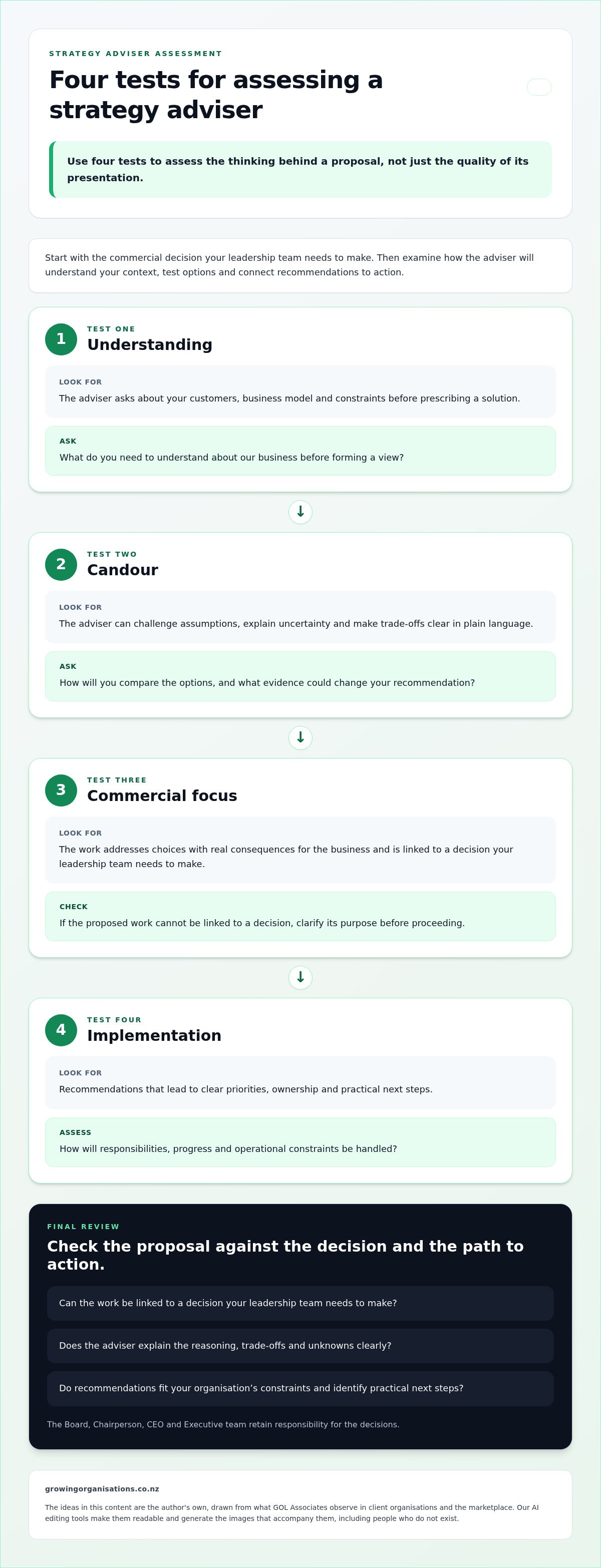
Use four tests. Understanding means the adviser asks about your customers, business model and constraints before prescribing a solution. Candour means they can challenge assumptions and describe uncertainty. Commercial focus means the work addresses choices with real consequences for the business. Implementation means recommendations lead to clear priorities, ownership and practical next steps.
Questions that reveal how an adviser thinks
Ask what the adviser needs to understand before forming a view. Ask how they will compare options and what evidence could change their recommendation. A useful answer explains the reasoning in plain language, including trade-offs and unknowns. If the proposed work cannot be linked to a decision your leadership team needs to make, clarify its purpose before proceeding.
Evidence of fit beyond a polished proposal
Notice how the adviser responds when leaders disagree or the evidence is incomplete. Do they explore the difference, or move past it to preserve a neat story? Look for an approach that involves decision-makers and connects analysis to implementation. Firm size, rankings and presentation quality may describe an adviser, but they do not establish whether the approach fits your company.
Advisory approaches vary, so focus on what the work involves rather than relying on the label.
| Approach | Most useful when | What to assess |
|---|---|---|
| Analysis-led | Leaders need a clearer view of the market, business model or performance drivers. | Whether the analysis addresses a decision, rather than becoming an end in itself. |
| Facilitation-led | The leadership team needs to surface different views and reach a shared position. | Whether discussion produces decisions and resolves key areas of disagreement. |
| Implementation-linked | Strategic priorities are emerging, but the organisation needs support to put them into practice. | How responsibilities, progress and operational constraints will be handled. |
These approaches can overlap. The right balance depends on the decision, the evidence available and the leadership team’s capacity to act. Ask what the work will produce at each stage. Useful outputs might include agreed priorities, a clear rationale for the chosen direction and named owners for follow-through. Analysis without a decision or clear responsibility is not enough.
As a Board member, Chairperson, CEO or Manager, bring a real decision into the conversation. For example, if the company is weighing investment in an existing offer against developing a new one, ask how each option will be assessed against commercial priorities and delivery capacity. This tests whether the adviser engages with the choices your organisation actually faces. Explore tailored business growth strategy as one way to frame that discussion.
Compare strategy advice, implementation support, and interim expertise
These engagements address different problems. Strategy advice helps leaders decide what to do. Implementation support helps turn agreed priorities into operational work. Interim expertise provides temporary capacity or specialist experience for a defined need. The right choice depends on whether the immediate gap is direction, execution or capability.
Different forms of support can be combined, but the purpose of each part should stay clear. If your team has not agreed on a direction, adding delivery capacity may help it move faster without resolving the underlying choice. If the direction is settled but progress is slow, further analysis may add little. Define the need before shaping the engagement.
| Engagement type | Designed to address | Useful focus |
|---|---|---|
| Strategy advice | Unclear choices, commercial direction or business model. | Assessing options and helping leaders decide where to focus. |
| Implementation support | Agreed priorities that need to become coordinated work. | Translating decisions into responsibilities, actions and review points. |
| Interim expertise | A temporary gap in capacity or specialist experience. | Providing focused expertise or delivery capacity for a defined need. |
Choose strategy advice when decisions are unclear
Strategy advice is useful when leaders need to decide between credible options. That might mean testing whether to develop an existing offer, change the business model or pursue a different commercial direction. The adviser should help the team examine the assumptions and implications behind each option before it commits resources. The measure is better-informed decision-making, not the number of pages in a strategy document.
For a Board, Chairperson or CEO considering a business strategy consultant for my company, the key question is whether the work will clarify a live choice. Ask which decisions the engagement is intended to support and how the options will be assessed. If the business already knows its priorities, a strategy exercise may not be the main need.
Choose implementation support when priorities need to become action
Once leaders have agreed priorities, implementation support helps connect them to practical work. This can involve working with the leadership team to clarify responsibilities, sequence activity and address obstacles as they arise. Implementation support does not replace strategic direction. Leaders still own the choices, while the support helps the organisation act on them.
Agree what progress should look like and who will make the relevant decisions. If the challenge is a temporary shortage of expertise or delivery capacity, interim support may fit better than advisory work. Keep the distinction clear: interim expertise supplies capacity, while implementation support helps leaders organise and advance agreed priorities.
When planning business strategy execution, define the decision or delivery gap first, then shape the engagement around it. This makes it easier to judge whether you need advice, practical implementation support, interim expertise or a deliberate combination.
Prepare for a productive consultant engagement in Aberdeen
Good preparation gives an adviser the context to ask better questions. It does not mean building a polished case for a decision already made. For an Aberdeen-based company, explain how the business operates, where its commercial uncertainty lies and what the leadership team needs to resolve. The same applies to organisations elsewhere in Scotland: location is part of your context, not a substitute for understanding your customers, priorities and constraints.
Before the first discussion, bring a short, honest account of the issue. It can be unfinished. Naming disagreements, gaps in evidence or competing priorities gives the conversation a useful starting point.
Clarify the decision before the first discussion
Keep preparation focused on the decision rather than assembling a large pack of background material. A Chairperson, CEO, Managing Director or Manager can use this sequence to frame the conversation:
- Name the decision. State what the leadership team needs to choose or what commercial uncertainty is blocking progress.
- Set out the context. Share the relevant priorities, existing plans and information that shapes the issue. Distinguish established facts from assumptions.
- Identify the constraints. Note limits on capacity, time, investment or decision-making authority that affect what the company can do.
- Define a useful outcome. Describe what leaders should be better able to decide or do after the work. That might mean selecting between options, clarifying a priority or agreeing what evidence is still needed.
This is enough to begin a serious discussion. It is not a brief designed to steer the adviser towards a preferred answer. If the leadership team is divided, say so. A candid account is more useful than presenting agreement that does not exist.
Agree how the work will connect to implementation
Clarify who needs to take part in the work and which decisions belong with the leadership team. Ask how recommendations will become practical priorities, who will own each action and how the team will review progress. Review arrangements should suit the work and the organisation, rather than follow an assumed standard timetable.
Be equally clear about the support required. If leaders need to choose a direction, the engagement should make room to assess options. If priorities are already agreed, discuss how advisory support will connect to the work of putting them into practice. This keeps implementation tied to leadership decisions rather than treating it as a separate activity without a clear strategic purpose.
Choosing a business strategy consultant for my company starts with stating the real question, not perfecting the paperwork. If your team is considering an engagement in Aberdeen, discuss your strategic questions and the support needed to move them forward.
How Growing Organisations works with leadership teams on strategy
Growing Organisations Limited provides business growth strategy and implementation consultancy, working with leadership teams on the decisions their organisations face. The work is tailored to the organisation and its commercial priorities. It connects strategic choices with practical execution, rather than leaving the Executive team with recommendations detached from day-to-day operations.
The firm aims to improve commercial clarity, confidence and organisational capability. For a Board, Chairperson, CEO or Managing Director, this means examining the choices in front of the business and how the organisation can act on them. The approach does not remove leadership responsibility or promise a particular commercial result.
How the Kairos framework supports strategic decisions
Kairos is Growing Organisations’ decision-tree and strategic checkpoint methodology, integrated with the Business Model Canvas. It gives leaders a structured way to examine choices and the assumptions behind them. Checkpoints help the team consider whether its reasoning remains sound as it works through strategic decisions and identify where further thought is needed.
The framework supports discussion; it does not make decisions for the leadership team. Leaders remain responsible for weighing the options against their commercial priorities and operating reality. The framework brings structure to that work, making the basis for a choice clearer and helping the team consider next steps alongside it.
What a tailored advisory relationship is designed to support
Not every organisation needs the same balance of advice and implementation support. The engagement should reflect the question at hand, the leadership team’s capacity and the practical work needed to advance agreed priorities. This may involve clarifying strategic options, then working with leaders to connect decisions to responsibilities and action.
A useful advisory relationship makes room for candid discussion. Leaders need to be able to examine assumptions, acknowledge constraints and adjust their thinking as the work develops. The adviser contributes structure and perspective. The organisation contributes its knowledge, judgement and ownership of decisions.
If you are considering a business strategy consultant for my company, focus the conversation on the strategic priority you need to address and the support that would help your team act on it. Growing Organisations brings its work back to stronger commercial clarity and the confidence and capability to move forward.
Discuss your company’s strategy with Growing Organisations.
Make the next decision count
The next step is not to commission a strategy because the business feels busy or uncertain. Decide what your leadership team needs to resolve and what kind of support would help it move forward. That gives the discussion a clear starting point and keeps the focus on your company’s priorities.
If you are considering a business strategy consultant for my company, look for a working relationship that supports honest debate and practical progress. Growing Organisations’ approach is grounded in Candour, Rigour, Discretion, Mastery and Partnership. Its Kairos framework brings decision-tree thinking, strategic checkpoints and the Business Model Canvas together to structure strategic work.
Your organisation retains ownership of its choices. Useful support helps leaders examine those choices carefully and connect agreed priorities to action. That gives the leadership team a practical basis for moving forward, even when the answer is not yet obvious.
Discuss your company’s strategy with Growing Organisations and set out what your leadership team needs to resolve.
Frequently Asked Questions
How do I know whether my company needs a business strategy consultant?
Consider strategy advice when important commercial choices keep returning without resolution, or separate proposals pull the company in opposing directions. For example, leaders may be unsure whether to deepen an existing offer or pursue a new customer segment. An adviser can help test the assumptions behind each path. Choosing a business strategy consultant for my company starts with a live decision, not a general wish to improve.
Can a business strategy consultant work with our existing leadership team?
Yes. An external adviser can work alongside your existing leadership team, using its knowledge of customers, operations and organisational history rather than replacing it. Involve the people who understand the decision’s commercial and delivery consequences, not only the person sponsoring the work. The Board and executives retain responsibility for choices. A constructive engagement gives leaders room to challenge analysis and refine recommendations before they commit the organisation to action.
What should I prepare before speaking with a strategy consultant?
Bring material that helps explain the decision, not a complete corporate archive. Useful items may include the current business plan, relevant customer feedback, recent proposals and records of earlier decisions that were revisited. Mark which points are confirmed and which remain assumptions. In Scotland, make sure colleagues with important operational or commercial context can contribute, even if they are not part of the Board.
How long does a business strategy consulting engagement take?
There is no single standard duration. A focused piece of work to resolve a defined decision will differ from an engagement that also supports implementation across the organisation. Agree the scope, leadership involvement, expected outputs and points for reviewing progress before work begins. The engagement should be long enough to address the agreed question, but its length should follow the work rather than an assumed consulting timetable.
What is the difference between a strategy consultant and an interim manager?
An interim manager temporarily fills an operational leadership or expertise gap, taking responsibility for defined work within agreed authority. A strategy consultant advises the leadership team on choices and direction, rather than acting as a temporary executive. If the organisation needs someone to run a function while a post is vacant, it needs temporary capacity. If leaders need to decide what that function should deliver, they need strategic advice.
Can strategy advice help a small or owner-managed business?
Yes. A smaller or owner-managed company can use strategy advice to work through a consequential choice without building a large planning exercise around it. An owner considering whether to expand an offer or protect delivery capacity can make assumptions explicit before committing. The engagement should be proportionate to the decision and the organisation’s ability to act, rather than modelled on a larger company’s structure.
How can a company assess whether strategy advice is producing useful progress?
Look for better decision-making and follow-through, not simply reports delivered. Check whether the team has resolved an open question, agreed why it chose a particular option and assigned responsibility for the next action. Then review whether the work is advancing and what new information has changed the plan. Measures should match the priority under review, rather than rely on a generic set of metrics.
[The ideas in this content are the author’s own, drawn from what GOL Associates observe in client organisations and the marketplace. Our AI editing tools make them readable and generate the images that accompany them, including people who do not exist.]