Whether you are assessing business scaling services in Edinburgh or support for a growing enterprise in Auckland, growth plans rarely stall because leaders lack ambition. They stall when priorities have no clear owner, or when the real constraint is strategy, capability or execution. The right support should connect board-level decisions to the work that changes performance, not leave your team with another framework to interpret.
You may already know growth needs more discipline. The harder question is what kind of support will address the constraint without creating an open-ended advisory relationship. This article explains how to assess whether external support is appropriate, compare strategic advice with hands-on implementation, and define the role a consultancy should play.
Growing Organisations provides tailored growth strategy, implementation support and organisational development. Its Kairos methodology uses decision trees and strategic checkpoints alongside the Business Model Canvas (TM) to bring structure to leadership choices. This article offers a practical basis for assessing the scope of support, the ownership required from your executive team and how decisions should link to business performance. The aim is to help you make an informed choice, including whether Growing Organisations is the right advisory partner for your business.
Key Takeaways
- Separate growth ambition from a specific business constraint before deciding whether outside support is warranted.
- Compare scaling services by the work they cover, who owns implementation and how progress is reviewed.
- Before appointing a consultancy, define the issue, agree the scope, assign responsibilities and set measures for review.
- Assess whether Growing Organisations’ strategy and implementation support fits the decisions your leadership team needs to make.
When do businesses need business scaling services?
Growth can increase pressure before it improves business performance. More demand may expose slow decisions, stretched capacity or unclear accountability. Wanting to grow does not, by itself, mean your business needs outside advice. The case for support is stronger when leadership can identify a persistent constraint that internal effort has not resolved.
Business scaling services help leaders make growth decisions and put agreed priorities into action. Scaling does not have to mean rapid expansion. It can mean improving commercial performance, making delivery more dependable or reducing excessive reliance on one person. For a wider view of the idea, see this overview of understanding business scalability.
Consider external support when important priorities keep slipping, execution gaps recur or decisions repeatedly wait for the same person. These are signals to investigate, not automatic proof that a consultancy is needed.
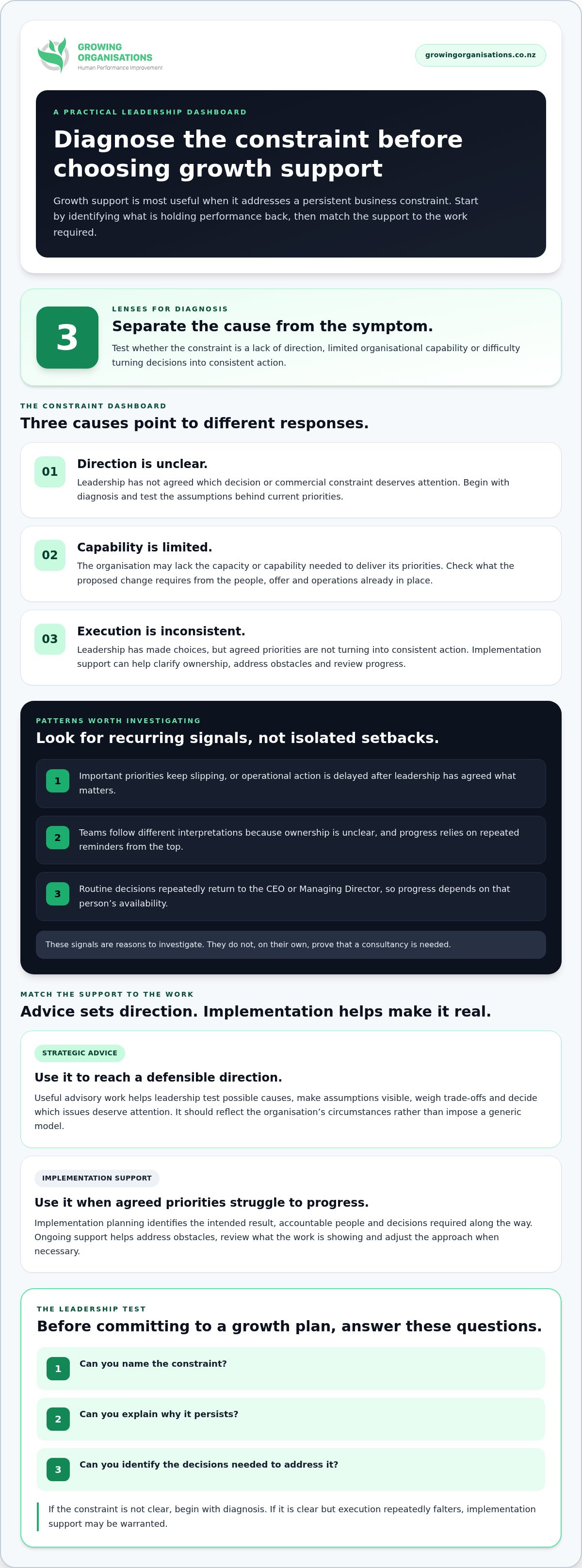
First establish whether the cause is a lack of direction, limited organisational capability or difficulty turning decisions into consistent action. That distinction helps leaders identify the support their business needs.
Signs your current approach is no longer sufficient
Look for patterns, not isolated setbacks. Leadership agrees a priority, but operational action is delayed. Teams pursue different interpretations because ownership is unclear. Important work competes with day-to-day demands, so progress depends on repeated reminders from the top.
A further warning sign is a decision bottleneck. If routine choices keep returning to the CEO or Managing Director, the organisation may lack clear authority or the capability to act without escalation. The issue is not simply that one leader is busy. It is that progress depends on their availability.
What a consultancy should help leadership resolve
Before selecting a growth initiative, the board and executive team need to agree which decision is unresolved and what commercial constraint it affects. Is the business aiming to improve performance in its current market, address a delivery limit or reduce dependence on a key decision-maker? Clear answers keep the work tied to the organisation’s actual needs.
Separate visible symptoms from underlying causes. Delayed delivery may reflect unclear priorities, limited capacity or weak decision ownership. Each points to a different response. Useful advisory work helps leadership test these possibilities, identify what needs to change and determine who must act. It should serve the organisation’s priorities, not impose growth for its own sake.
For business leaders, the practical test is straightforward: can you name the constraint, explain why it persists and identify the decisions needed to address it? If not, begin with diagnosis rather than committing to an expansion plan. If the constraint is clear but execution repeatedly falters, implementation support may be warranted. Choose the intervention based on the evidence and the performance your business needs to improve.
What should business scaling services include?
A useful scaling engagement should give leadership a sound basis for choosing what to change, then make the next actions clear. Start with diagnosis: examine the commercial position, how work is organised and the assumptions behind current priorities. The adviser and leadership team can then distinguish causes from symptoms and decide which issues deserve attention.
Strategic choices should be selective. A broad list of initiatives can create more competing demands without clarifying what the business should do first. A focused direction makes the trade-offs visible, including what the organisation will defer. For general management context, the SBA guidance for business growth offers an external reference, while the decisions themselves must reflect your organisation’s circumstances.
From commercial diagnosis to an agreed growth direction
Diagnosis should give the board and executive team a shared view of the issue before they commit resources. This means testing whether a proposed change fits the organisation’s commercial aims and current capability. A business considering a new customer segment, for example, needs to understand what serving that segment would require from its existing offer and operations. The purpose is not to create a catalogue of possibilities. It is to reach a defensible direction with clear reasons behind it.
Good advice also makes assumptions visible. Leaders can then decide which assumptions are strong enough to act on and which need further evidence. This keeps strategy grounded in the business rather than in a generic model.
From strategy into implementation
Once leadership has made its choices, implementation planning translates them into owned work. It should identify the intended result, the people accountable for moving the work forward and the decisions that need to be made along the way. This gives the executive team a basis for resolving capacity conflicts and keeping agreed priorities from being displaced by lower-value activity.
Implementation support goes beyond a plan. It helps leadership address obstacles as they arise, review what the work is showing and adjust the approach when necessary. Measures should reflect the outcomes the team agreed to pursue, not simply count meetings or completed tasks.
Organisational development can strengthen the capability needed to sustain change. That might mean clarifying responsibilities or improving how teams make decisions across the organisation. The specific work depends on the issue identified. The aim is to build durable commercial capability, not add process for its own sake.
For leaders assessing the practical side of an engagement, business strategy execution support should connect agreed priorities to accountable work and review, while leaving business decisions with the leadership team.
How should businesses compare scaling consultancy options?
Compare the work an engagement will do, not the label attached to it. A strategy-only adviser helps leadership reach and test decisions. Implementation support helps turn agreed priorities into action. Integrated advisory connects those stages. The right model depends on the issue your business needs to resolve and the leadership capacity available to move the work forward.
For any particular business, that might mean choosing between external help to set a clearer direction and support to put an agreed priority into practice. The same comparison applies to business scaling services in a different location. A recognisable framework can provide structure, but it does not prove that its assumptions, pace or focus suit your organisation or its context. Fit comes from the work itself.
Use this comparison to make the differences explicit:
| Engagement model | Scope | Leadership involvement | Implementation responsibility | Progress review |
|---|---|---|---|---|
| Strategy-only advice | Diagnosis and strategic choices | Leaders provide context and make decisions | Primarily held by the business | Reviews whether the direction remains sound |
| Implementation support | Delivery of agreed priorities | Leaders set direction and remove barriers | Shared or assigned by the agreed scope | Tracks progress against agreed work |
| Integrated advisory | Strategy through to execution support | Leaders remain involved in decisions and ownership | Adviser and business work to defined responsibilities | Connects delivery reviews with strategic choices |
Strategy advice, implementation support, or both?
Strategy-only work suits a decision that leadership has not yet resolved, such as which commercial direction to prioritise. Implementation support is relevant when the direction is agreed but the organisation needs help progressing the work, coordinating responsibilities or addressing barriers. Integrated advisory links those needs. It can maintain continuity from decision to delivery, but it cannot guarantee results or replace leadership accountability.
Assess fit against your leadership priorities
Start with the commercial issue the engagement must address. Then assess whether the proposed scope includes direct collaboration with the executive team and makes responsibilities clear. A sound fit gives leaders a practical way to review progress, revisit decisions when conditions change and keep work aligned with agreed priorities. It should not substitute a framework for judgement.
Ask what the adviser will contribute at each stage. If the proposal focuses on recommendations, establish how your leadership team will own delivery. If the priority is implementation, clarify how progress and obstacles will be reviewed. For integrated work, confirm that strategic decisions and execution remain connected rather than becoming separate workstreams. This comparison gives the board and executive team a clear basis for matching support to the organisation’s needs.
How can you assess a business scaling consultancy before appointing it?
Before appointing an adviser, make the engagement testable. The board, CEO and executive team should be able to state the commercial issue, the work expected, who owns each decision and how progress will be reviewed. This gives you a way to assess business scaling services in NZ or elsewhere without relying on a polished pitch or a familiar framework.
Use this four-step appointment framework to turn that test into a clear brief.
- Define the issue. State the decision leadership needs to make or the commercial constraint the engagement must address. Describe the effect on the business, not just the operational symptom. For example, “projects are delayed” is a symptom. The brief should establish what leadership needs to understand about the cause and what decision depends on it.
- Agree the scope. Set out what the adviser will assess, recommend or support through implementation. Identify the executives who will participate and make decisions. Be explicit about boundaries, including work outside the advisory brief, such as recruitment, software provision or legal advice. A defined scope helps prevent an engagement from drifting into unrelated work.
- Establish roles and responsibilities. Decide who provides information, who approves direction and who is accountable for carrying agreed priorities forward. The adviser’s contribution should be clear, but leadership retains responsibility for business decisions. If implementation support is included, specify where the adviser supports delivery and where internal ownership sits.
- Set review measures. Choose measures that reflect the agreed priorities, then decide how often the team will review decisions, responsibilities and implementation progress. The review should identify what is moving, what is blocked and whether the original direction still fits. If new evidence changes the picture, agree how the scope or priorities will be reconsidered.
Define the brief and boundaries
A strong brief answers a direct question: what must this engagement help leadership resolve? Name the executives who will take part and the decisions they are authorised to make. Then set the boundaries. The clearer the brief, the easier it is to distinguish relevant strategic advice or implementation work from requests that fall outside the agreed consultancy scope.
Agree how progress and accountability will be reviewed
Set review measures before work begins, not after the first setback. Connect each measure to a business priority, assign responsibility for tracking it and agree how leadership will respond if progress stalls. Reviews should support informed decisions, not become reporting for its own sake. Effective business strategy execution support keeps decisions, ownership and delivery connected while allowing priorities to adjust when the evidence warrants it.
Use the framework as a final appointment check: can your leadership team explain the issue, scope, roles and review measures in plain terms? If any answer is unclear, resolve it before work starts.
How Growing Organisations supports business scaling.
For a business leadership team, choosing an adviser comes down to fit. The work should address a defined commercial priority, involve the right decision-makers and make responsibilities clear. Growing Organisations also works with owner-managed and closely held businesses, tailoring its advisory approach to the organisation’s needs rather than prescribing growth for its own sake.
How the Kairos framework supports strategic decisions
Kairos gives leadership a structured way to examine strategic choices and pause at decision points to consider whether the direction remains sound. For a board or executive team weighing competing priorities, this can bring discipline to the discussion and help keep decisions connected to the business’s commercial aims. The framework supports leadership judgement. It does not replace it or dictate a predetermined course.
Its value depends on how the approach serves the issue at hand. Leaders should be able to see how the advisory work relates to their priorities and how decisions will inform practical next steps. This keeps the methodology in service of the organisation, not the other way round.
What an engagement with Growing Organisations is designed to address
An engagement is shaped around the organisation’s priorities and the level of support its leadership team needs. Consultancy can help leaders clarify the issue and determine a direction. Where the agreed work requires it, practical support can help the team progress its priorities while retaining internal ownership of decisions and responsibilities.
Organisational development focuses on strengthening the capability needed to sustain commercial change. The work should relate to the business’s actual needs, whether that means improving how leaders make decisions or building the organisation’s capacity to follow through. The point is to connect advisory support to durable performance, with scope and progress reviewed against agreed priorities.
The engagement begins with a discussion of your growth priorities.
Make the next growth decision with intent
Your next step is to identify the decision that would make the greatest practical difference to performance. For businesses considering business scaling services in NZ or AU, that means weighing the evidence, deciding what deserves leadership attention and being clear about what can wait.
Before committing to a new initiative, consider what your organisation needs to learn, which leaders must own the decision and how you will judge whether the chosen direction remains relevant. That gives the board and executive team a sound basis for action without treating growth as an end in itself.
If a specific commercial priority needs focused attention, bring the decision you are facing and the outcome you need to assess to a discussion with Growing Organisations.
Discuss your growth priorities.
Frequently Asked Questions
Is a business scaling consultancy suitable for an established SME?
Yes, if the leadership team has a defined commercial issue that needs focused attention. An established SME might have a sound customer base but find that delivery decisions repeatedly wait for the same director. That situation can justify advisory support if internal changes have not resolved it. Business size alone is not decisive. Consider whether outside expertise would help clarify the constraint and whether leaders are prepared to act on the resulting decisions.
How does a business scaling consultant differ from a business coach?
The difference lies in the agreed work, not simply the title. Coaching often focuses on an individual leader’s development, such as how a Managing Director delegates or handles difficult decisions. A scaling consultancy focuses on business priorities and the organisational execution involved. For a technology business, for example, the distinction can be useful if a personal leadership challenge is affecting a wider commercial issue. Set the purpose and leadership involvement before the engagement begins.
What does a business scaling consultancy engagement involve?
The engagement is shaped around the organisation’s needs and may cover strategic advice, implementation planning or support as work proceeds. For example, leadership might first need to assess whether a delivery bottleneck reflects unclear decision rights or limited organisational capability. The scope should make clear what the adviser will address and what decisions stay with the executive team. Agreeing responsibilities at the outset helps prevent assumptions about who will do the work.
How long do business scaling services take?
There is no standard duration. A focused strategic decision differs from work that requires changes across an organisation, and implementation support affects the scope too. For a service business, agree the intended stages and review points before work starts. Use those reviews to assess whether the original question has been answered and whether further work is justified. This makes the engagement responsive to evidence rather than tied to an arbitrary timetable.
How much do business scaling services cost?
As is true in almost every professional service business, fees depend on the agreed scope, the work involved and the level of implementation support. There is no useful generic estimate that applies to every business. Compare the proposed fee with the specific work, adviser involvement and review arrangements included. Leaders comparing business scaling services should use the same test: understand what the engagement covers and what remains the organisation’s responsibility before making a commercial decision.
Can a scaling consultancy help implement a growth strategy?
Yes, implementation support can be included when it forms part of the agreed scope. It may help an already busy executive team turn a priority into work with clear internal ownership, then address obstacles as delivery progresses. For instance, if a planned change stalls because decisions cross several functions, the adviser can help leadership work through the implementation challenge. The team should still retain responsibility for decisions and internal commitments.
How should a business measure whether scaling consultancy is working?
Decide in advance what measures link to the commercial priorities the engagement is intended to address. If the work concerns a slow decision process, leadership could review whether the relevant decisions are being made and acted on as intended.
Set review points and use them to decide whether to maintain, adjust or stop an activity. Completed tasks show activity, not necessarily improved performance. The measures should help leaders make better-informed decisions.
[The ideas in this content are the author’s own, drawn from what GOL Associates observe in client organisations and the marketplace. Our AI editing tools make them readable and generate the images that accompany them including contrived people.]