A strategy can be clear in the boardroom and still disappear in the working week. Business strategy execution is where leadership priorities meet competing demands, limited capacity and the decisions people make every day.
If operational pressures keep pushing strategic work aside, you’re not alone. Teams can hear the same direction and act on different interpretations. Leaders may see plenty of activity without knowing whether it is improving commercial performance. A plan alone will not close that gap.
Effective execution connects strategic choices to coordinated action across the organisation. This article explains why strategies stall and how leaders can turn priorities into recurring operating decisions. It covers how to clarify ownership, align teams and identify what is blocking progress. The focus is practical: keep leadership intent connected to the work, and assess progress by its contribution to business results rather than activity alone.
Key Takeaways
- Business strategy execution means turning strategic choices into coordinated organisational action, not simply launching projects or staying busy.
- Make decision ownership clear so teams know who can act and how priorities connect to their roles and routines.
- Before changing a stalled initiative, diagnose whether the issue lies in the strategy or in barriers to execution.
- Make execution workable by clarifying choices, identifying constraints, focusing action and reviewing evidence.
- Growing Organisations provides tailored growth strategy advisory services and hands-on implementation support for business leadership teams.
What business strategy execution means beyond having a plan
Business strategy execution is the work of turning strategic choices into coordinated decisions and actions across an organisation. It connects what leaders have chosen to pursue with what teams prioritise, how resources are used and what work gets done. The test is not whether the strategy has been presented or recorded. It is whether it changes organisational behaviour in ways that support the chosen direction.
Writing a strategy sets out choices and intent. Execution begins when those choices shape how the business operates. Launching a project may help, but a project is only one way to make a change. It can finish on time and within budget yet fail to shift the decisions or routines that influence results. Staying busy is no better measure. Activity counts when it contributes to the intended outcome.
A sound direction does not automatically change everyday decisions. Staff still face customer requests, deadlines and established processes. Managers make trade-offs using the information and authority available to them. If leaders have not explained what the strategy means for those choices, people can agree with the direction and continue much as before.
Execution is not a communications exercise or a one-off announcement. Leaders need to translate broad priorities into practical implications. Which work should receive attention? What should take less time or stop? Which decisions can teams make themselves, and where is leadership input needed? Without clear answers, departments may pursue different interpretations of the same priority.
What business strategy execution looks like in practice
Consider a business choosing to grow through stronger retention of existing customers. That choice should affect operational decisions. Teams might prioritise resolving recurring service issues, while managers set aside time to understand why customers leave. The strategy becomes visible through those choices, not just in a presentation or project launch. Resources and routine work now support the stated commercial intent.
Why agreement on direction does not guarantee action
Agreement is a starting point, not proof of alignment. Competing demands can pull teams back towards familiar work, especially when a strategic priority has no clear implications for current commitments. One team may interpret growth as winning new customers, while another focuses on selling more to existing ones. Leaders need to make the intended choices explicit, resolve competing priorities and reinforce them through ongoing decisions. Execution requires sustained attention as conditions and trade-offs change.
How business strategy execution connects leadership choices to organisational action
Business strategy execution depends on a working connection between leadership decisions and the conditions people face as they do their jobs. Priorities need to shape roles, decision pathways and operating routines. Otherwise, the strategy sits alongside existing ways of working without influencing them.
The operating model is a useful lens. It shows how work, authority and resources move through the business. This does not mean redesigning the whole organisation. It helps leaders see whether current arrangements let teams act on strategic priorities or whether hand-offs, approvals and competing demands are getting in the way.
Consider a business seeking to shorten the time between a customer request and a completed service. The strategic choice can affect performance only if teams know which decisions they can make, which work takes precedence and where they depend on another team. If those connections remain unclear, delays may persist despite broad agreement on the goal.
Leadership decisions that shape execution
Teams watch what leaders choose when demands conflict. If executives say a priority matters but repeatedly redirect people towards urgent, unrelated work, that behaviour sets the real order of precedence. Visible decisions have more weight than slogans.
Leaders reinforce direction by making trade-offs explicit. They can explain which work should pause, where capacity should go and what decisions can be made closer to the work. Those choices give managers a consistent basis for setting daily priorities without escalating every issue.
Organisational conditions that help or hinder action
Roles and capability determine whether people can do the expected work. Decision pathways determine whether they can act in time. Progress may also depend on another team providing information, approval or capacity. If that contribution is not planned for, a priority can stall between functions.
Strategic work can exceed available capacity. Teams may have the skills to deliver an initiative but lack the time to do so alongside existing commitments. That is an execution barrier, not automatically evidence that the strategic choice is wrong. Leaders need to establish whether the organisation can support the choice before judging its merit.
At a high level, track whether action is progressing and contributing to the intended commercial outcome. Measures should help leaders decide what to adjust, not reward activity for its own sake. For more detail on selecting and using measures, see the article’s discussion of performance measurement.
Growing Organisations provides tailored growth strategy and implementation support to help leadership teams connect commercial priorities with operating decisions.
Where business strategy execution breaks down and how leaders can diagnose it
A stalled initiative is visible. Its cause is not. A delay may point to unclear decisions, limited capacity or a dependency between teams. It may also reveal that the strategy rests on an outdated assumption or asks the organisation to pursue conflicting outcomes. Treat the symptom as evidence to investigate, not as a diagnosis.
More communication can clarify intent, but it cannot resolve every barrier. Repeating the message will not create missing capability, free up capacity or settle a conflict between priorities. Leaders need to understand what is happening in the work and identify what is preventing progress.
Is the problem the strategy or its execution?
Test both. Are the commercial conditions and assumptions behind the strategic choice still relevant? Do leaders and teams describe the priority in the same way, and can they explain what it means for decisions and work? A sound choice can be poorly executed. A well-run delivery effort can also pursue a choice that no longer makes sense.
Revisit direction when evidence challenges the choice itself, such as a material change in customer demand or an assumption that no longer holds. Focus on delivery when the direction remains credible and the obstacle lies in how the organisation is acting. If interpretations differ, clarify the choice before adding pressure.
What recurring friction can reveal about execution
Look for patterns rather than isolated frustrations. Repeated clashes over capacity may mean strategic work has been added without changing other commitments. Decisions that keep returning to senior leaders may signal unclear authority. Repeated hand-off delays can expose dependencies that nobody has planned around.
Use visible symptoms to frame better questions:
| Visible symptom | Question for leaders |
|---|---|
| An initiative repeatedly slips | Is capacity available, or is other work taking precedence? |
| Teams act on the same priority differently | Do they understand the intended choice and its practical implications? |
| Decisions wait for approval | Who has authority to decide, and what genuinely needs escalation? |
| Work stalls between teams | Which contribution or dependency is missing, and who can resolve it? |
Workarounds deserve attention. A team that routinely bypasses a process may be responding to a constraint in the way work is organised, not resisting the strategy. Examine what people are expected to do, what they can decide and what resources they can use before judging their intent.
In business strategy execution, diagnosis should lead to a specific response. Reconsider the strategic choice if its basis has weakened. Clarify direction if people interpret it differently. Address capacity, decision rights or dependencies when those conditions block delivery. Otherwise, leaders risk demanding more effort while leaving the cause untouched.
How leaders can make business strategy execution workable in practice
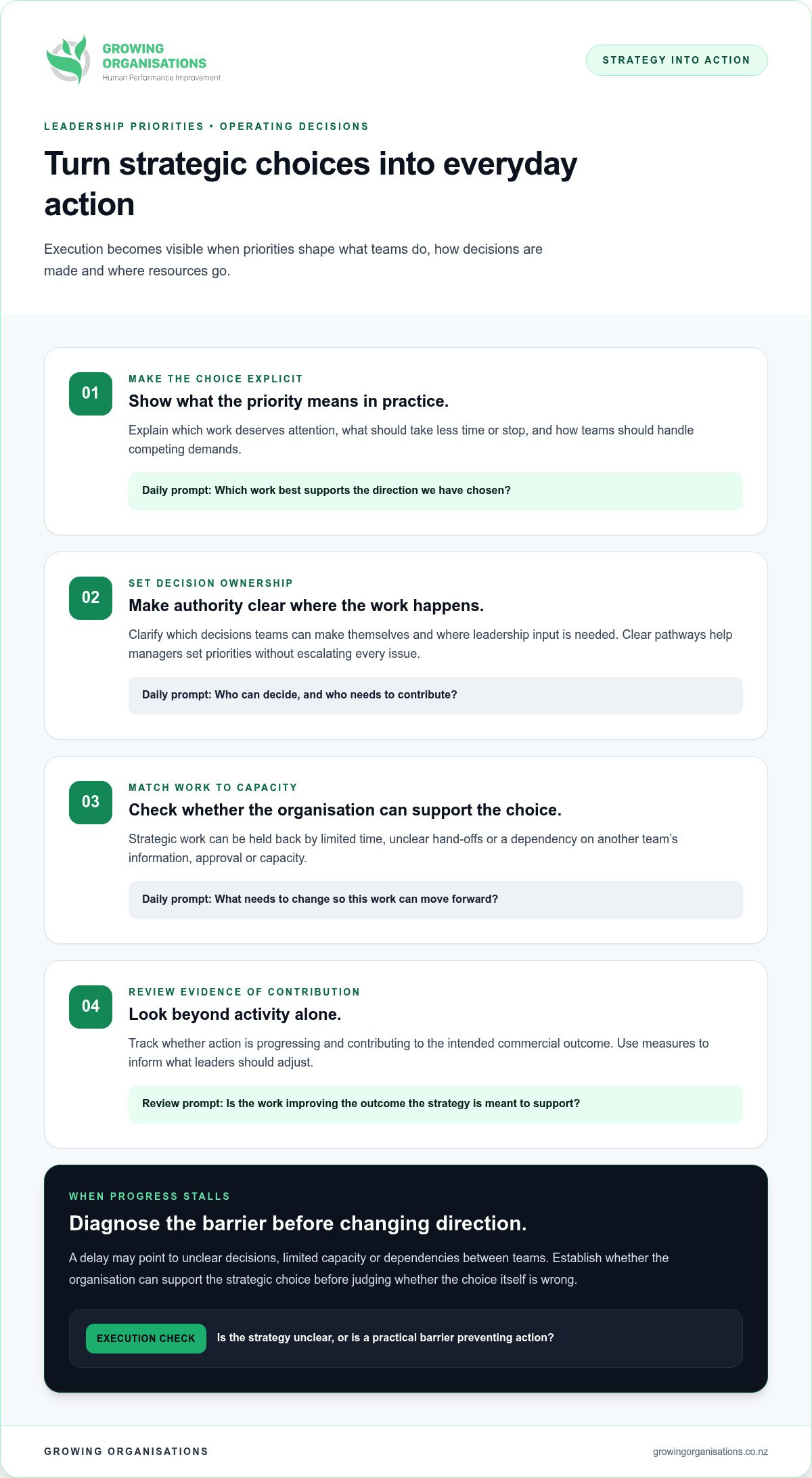
Execution becomes manageable when leaders turn strategic intent into a small number of operating choices. The aim is not to add a heavy process. It is to make clear what has priority, what is getting in the way, where effort should go and what the evidence says about progress. Keep the approach proportionate to organisational capacity and the scale of the strategic change.
Use this sequence as a practical starting point:
- Clarify the choices. State the outcomes that matter and explain how they should guide trade-offs.
- Identify the constraints. Surface capacity, capability and dependencies that could limit progress.
- Focus action. Decide which work to prioritise, change or stop so strategic efforts have room.
- Review the evidence. Compare progress with the intended outcomes and decide what needs attention.
Start with strategic choices and real constraints
A priority is useful only if leaders can apply it when demands compete. Define what takes precedence and what the organisation will not pursue for now. Then test the plan against available time, skills and decision-making capacity. If the work depends on another team, make that dependency visible. Adding a priority without changing existing commitments does not create capacity. It spreads it more thinly.
Ask what existing work should stop, pause or change to make room. The answer may involve sequencing rather than cancelling an initiative. Be specific about the trade-off so managers can make consistent decisions without guessing which commitment leadership values most. A smaller organisation may need only a light-touch review; a larger or more interdependent business may need clearer coordination between functions.
Use evidence to adjust execution without losing focus
Agree a consistent leadership cadence for reviewing progress. Keep the discussion tied to intended outcomes, emerging obstacles and decisions needed. The purpose is not to report every task. It is to identify whether action is moving the strategy forward and where leadership intervention could help.
Disciplined adjustment responds to evidence while preserving a sound strategic choice. Reactive change replaces direction whenever pressure rises. Separate assumptions that need testing from priorities that remain valid. If an assumption weakens, review its implications. If the strategy still holds but delivery is stuck, address the execution barrier rather than changing direction by default.
Accountability and performance measurement support this review, but each needs its own treatment. Use the related guidance on accountability to clarify ownership, and the performance measurement article to consider how to assess progress. Keep measures useful for decisions, not as an end in themselves.
Growing Organisations provides hands-on growth strategy implementation support for leadership teams putting strategic choices into action.
How Growing Organisations supports business strategy execution in business
A leadership team can understand what is blocking progress and still lack the time or internal capacity to resolve it. Priorities need to become workable plans, and commercial initiatives need sustained attention as they move into day-to-day work. Tailored consultancy and hands-on implementation support help leadership teams address that gap.
Growing Organisations works with leadership teams on business strategy execution, connecting growth ambitions with practical organisational action. The work goes beyond producing a strategy document. The firm helps leaders identify growth opportunities, establish actionable plans and operationalise commercial initiatives in a way that fits the organisation and its circumstances.
Connecting growth priorities with practical organisational action
Support starts with the business’s growth priorities and the choices behind them. Consultancy helps leaders assess where opportunities lie and shape those opportunities into a plan the organisation can act on. The plan reflects the business’s goals and the realities of putting change into practice.
Hands-on implementation support helps leadership teams move strategic initiatives forward. For example, if a business identifies a promising route to growth, the work may involve translating that opportunity into practical actions and helping the team put the initiative into operation. The right actions depend on the organisation’s strategy, capability and operating conditions.
Execution also depends on what the organisation can sustain. Organisational development can strengthen internal capability, helping people build capacity to support commercial priorities over time. This is useful when progress depends on the organisation adapting how it works, as well as introducing a new initiative.
Working with leadership teams in Europe
Growing Organisations serves businesses in Europe and the UK. Its approach is tailored and collaborative, grounded in the growth opportunities and execution challenges facing each leadership team. Rather than imposing a fixed process, the work considers the organisation’s direction, current conditions and the practical changes needed to put strategic intent into action.
For Boards, Chairpersons, CEOs and Managing Directors, the support stays connected to the commercial challenge. The leadership team remains central to the choices and decisions. Consultancy helps establish an actionable plan, while implementation support helps move initiatives from intention into organisational practice. Organisational development can build internal capability for sustainable commercial success.
If a growth priority is struggling to gain traction, Growing Organisations can work with your leadership team to identify the execution barriers and put practical strategy and implementation support in place.
Make the next strategic decision count
Choose one priority with a clear commercial contribution and put it on the next leadership agenda. Ask what decision would move it forward, who needs to make that decision and what evidence would show whether it helped. Keep the discussion grounded in the work rather than reassuring updates. A clear next decision gives the leadership team a practical focus without creating another broad programme.
That is a useful starting point for business strategy execution: make deliberate choices about where the organisation directs attention and effort. If the priority remains sound but momentum is weak, identify the specific obstacle the team can address. If the underlying commercial case has changed, discuss resetting direction.
Growing Organisations works with leadership teams in Europe on strategy and implementation. Discuss your strategy execution needs with Growing Organisations to identify a practical next step for your organisation.
Frequently Asked Questions
Can a small business execute strategy without a large management team?
Yes. A small business can execute strategy without a large management structure. One person may coordinate a priority alongside other responsibilities, but it still needs a clear owner and time set aside for it. Before approving another initiative, decide which current task will be deferred. If customer work repeatedly displaces strategic work, revisit the timing or capacity. This proportionate approach can suit Scottish firms where senior leaders stay close to daily operations.
Is strategy execution the same as strategy implementation?
The terms overlap, but they can describe different parts of the work. Implementation often means putting a defined plan or initiative into effect, such as introducing a new sales process. Execution is broader and ongoing. It includes the decisions that keep initiatives connected to the organisation’s strategic intent. A project may be implemented, yet its value can fade if leaders stop reinforcing the choices that made it strategically important.
How often should a Board review strategy execution?
There is no universal review schedule. The Board needs information often enough to scrutinise progress and consider material changes, while executives handle operating decisions between Board discussions. A useful test is whether the report shows movement towards intended outcomes, explains meaningful deviations and identifies decisions requiring Board attention. A dashboard full of completed tasks may still leave directors unable to judge whether a commercial priority is gaining traction.
What is the Board’s role in business strategy execution?
The Board oversees strategic direction and challenges whether management’s actions remain consistent with it. Executives lead delivery and should raise important risks, changes in assumptions or decisions requiring Board input. The Board contributes most effectively by asking focused questions about progress and the basis for management’s choices, rather than directing individual tasks. This keeps oversight distinct from day-to-day management while supporting sound business strategy execution.
Can employees influence business strategy execution?
Yes, within constraints. Employees influence results through the choices they make in daily work, and their experience can reveal practical barriers leaders may not see. For instance, staff handling customer enquiries may notice a recurring reason prospects do not proceed. Leaders can invite that insight, assess its relevance and explain the decision that follows. This gives employees a meaningful voice without implying that every strategic choice is subject to a vote.
How can leaders communicate strategy without overwhelming teams?
Focus communication on the implications people need to act on. A team responsible for customer retention needs to know which customer issues to prioritise and how to raise a recurring problem. Avoid sending every detail of the strategy to every role. Relevance is an important filter.
As circumstances change, explain what has shifted and what remains in force. Check understanding by asking managers how the priority affects an upcoming decision.
What should leaders do when strategic initiatives compete for the same resources?
Make the conflict explicit and choose what takes precedence. Compare each initiative’s strategic contribution with the people, time and expertise available, then decide whether to sequence the work, change a commitment or reconsider a choice.
If two initiatives depend on the same specialist team, starting both may delay each one. Explain the trade-off and its rationale so teams do not have to resolve the competition through informal workarounds.
[The ideas in this content are the author’s own, drawn from what GOL Associates observe in client organisations and the marketplace. Our AI editing tools make them readable and generate the images that accompany them, including people who do not exist.]