A business advisor should sharpen your decisions, not make them for you. For a Scottish SME, an advisor can help identify business problems, address knowledge gaps and spot blind spots before they become costly. You remain responsible for decisions, with clearer priorities and stronger grounds for action.
That distinction matters when growth puts pressure on cash flow, stretches the leadership team or leaves strategic priorities competing for attention. You may already know the business needs to change. The challenge is deciding what to address first and turning that decision into action.
This article explains what a business advisor does, how they can support cash flow, strategy and execution, and how to choose someone whose experience and working style suit your business. It also covers how to agree useful objectives and set a meeting cadence that builds momentum without adding meetings for their own sake.
Key Takeaways
- A business advisor can help identify blind spots and fill gaps in business knowledge while leaving key decisions with you.
- Separate cash-flow pressure from profitability concerns to focus attention on the underlying issue.
- Turn strategic priorities into clear actions, timelines and measures so progress is visible.
- Agree objectives, roles and expectations with your advisor, then meet often enough to maintain momentum.
- Choose an advisor with relevant growth experience who communicates clearly, challenges your thinking and focuses on practical outcomes.
What is a business advisor?
A business advisor helps owners address business problems, fill knowledge gaps and make decisions with greater clarity. For a Scottish SME considering expansion, an advisor can test assumptions and identify operational blind spots. They do not take control of the business. An SME business advisor in Scotland, like an advisor elsewhere, should help the owner make informed choices, not make those choices for them.
Business Strategy and Growth Planning
Business strategy and growth planning turn commercial goals into priorities, decisions and practical action. This is important when growth could stretch cash, people or delivery capacity. An advisor at Growing Organisations can challenge assumptions, compare options and identify blind spots before they become costly. For example, a Scottish company weighing expansion into a new market can assess whether its existing offer, team and operating model can support that move. The owner retains responsibility for the decision and its consequences.
Good planning also brings discipline to investment choices. Before committing capital, define what the investment should enable and how it supports the business’s direction. An advisor can help leadership compare that case with competing priorities, then clarify what execution requires. The question is not simply whether growth is possible, but whether the business can deliver it while protecting its commercial position.
Leadership Support During Growth
Leadership support helps owners and executives respond to the changing demands of a growing business. It is valuable when decisions once made by a founder start affecting managers and teams across the organisation. An advisor can provide a sounding board, challenge assumptions and help clarify where leadership attention is needed. For instance, a founder delegating operational decisions may need to establish clear decision rights while remaining accountable for overall direction.
This support should strengthen the leadership team’s judgement, not create dependence on an outside voice. An advisor can help leaders surface different views and decide what needs resolution. The result is clearer ownership of decisions and a better understanding of how those choices affect the business.
Business Plans and Cash Flow Support
Support with business plans and cash flow connects growth intentions to financial and operational demands. An advisor can help examine assumptions about timing, resources and delivery, then identify where a plan puts pressure on cash. For example, a company taking on a large project may need to account for the timing of supplier costs and customer payments. This gives leaders a clearer view of the working capital needed to pursue growth.
What support do business advisors offer for business plans, cash flow and growth? They can help test a plan’s assumptions, set commercial priorities and examine how growth affects capacity and cash flow. An SME business advisor in Scotland can also support owners in turning those priorities into action.
How much do business advisors charge? Fees depend on the scope of work, the advisor’s expertise and the support required. Set out the expected work and pricing before an engagement begins.
Are advisory services subsidised or funded? Regional grants and innovation vouchers are not guaranteed, and the amount varies case by case. Treat possible support as a planning consideration, not as secured funding.
When the challenge is turning a growth priority into a practical plan, an SME business advisor in Scotland can help leadership examine the choices and demands of execution. The business remains responsible for its decisions and results.
Cash flow, profitability and financial control
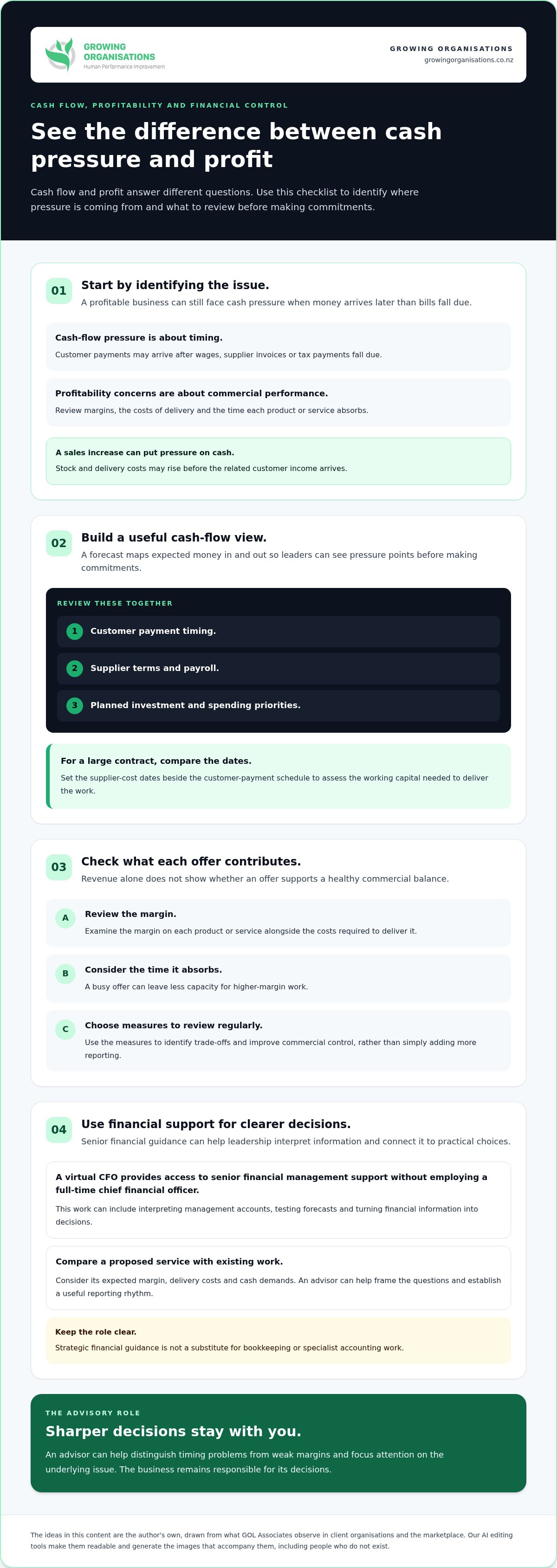
Cash flow and profit answer different questions. A profitable business can still face pressure if customer payments arrive after wages, supplier invoices or tax payments fall due. An advisor can help you distinguish timing problems from weak margins, then focus management attention on the cause. For example, a sales increase may raise stock and delivery costs before the related customer income arrives.
Cash flow and working capital
A cash-flow forecast maps expected money in and out, helping leaders see pressure points before making commitments. Review customer payment timing, supplier terms, payroll and planned investment together. If a large contract requires materials upfront, compare its payment schedule with the dates those costs fall due. This helps the leadership team weigh growth opportunities against the working capital needed to deliver them. It also gives managers a basis for discussing collection delays or spending priorities with the people responsible.
Virtual CFO and financial management
A virtual CFO is a way to access senior financial management support without employing a full-time chief financial officer. The work can include interpreting management accounts, testing forecasts and turning financial information into decisions. For example, a leadership team considering a new service can compare its expected margin, delivery costs and cash demands with existing work. An advisor can help frame those questions and establish a useful reporting rhythm. This is strategic financial guidance, not a substitute for bookkeeping or specialist accounting work.
Profitability, compliance and tax
Profitability depends on more than revenue. Examine the margin on each product or service, the costs required to deliver it and the time it absorbs. A busy offer can weaken the overall balance if its delivery demands leave less capacity for higher-margin work. An advisor can help leaders identify these trade-offs and decide which measures to review regularly. The aim is better commercial control, not simply more reporting.
Financial compliance and tax advice are the accountant’s remit. An accountant can help a business comply with financial rules, find ways to reduce tax and improve its finances. An advisor can help leadership use that financial picture to make commercial choices, such as whether planned investment fits current cash needs. Keep the roles distinct, then connect the advice through shared business priorities.
For an executive team, the practical test is whether financial information changes a decision. A useful review should clarify what is driving cash pressure, which activity contributes profit and what trade-offs an investment creates. If those insights need to become a wider growth plan, business growth strategy and implementation can connect financial priorities with execution.
Strategy, execution and accountability
A strategic plan creates value only when it changes what the business does. An advisor can act as a sounding board, challenge assumptions and help owners turn ideas into priorities, timelines and actions. For a leadership team, this means translating an ambition such as entering a new market into decisions about ownership, delivery and measures of progress.
From priorities to execution
Start by defining the outcome each priority must deliver. Then identify the actions, owner and timing needed to move it forward. For example, a plan to improve customer retention might require reviewing customer feedback, assigning responsibility for follow-up and tracking repeat business. These steps make the strategic intent visible in day-to-day work.
An advisor can help management distinguish urgent activity from work that advances the agreed objective. If a new initiative competes with existing commitments, the leadership team can assess its likely value and resource demands before proceeding. This discipline is particularly important in founder-led businesses, where decisions can otherwise depend on one person’s attention. Clear ownership makes it easier to spot stalled work and decide what needs to change.
Accountability that supports progress
Accountability means regularly reviewing agreed actions, evidence and decisions, not simply reporting completed tasks. The advisor can ask what moved forward, what blocked progress and what leadership must decide next. If a milestone slips, establish whether the cause was unclear ownership, inadequate capacity or a flawed assumption. Address the cause rather than adding activity without purpose.
Useful measures connect directly to the objective. A sales initiative, for instance, might be reviewed through qualified opportunities and conversion, alongside the capacity to deliver new work. The measures should help the executive team make a choice, such as changing the approach or reallocating effort. This keeps accountability tied to commercial progress rather than activity for its own sake.
Accountants, compliance and management accounting
Accountants and advisors bring different perspectives to business finances. An accountant can help a business comply with financial rules, find ways to reduce tax and improve its finances. Compliance accounting supports those responsibilities. Management accounting uses financial information to inform internal decisions, such as comparing the performance and resource demands of different activities. This distinction helps leaders direct each question to the right expertise.
Bring the accountant’s financial picture into strategic reviews. If a proposed investment changes expected costs or returns, discuss the assumptions with the accountant, then assess the commercial decision with the leadership team. For example, compare the expected contribution of a new offer with the people and delivery capacity it requires. This connects financial insight to execution without confusing compliance work with strategic advice.
A business advisor helps maintain that connection by challenging the plan, reviewing actions and keeping decisions in view. The owner and executive team remain accountable for their choices. The advisor’s contribution is a clearer route from strategic intent to measurable progress.
Advisor engagement process and meeting cadence
A useful advisory relationship starts with a defined business need, not a recurring meeting in search of an agenda. Before engaging, identify the decision or obstacle that needs attention. For example, a leadership team preparing to enter a new market might need help assessing priorities, delivery capacity and risks. This gives both parties a practical basis for deciding whether to work together.
As an experienced SME business advisor NZ businesses trust, getting started generally involves two or three initial conversations or face-to-face meetings. Use those discussions to explain the business context, test how the advisor thinks and agree what a productive engagement would address. Notice whether they ask precise questions about your commercial goals and constraints. This gives you a clearer view of fit before work begins.
Agree objectives and a plan before the engagement starts. Set out the expected outcomes, the advisor’s role, your team’s responsibilities and how progress will be reviewed. A written agreement can also record expectations, roles and pricing. Be specific: if the objective is to improve decision-making around growth, define which decisions are in scope and what information the leadership team will provide.
What should I check in an advisory agreement, and how can I avoid poor advice? Check that the agreement explains objectives, roles, expectations, pricing and how the work will be reviewed. To avoid poor advice, test recommendations against your business context, ask for the reasoning and raise concerns early.
Meeting cadence should match the work, not follow a default calendar pattern. Meet often enough to maintain momentum, review actions and resolve decisions before they stall. A live growth initiative may need closer discussion than a stable planning phase. Each meeting should have an agenda tied to current priorities, such as a delayed decision, a change in assumptions or an action requiring leadership input.
Keep the meeting useful by reviewing a short set of items:
- Which agreed actions have moved forward, and what evidence shows progress?
- What decision or obstacle needs attention from the owner or leadership team?
- Have new conditions changed the plan, resources or priorities?
- Who owns the next action, and when will it be reviewed?
These prompts turn discussion into follow-through. A founder, for instance, can bring a delayed customer decision to the meeting, agree who will resolve it and track the outcome next time. When working with Growing Organisations, the advisor contributes challenge and perspective. The business retains responsibility for decisions and execution.
Address concerns as soon as they arise. If recommendations feel too generic, explain which operating realities they miss and ask the advisor to revisit the analysis. If communication or expectations have shifted, discuss the issue directly while there is still room to resolve it. A clear agreement, relevant agenda and honest conversation provide a sound basis for useful work.
Choosing an advisor who suits your working style
Choose an advisor with relevant SME growth experience, clear communication and a working style that suits your leadership team. Compare their approach with a real business challenge.
Comparing Advisors, Accountants and Coaches
Compare advisors, accountants and coaches by the decisions and work you need support with. An advisor can help shape and implement growth priorities; an accountant can advise on financial compliance and tax. A coach may focus on leadership development. This distinction matters when a Scottish business needs strategic challenge rather than financial compliance support or individual coaching.
How do I compare business advisors, accountants and business coaches? Match the role to the need: strategy and execution point to an advisor, tax and financial compliance to an accountant, and leadership development to a coach. Some professionals combine areas of expertise, so assess the actual work and outcomes they describe.
Finding a Qualified SME Advisor
Finding a qualified SME advisor means identifying someone whose experience fits your organisation’s growth challenge. Start with a specific issue, such as expanding into a new customer segment or improving coordination between managers. Ask how they would approach it and what information would shape their advice. A clear answer should relate to your circumstances rather than rely on a standard formula.
Assess how they balance challenge with support. For example, if your team is considering a new offer, an advisor should explore customer demand alongside your capacity to deliver it. Notice whether they explain their reasoning plainly and make practical recommendations. This helps you judge how their working style would influence decisions across your Scottish leadership team.
How can I find a qualified SME business advisor in Scotland? Look for relevant SME growth experience, clear communication and practical judgement. Discuss a current business challenge and assess whether their questions reflect your operating context and the decisions ahead.
Qualifications and Professional Memberships
Qualifications and professional memberships can show an advisor’s training or specialist focus, but their relevance depends on the work. For example, financial credentials may matter for financial analysis, while experience in organisational development may suit a leadership or operating challenge. Consider credentials alongside comparable SME experience and the advisor’s ability to explain how their expertise applies.
What qualifications or memberships should a Scottish business advisor have? Consider qualifications or memberships relevant to the advice required, then weigh them against practical experience and fit. The useful test is whether the advisor can apply their expertise to your business decisions.
If your leadership team needs to turn a growth priority into practical action, explore business growth strategy and implementation.
Growing Organisations: Consultancy and Development
Growing Organisations helps leadership teams address growth challenges through Consultancy and Development, and Business Growth Strategy and Implementation. Turn to this work when your business has identified a growth priority but needs a practical plan and support to put it into action.
For example, a leadership team weighing competing growth initiatives can use consultancy to clarify priorities, align decisions and define the work required. The focus is on strategy connected to implementation, not advice detached from day-to-day business demands.
If your next growth decision needs a clearer strategy and a path to execution, contact Growing Organisations to discuss your business priorities.
Make the next growth decision deliberate
The next step is not to add another meeting or produce a thicker plan. Decide which business question deserves leadership attention now, and what evidence would help answer it. That focus gives an SME business advisor in NZ a clear starting point and gives your team a practical test of whether the work is useful.
Bring one live decision to the discussion. It might concern where to direct management attention, which growth opportunity to pursue, or what needs to change before the business can scale. Be candid about constraints and what success would mean for your organisation. A grounded conversation can clarify the work ahead and whether the approach suits your leadership team.
Growing Organisations works with leadership teams through Consultancy and Development, alongside Business Growth Strategy and implementation. If you’re ready to discuss a growth challenge, talk with Growing Organisations. Take the next decision seriously, then give your team a clear basis for moving forward.
Frequently Asked Questions
What does an SME business advisor in New Zealand do?
An SME business advisor in New Zealand helps owners work through business challenges and make informed decisions. For example, if customer demand is rising but delivery is becoming inconsistent, an advisor can help examine the causes and clarify which operational choices need attention. The advisor provides an outside perspective and supports the owner’s judgement. They do not take control of the business or replace specialist financial, legal or technical advice.
How can an SME prepare for its first meeting with a business advisor?
Prepare a specific business issue, the decision you need to make and relevant information that explains the situation. For example, if a key customer relationship is affecting planning, outline what has changed, what you have tried and what outcome you need. Bring questions about the advisor’s approach and how you will assess whether the work is useful. This gives the first discussion a practical focus.
What government rules and tax requirements should New Zealand SMEs discuss with an advisor?
Discuss which compliance and tax questions apply to your business activities and structure, then direct technical requirements to an accountant. For example, ask how a planned change in trading activity could affect financial processes or reporting, and which specialist should advise on the details. An advisor can help connect those considerations to business decisions, but an accountant is the appropriate professional for compliance and tax advice.
The ideas in this content are the author’s own, informed by what GOL Associates observe in client organisations and the marketplace. AI editing tools help make them readable and generate the accompanying images, including depictions of people who do not exist.