More advice is not the same as more progress. SME growth support of the right kind is normally valuable when it addresses the constraint holding the business back and changes what happens next.
For business leaders in Scotland, the challenge is often identifying whether growth is constrained by strategy, commercial performance or the organisation’s ability to deliver. It is reasonable to question whether external advice will influence daily decisions and how its value can be assessed before work begins. A plan separate from the work is not enough.
This article sets out a practical way to define the issue, assess whether an advisory approach fits and agree what accountable action should follow. It explains how strategic checkpoints, including those in the Kairos framework, can support clearer decisions. The aim is to connect priorities with practical implementation, named ownership and evidence of progress, so support becomes part of the business’s work rather than another document on the shelf.
Key Takeaways
- Separate a temporary performance dip from a growth decision that needs leadership attention before choosing support.
- SME growth support of the right kind is normally valuable when its scope reflects the business’s stage, leadership needs and intended commercial outcome.
- Compare advisory approaches by how they diagnose the issue, involve leaders and connect recommendations to implementation.
- Set decision points, ownership and evidence of progress before work begins so the leadership team can review delivery.
- See how Growing Organisations uses the Kairos framework, integrated with the Business Model Canvas, to structure strategic decisions and practical growth work.
When does an SME in Glasgow need growth support?
Before choosing support, identify what is constraining the business. A short-term dip in sales or delivery may call for a focused operational response. A growth decision is different. Leaders may need to choose where to invest, which customers to prioritise or whether the organisation can deliver the next stage. External advice is useful when it helps resolve a defined decision.
Start with the evidence your leadership team already has. Review trends in sales, margins, customer retention, the pipeline and delivery capacity against the company’s own targets. Look at where performance is changing, not only whether the headline result is up or down. For context on the range of businesses covered by the term, see Small and medium-sized enterprises (SMEs). The practical question is specific to your business: what is preventing the next commercial move?
Signals that the business needs outside perspective
Repeated discussion without a decision is one signal. Senior leaders may agree that growth is important but disagree on which customer, offer or investment should come first. Priorities can stall because no one owns the next step, assumptions have not been tested or commercial trade-offs remain unstated. These are defined choices that need evidence, alignment and follow-through, not simply a general wish to grow.
Look for the pattern behind the symptoms. If a sales target is being missed, establish whether the issue is demand, conversion, pricing or capacity before deciding what support is needed. If an agreed initiative repeatedly slips, examine decision rights, ownership and the resources committed to it. An outside perspective can help leaders test assumptions and see where discussion has replaced action. It should not obscure an issue the business can already define and address internally.
Define the result before choosing support
State the decision or outcome the work must address. “We want to grow” is too broad to guide an engagement. “We need to decide which customer segment to prioritise and what that means for our offer” gives the work a clear purpose. Then name the evidence that would show progress. It might be a clearer commercial choice, an agreed owner for a priority or movement in a measure the leadership team already tracks.
Be clear about who needs to take part. A decision about market focus may need the Managing Director and commercial leaders. A change to delivery priorities may also require operational leadership. Involve people according to the decision, rather than by habit.
- Identify the unresolved business decision.
- Choose evidence tied to the intended outcome, using measures the business can review.
- Agree which leaders will contribute, decide and own the work that follows.
SME growth support of the right kind is normally valuable when it is tied to a stated business need. Define that need first. It gives the leadership team and its adviser a clear basis for judging whether the work is relevant.
What should useful SME growth support in Glasgow include?
Useful growth support connects a clear diagnosis to commercial choices and practical work. It should reflect the company’s stage, leadership needs and intended outcome, rather than follow a standard package. A business testing a new market needs different strategic input from one seeking to improve margins or increase capacity. The scope should reflect that difference.
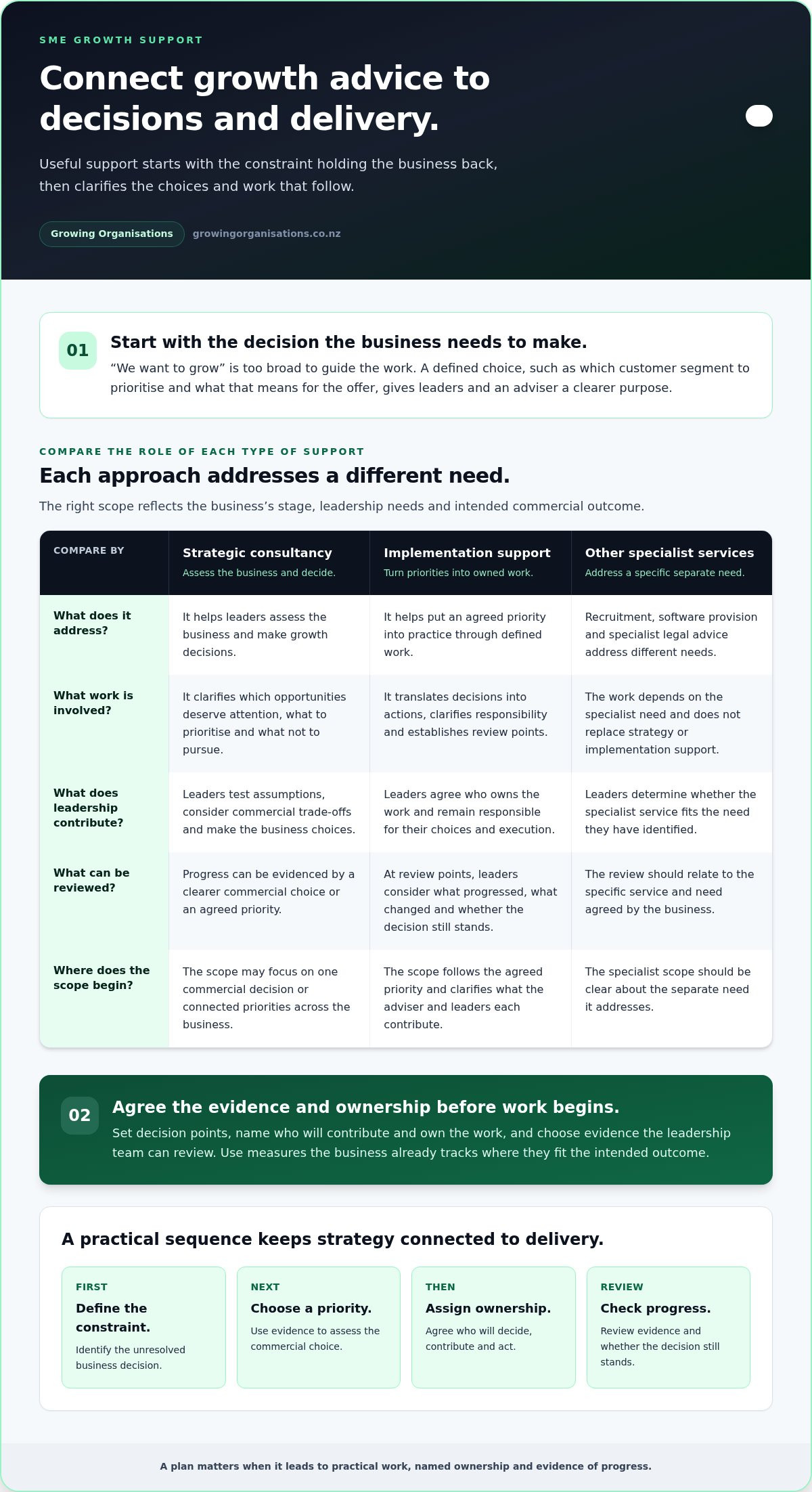
Support also needs a clear boundary. Strategic consultancy helps leaders assess the business and make growth decisions. Implementation support helps turn agreed priorities into owned work. Recruitment, software provision and specialist legal advice address different needs. They may be relevant to a business, but they do not replace strategy and implementation support.
Strategy support should sharpen business choices
A business growth strategy should clarify which opportunities deserve attention, what the company will prioritise and what it will not pursue. The Business Model Canvas can structure discussion about how the business creates and delivers value, including its customers, offer and commercial model. The purpose is not to complete a template. It is to make assumptions visible and support a sound leadership decision.
For a Glasgow SME considering a new customer segment, strategic work could test how that choice fits the existing offer and delivery model. Wider resources, including World Bank Group support for SMEs, address broader challenges that can affect growth, including access to finance. Company-level advice still needs to engage with the decisions and conditions specific to the business.
Implementation support should connect decisions with work
Once leaders agree a priority, someone must own the next action. Implementation support can help translate the decision into work, clarify responsibility and establish review points. At each review, leaders can consider what has progressed, what has changed and whether the original decision still stands. This keeps strategy connected to operating decisions rather than leaving it as a document.
Recommendations describe possible action. Implementation support helps leaders put decisions into practice through defined work, ownership and review. It does not remove the company’s responsibility for its choices or execution, and it cannot promise results independent of them.
Scope matters as much as method. A focused engagement may centre on one commercial decision; a broader one may address connected priorities across the business. Either way, the work should clarify what the adviser will contribute, what leaders must decide and how progress will be reviewed. This is the difference between advice that informs a conversation and support that stays engaged with execution.
Growing Organisations Limited provides business growth strategy and implementation consultancy for leadership teams. Its tailored work connects strategic discussion with practical commercial priorities. For more about this approach, explore business growth strategy and implementation.
How can Glasgow SMEs assess whether an adviser is the right fit?
Fit depends on the business’s defined issue, not a broad promise of growth. Before appointing an adviser, compare how each proposed approach will move from understanding your situation to leadership decisions and practical follow-through. A polished pitch is not evidence of a suitable method. The detail should withstand scrutiny.
Compare the work, not the pitch
Use the same criteria to assess each proposed approach. Look for clear links between your commercial priorities, the proposed work and what your leadership team will do with the findings. A defined scope makes those links visible. Broad claims about unlocking potential do not explain what will happen or how you will assess its usefulness.
| Criterion | What a clear approach should show | What to clarify |
|---|---|---|
| Diagnosis | How the adviser will understand your business, its commercial position and the issue to address. | Which evidence and assumptions will inform the diagnosis? |
| Tailored scope | How the work reflects your company’s stage, priorities and intended outcome. | What is included, and which decisions should the work inform? |
| Leadership involvement | Which leaders contribute, make decisions and take responsibility for agreed actions. | When will the Board, CEO or Executive team need to be involved? |
| Implementation | How recommendations connect to owned work and review points. | How will progress be assessed, and what happens if assumptions change? |
Use these questions to test the method before agreeing its scope:
- What business decision is this work designed to inform?
- How will you distinguish evidence from assumptions?
- What work will follow the findings, and who from our team will own it?
- How will we review progress and decide whether to adjust course?
Test how the leadership team will work with the adviser
Good advisory work makes room for candid discussion. Leaders should be able to examine uncomfortable evidence, challenge assumptions and state where they disagree. Clarify who needs to contribute to diagnosis, who holds decision authority and who will attend reviews. The adviser’s method should support those responsibilities rather than leave them vague.
Pay attention to the route from findings to assigned work. If an adviser identifies a customer or delivery issue, the next step should clarify what leaders need to decide, who will act and what evidence will be reviewed. This is where business strategy execution becomes practical: decisions have owners, and review points give leaders a basis for adjustment.
SME growth support of the right kind is normally valuable when the proposed work fits the issue and gives leaders a clear way to assess progress. Judge the approach by its diagnosis, scope and working method, not by a generic assurance of results.
How should an SME structure growth support for measurable progress?
Make the engagement accountable business work, not a separate advisory exercise. The leadership team should know which question it is addressing, who will make decisions and how progress will be reviewed. Measures should fit the company’s priorities and available evidence. No universal benchmark can tell every Glasgow SME whether its growth support is working.
Agree the issue, scope and evidence
Start by recording the business question the work must resolve. Then agree the scope, the leaders who need to take part and the points at which decisions will be made. This gives the adviser and leadership team a shared reference if priorities shift or new information changes the original view.
Select evidence that speaks to the issue. A business exploring a new route to market might review its customer enquiries, conversion patterns and delivery capacity. A company focused on improving an existing offer may examine relevant sales and margin information. Choose measures the business can access and interpret. Avoid targets selected simply because they appear in a standard framework.
Connect recommendations to accountable action
Use a clear sequence to move from diagnosis into execution. Each stage should leave the leadership team with a decision, an owner or an agreed next step.
- Define the question. Record the commercial or organisational issue the engagement will address. The CEO or Managing Director should confirm that it aligns with the business’s priorities.
- Agree the scope and participants. Set out the work, which leaders need to contribute and where decision authority sits. The Board or Executive team should resolve competing priorities that could block progress.
- Review findings and decide. Consider what the evidence supports, where assumptions remain and what choices are available. Leaders should record the decision and the reasoning behind it.
- Assign action and review progress. Translate the decision into practical work with a named owner. At agreed review points, assess the evidence, address obstacles and decide whether to continue, adapt or pause the work.
Implementation support can help leaders put agreed priorities into practice and keep actions connected to the decisions that shaped them. Reviews do not promise results. They give leaders a disciplined opportunity to learn from progress, test whether assumptions still hold and make considered adjustments. The company remains accountable for its decisions and execution.
SME growth support of the right kind is normally valuable when the work has a clear purpose and a review process grounded in the business’s own evidence. Growing Organisations Limited works with leadership teams on strategy and implementation. Discuss a growth strategy and implementation engagement built around your organisation’s priorities.
How Growing Organisations supports Glasgow SMEs
Growing Organisations Limited works with leadership teams on business growth strategy and implementation. The work is tailored to the company’s commercial context and the decisions its leaders need to make. This is useful when an issue crosses functions, affects several priorities or requires the Executive team to align behind a course of action.
A structured method for leadership decisions
The Kairos framework brings together a decision-tree, strategic checkpoints and the Business Model Canvas. It gives leaders a structure for examining choices, testing assumptions and deciding what needs attention next. The checkpoints keep discussion tied to the company’s commercial position rather than a generic model of growth.
The framework organises decision-making; it does not replace leadership judgement. Its relevance comes from how it is applied to the organisation’s circumstances. A team considering a shift in customer focus, for example, may need to examine how that choice relates to its business model and strategic priorities. Advisory work can be tailored to the decision, then connected to implementation so agreed priorities have a path into practical work.
The approach is straightforward: analysis should help leaders decide, and implementation should connect decisions with action. Kairos checkpoints give the discussion structure. The leadership team remains responsible for its choices, ownership and execution.
Growing Organisations’ mission centres on commercial clarity, confidence, capability and measurable, durable performance improvement. Its brand promise, “Platinum Advisory. Measurable Results.”, reflects the standard of the work: advice should have a clear purpose and stay connected to what the business is trying to achieve. Measurement should use evidence relevant to the organisation, not an assumed benchmark or a guaranteed outcome.
Discuss the next step with Growing Organisations
For business leaders in Scotland, a useful first discussion starts with the decision or constraint that needs attention now. It should establish what the business needs to address, whether the proposed scope fits that need and what progress would mean for the leadership team. This gives both sides a practical basis for considering the work.
You do not need a polished brief to start the discussion. Bring the commercial question that keeps returning, the priority that is not moving or the choice the leadership team needs to make. Growing Organisations can shape strategic consultancy and implementation support around that context.
If your leadership team is ready to examine a growth priority, discuss it with Growing Organisations and establish a clear basis for the next decision.
Put your next growth decision to work
Growth requires choices about where leadership attention goes and what the business is prepared to prioritise. Treat the next decision as a commitment, not just an ambition. Set out what the company wants to make possible, what trade-offs may be involved and how leaders will keep the work in view as conditions change.
SME growth support of the right kind is normally valuable when it helps leaders move from intention to deliberate action. Its value is not in adding activity, but in helping the business direct its effort towards a clear purpose. That requires frank discussion, sound judgement and continued ownership from the people responsible for delivery.
If your leadership team in Scotland is weighing its next move, map your growth priorities with Growing Organisations. A focused discussion can help you consider the decision ahead and the work needed to take it forward.
Frequently Asked Questions
Is SME growth support useful for a small business?
SME growth support of the right kind is normally valuable when it addresses a specific pressure rather than a general wish to expand. A small firm might need help deciding whether to accept a large contract when delivery capacity is already tight. Relevant evidence could include current workload, margins and the resources required. The leadership team must be willing to make and own the resulting choice. Assess whether the support will help leaders make or implement an identified decision.
What should I expect from SME growth support in Glasgow?
A well-scoped engagement in Glasgow should start with your company’s circumstances and the question its leaders need resolved. Depending on the agreed scope, the work may examine the commercial position, clarify strategic options or help put a chosen priority into practice. A team facing uneven demand may need a different approach from one preparing to expand delivery. Agree the work and intended measures of progress before it begins.
How do I know whether my business needs a growth consultant or implementation support?
Growth consultancy can help clarify a commercial choice, while implementation support focuses on putting an agreed priority into practice. A business may need one or both. If leaders have not decided which customers to pursue, the immediate need is strategic clarity. If that choice is settled but actions keep slipping, implementation may be the constraint. Before agreeing the scope, identify the decision, who will own the work and what evidence will indicate progress.
How much does SME growth consultancy cost?
The fee depends on the agreed work and its scope. A focused piece of strategic advice has different requirements from work that also supports implementation across the organisation. An initial discussion should establish the business need, the work involved and what the engagement is expected to address. This gives leaders a basis for assessing the proposed scope against their priorities before committing, without relying on a generic fee estimate.
How long does business growth support take?
Duration depends on the business question, the agreed scope and the amount of implementation work involved. A decision that can be made with existing evidence may require a different approach from work involving several connected priorities. Agree the intended work and relevant progress measures before starting. Clear checkpoints help leaders review what has changed and whether further work is needed, so duration alone does not become the measure of value.
Can an adviser guarantee business growth results?
No adviser should guarantee commercial outcomes that depend on a company’s decisions and execution. Advisory work can give leaders structure, challenge assumptions and support delivery of agreed priorities, but it cannot remove the uncertainty involved in business choices. The leadership team remains responsible for deciding what to pursue and how to act. Set expectations around the adviser’s contribution, the company’s responsibilities and the evidence you will use to review progress.
What is the difference between SME growth support and government business support?
Government support is shaped by public programmes and policy priorities. Consultancy is scoped around a particular company’s decisions and work. They serve different purposes and may address different needs. For a Glasgow business, broad resources can offer general guidance, while tailored advisory work can focus on a specific leadership question, such as whether to prioritise a new market or strengthen delivery. Distinguish the general information you need from the company-specific decisions requiring leadership attention.
To discuss a growth priority with Growing Organisations, start a conversation about your business strategy and implementation needs.