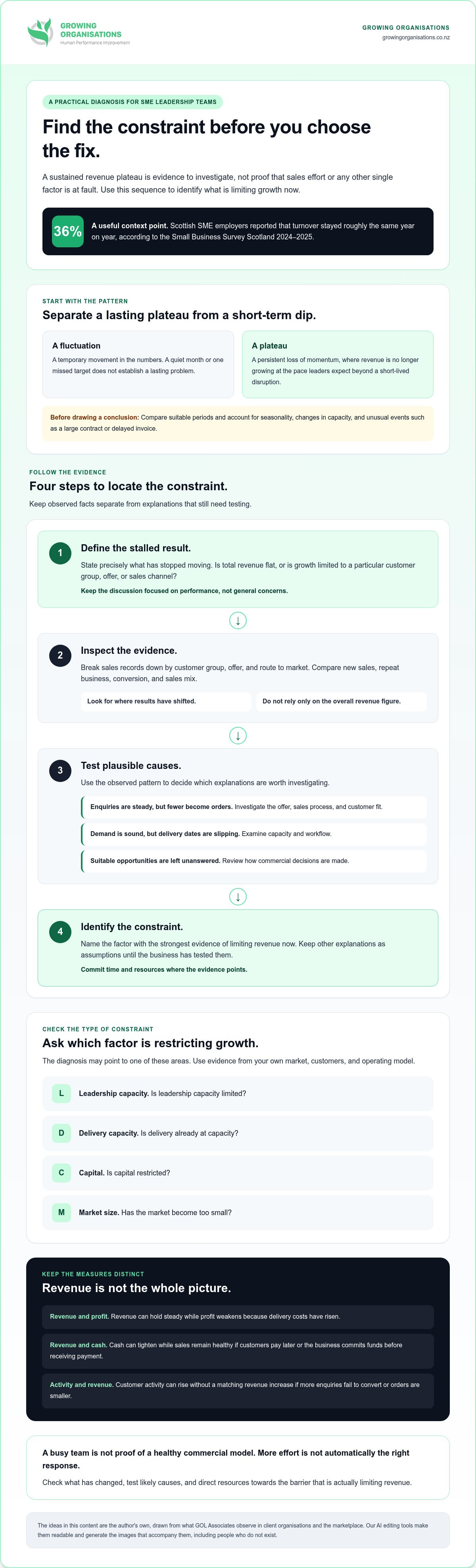
Thirty-six per cent of Scottish SME employers reported that turnover stayed roughly the same year on year, according to the Small Business Survey Scotland 2024-2025. Flat revenue is not always a crisis. But if the team is putting in more effort without seeing results, another burst of sales activity may be the wrong response.
Boards and leadership teams need to identify what is holding growth back. Is leadership capacity limited, is delivery already at capacity, is capital restricted, or has the market become too small? Useful revenue plateau solutions for SMEs start with that diagnosis, not with a list of fashionable growth tactics.
This article explains how to distinguish a temporary pause from a sustained plateau, examine the constraint and choose a response the organisation can put into practice. It also considers why businesses can stall at key points, including around the £5 million turnover mark, and how to turn a decision into owned actions and measurable tests. The aim is to direct resources towards the barrier that is actually limiting revenue.
Key Takeaways
- Distinguish a sustained loss of revenue momentum from a short-term dip, and keep revenue separate from profit, cash position and customer activity.
- Define the stalled result, examine the evidence and test likely causes before changing sales activity.
- Compare revenue plateau solutions for SMEs by the constraint they address, the trade-offs involved and the measure that will show progress.
- Turn the chosen response into practical priorities, clear ownership and measurable action, with strategy and implementation support where needed.
- See how Growing Organisations uses the Kairos framework and Business Model Canvas to help leadership teams connect diagnosis with execution.
Recognise a revenue plateau in a Scottish SME before choosing a response
A quiet month is not a plateau, and neither is one missed target. A revenue plateau is a sustained loss of momentum: the business is no longer growing revenue at the pace its leaders expect, and the pattern continues beyond a short-lived disruption.
Reacting to a single dip can send the team towards the wrong fix. But if leaders wait too long to examine a persistent pattern, the underlying constraint may become harder to address. The board’s first task is to establish what has changed and over what period.
Which signals suggest revenue growth has stalled?
Compare like with like. Review revenue across suitable periods, allowing for seasonality, changes in opening hours or capacity, and significant shifts in the business. A seasonal business should not treat a predictable quiet period as evidence of a lasting problem. Equally, a rise against a weak comparison period may not indicate a durable recovery.
Look beneath the total. Has the number of new sales changed? Is repeat business steady? Has the average transaction value shifted? These measures help reveal whether the topline depends on broad demand or on a small number of larger orders.
Check whether an unusual event distorts the picture. One large contract, a delayed invoice or a customer bringing a purchase forward can make a reporting period look stronger or weaker than the underlying trend. Establish whether the pattern remains once that effect is understood.
What a plateau does and does not tell leaders
Revenue, profit and cash position are related, but they are not interchangeable. Revenue can hold steady while profit weakens because delivery costs have risen. Cash can tighten while sales remain healthy if customers pay later or the business commits funds before receiving payment. Customer activity can rise without a matching revenue increase if more enquiries fail to convert or orders are smaller.
A busy team is not proof of a healthy commercial model. More meetings, proposals or customer requests may show increased effort, but they do not establish that the right customers are buying the right offer at a sustainable value. Retained customers are useful, but loyalty alone does not show whether the business is attracting enough new demand or earning enough from existing relationships.
Use this distinction in the boardroom: “A fluctuation is a temporary movement in the numbers; a plateau is a persistent pattern that demands an explanation.” A plateau is evidence to investigate, not proof that sales effort, pricing or any other single factor is at fault.
Keep the enquiry grounded in your own market, customer mix and operating model. Compare the evidence, identify what has changed, and resist importing a remedy from another business. That discipline is the starting point for choosing revenue plateau solutions for SMEs that fit the actual constraint.
Diagnose the constraint behind a Scottish SME revenue plateau
Once the pattern is clear, resist jumping straight to a remedy. More sales activity may help, but only if the evidence points to a demand problem. If orders are already arriving faster than the business can deliver, generating more leads could deepen the blockage rather than lift revenue.
Use a disciplined sequence, keeping observed facts separate from explanations that still need testing.
- Define the stalled result. State precisely what has stopped moving. Is total revenue flat, or is growth limited to a particular customer group, offer or sales channel? A clear definition keeps the discussion focused on performance rather than general concerns.
- Inspect the evidence. Break available sales records down by customer group, offer and route to market. Compare new sales, repeat business, conversion and sales mix. Look for where results have shifted, not just whether the overall figure has changed.
- Test plausible causes. If enquiries are steady but fewer become orders, investigate the offer, sales process and customer fit. If demand is sound but delivery dates are slipping, examine capacity and workflow. If suitable opportunities are left unanswered, review how commercial decisions are made.
- Identify the constraint. Name the factor with the strongest evidence of limiting revenue now. Keep other explanations as assumptions until the business has tested them. This helps the leadership team decide where to commit time and resources.
Test the commercial evidence behind the plateau
Analysis by customer, offer and channel can expose a weak spot hidden by a stable topline. A firm may be winning fewer new customers while repeat orders keep revenue level. Another may be selling more work, but seeing demand shift towards lower-value offers. Check whether a particular route to market produces enquiries that convert into suitable, valuable work.
Review the work the business accepts, too. Some jobs may keep teams occupied without contributing strongly to commercial performance. If they also use capacity needed for more suitable demand, activity can rise while growth stalls.
Find internal constraints without mistaking symptoms for causes
Include internal issues in the diagnosis when there is evidence linking them to commercial outcomes. Trace delays in decisions about pricing, proposals or delivery. Check whether the right people can make those decisions, and whether a process is preventing the business from serving demand it could otherwise meet.
Do not label a team “the bottleneck” simply because it is busy. Establish which work is delayed, which revenue opportunity is affected and why. Scottish Enterprise research identifies growth blockages among Scottish companies in the £5 million to £10 million turnover range. Treat that as a reason to examine your own operating model, not as a diagnosis of your business.
Test each proposed cause against commercial evidence before choosing a remedy. For leadership teams that need help turning evidence into a focused plan, growth strategy and implementation support connects diagnosis with owned action.
Compare revenue plateau solutions for SMEs by the constraint they address
The right response depends on what the evidence shows is limiting revenue. Do not add an offer, enter another market or invest in technology simply because growth has slowed. Each change uses management attention and may create new delivery demands. Start with the smallest credible intervention that tests the cause.
Match the response to the evidence
If demand is weak, examine whether the offer still addresses a relevant customer problem and whether its value is clear before increasing sales activity. If suitable work is available but delivery is constrained, review workflow, capacity and hand-offs before generating more volume. If priorities are blurred, leadership needs to decide which opportunities to resource, defer or stop.
Refining an existing offer is often a more direct test than launching a new one when customers already buy the core service but hesitate over its scope, value or fit. A new offer or market brings fresh assumptions and demands. Pursue it when the evidence supports the opportunity and the organisation can serve it, not as a reflex.
Compare risks, trade-offs and evidence of progress
Use the comparison to make the consequences plain. Include an early signal that the change is taking hold and a commercial result that matters to the business. Choose measures the team can realistically maintain using its existing records.
| Evidence of constraint | Possible response | Trade-off | Measures to monitor |
|---|---|---|---|
| Suitable customers are not responding to the current offer. | Refine the target customer, offer or value proposition. | Some existing prospects may no longer be a fit. | Track qualified enquiries and conversion, then review revenue by offer or customer group. |
| Demand exists, but work is delayed or delivery is inconsistent. | Improve a workflow or redirect capacity towards suitable work. | Process changes take time and may disrupt current routines. | Monitor work in progress and delivery delays alongside completed work and revenue. |
| A route to market produces activity but weak results. | Adjust the channel or focus effort on a more productive route. | Less attention goes to other channels. | Compare qualified opportunities and conversion by channel, then assess resulting sales. |
| Decisions stall or priorities compete for the same people. | Clarify decision rights and stop or defer lower-priority work. | Some initiatives will receive fewer resources. | Review decision delays and progress against the chosen commercial priority. |
Turn the diagnosis into an owned commercial test
Keep the action cycle focused. Agree the evidenced constraint, state the change to test and name the customer group or operating area affected. Record the baseline, assumptions and measures before work begins. Give a named leadership owner authority over the decisions needed to run the test, and limit simultaneous priorities to what the teams can support.
Set review points to fit the sales cycle and the intervention. At each review, compare actual evidence with the expected signal, then continue, adjust or stop. Escalate unresolved decisions and resource conflicts promptly rather than letting them stall the test. For support turning a diagnosis into an owned plan, work with us on business growth strategy and implementation.
How Growing Organisations helps Scottish SMEs move beyond a revenue plateau
Once leaders have identified the likely constraint and compared practical responses, the next challenge is making a sound choice stick. Growing Organisations Limited works with owner-managed and closely held businesses, including organisations in Scotland, on tailored growth strategy and hands-on implementation. The work starts with the company’s evidence and circumstances, rather than a standard prescription for every plateau.
What advisory and implementation support can address
A plateau may point to a commercial choice, an organisational constraint or a connection between the two. Leaders might need to sharpen the offer for a customer group, change how an opportunity reaches the market or resolve a decision delay that is holding up a viable response. Organisational capability is relevant when it affects commercial performance, but it does not replace examination of revenue evidence.
GOL’s Kairos framework is a decision-tree and strategic checkpoint methodology integrated with the Business Model Canvas. It gives leadership teams a structured way to examine choices and their implications for the business model. The work brings commercial assumptions into view, tests where decisions lead and clarifies which action the evidence supports.
Advice alone does not put a decision into practice. GOL also provides hands-on implementation support, connecting agreed priorities with the work, ownership and measures needed to act. Support can be shaped around the constraint leaders have identified. A business addressing a delivery blockage has different priorities from one reassessing its customer focus. Neither intervention guarantees a particular revenue outcome.
For boards, Chairs, CEOs and executive teams, this creates a working link between strategic decisions and activity across the organisation. It also makes unresolved choices easier to identify. If a priority lacks an owner, depends on unavailable capacity or rests on an untested assumption, leaders can address that before committing further resources.
Decide whether a focused advisory conversation is the next step
A useful discussion can begin with the evidence already in front of the leadership team. Bring the revenue pattern, the customer or operating information behind it and the decisions that remain unresolved. The discussion can then focus on the constraint, credible options and what implementation would require in your organisation.
The purpose of revenue plateau solutions for SMEs is to move from diagnosis to a response the business can carry out and assess. If your leadership team needs help making that connection, explore growth strategy and implementation support with Growing Organisations.
Make the next growth decision count
A revenue plateau can be a point of choice. The next decision does not need to be a sweeping change. It needs to address the constraint exposed by the evidence, with enough focus for the leadership team to see whether the response is working.
Apply that standard to revenue plateau solutions for SMEs. Keep the commercial question in view, make trade-offs explicit and give the chosen action a clear owner. Progress depends on decisions the organisation can put into practice, not on adding activity for its own sake.
If your Board or executive team is ready to move from unresolved questions to a practical growth priority, discuss your growth priorities with Growing Organisations.
Frequently Asked Questions
What is a revenue plateau for an SME?
A revenue plateau is a persistent loss of momentum in sales income, rather than one disappointing month or an isolated missed target. It does not mean profit or cash flow is also flat: costs may squeeze profit while sales rise, or payment timing may tighten cash despite steady revenue. Treat the pattern as a prompt to investigate what has changed in the business, not as proof of a particular cause.
Why do Scottish SMEs reach a revenue plateau?
There is no single explanation for Scottish SMEs. A business may see weaker demand in a customer segment, a shift towards lower-value work, an offer that no longer fits buyers’ needs, or limits on delivering suitable orders. Leadership decisions can also delay a response. These are possible explanations, not conditions to assume from the company’s location. Compare them with your own sales, customer and delivery evidence before deciding which deserves attention.
How can I identify what is holding back my SME’s revenue?
Start by stating exactly which result has stalled, such as new customer sales or revenue from a particular offer. Then examine records by customer type and route to market, and look for changes in conversion, repeat orders or the work being won. Test commercial and operational explanations against those observations. Keep what is known separate from what is assumed. This evidence-led process helps leaders choose revenue plateau solutions for SMEs without committing to a remedy too early.
Should an SME change its strategy when revenue stops growing?
Not automatically. A plateau may reflect a change in execution or delivery rather than a strategy that no longer fits. Review whether customer needs, market conditions or the business’s ability to deliver have shifted. For example, if demand remains sound but proposals are slow to reach buyers, the immediate issue may be a decision process, not strategic direction. Refine priorities when evidence supports it; reconsider the strategy when its central assumptions no longer hold.
Can improving operations increase revenue for a small business?
It can, if operational limits are stopping the business from serving suitable customer demand. For example, a slow hand-off between agreeing work and scheduling delivery may delay orders the business has already won. Improving that process could help convert demand into completed sales. But an operational change will not necessarily attract new customers. Define the revenue constraint first, then monitor whether delivery improves and whether the relevant sales outcome follows.
How should an SME measure whether a revenue plateau solution is working?
Before starting, record the current position and choose a leading measure that shows whether the change is taking hold, such as response time to qualified enquiries. Pair it with a commercial outcome, such as converted sales from that group. Set review points that fit the buying cycle, rather than choosing an arbitrary date. Compare actual results with the expected evidence, then decide whether to continue, revise or stop the intervention.
When should a Scottish SME seek external growth advice?
Consider outside advice if leaders cannot agree on the constraint, the available evidence points in conflicting directions, or agreed actions keep stalling. Bring the relevant sales records and the decisions that remain unresolved. Useful advice should help leadership clarify the choices and translate one into practical work. The responsibility for decisions stays with the business, and advice cannot guarantee revenue growth. Its value is a clearer basis for action and accountability.
[The ideas in this content are the author’s own, drawn from what GOL Associates observe in client organisations and the marketplace. Our AI editing tools make them readable and generate the images that accompany them, including people who do not exist.]